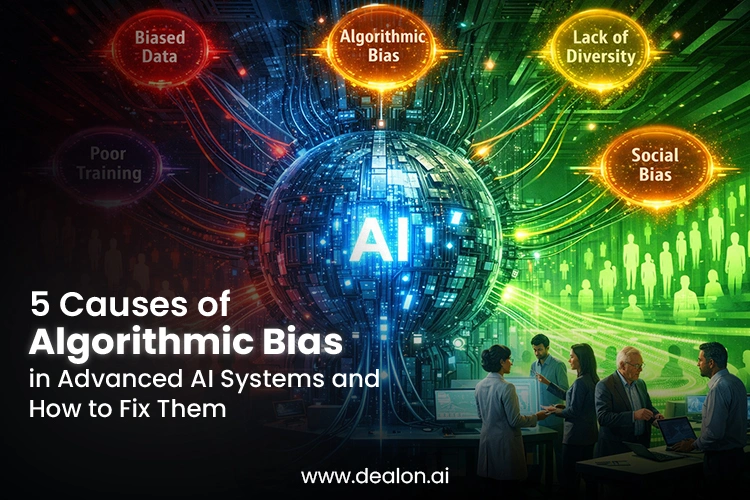

AI is now one of the most disruptive technologies in the twenty-first century. Since AI systems are now involved in the diagnosis of healthcare and financial risk assessment, talent management, and policing, the concept of AI has penetrated every part of contemporary life. These smart algorithms are expected to process huge amounts of data, identify trends, and produce insights that people otherwise would not have noticed. Nonetheless, during the increased integration of AI in essential decision-making, the issue of algorithmic bias has increasingly become of concern.
Artificial intelligence systems can become algorithmically biased when they are prone to generating systematically unfair or discriminatory results. However, rather than working in a completely neutral mode, AI models can be biased in unintended ways and can reproduce the social inequities or reflect human biases that are concealed in the data the model is trained on. Such biases may have an impact on hiring algorithms, credit rating systems, facial recognition systems, health technology, and a variety of other AI applications.
It is not always the case that AI systems are designed to be discriminatory; instead, the bias tends to be present in the manner in which the algorithms are trained, what types of data they use, and the design decisions taken throughout construction. To develop responsible, transparent, and fair AI technologies, it is thus crucial to understand the underlying causes of the bias in the algorithms.
This blog will identify five significant origins of algorithmic bias in high-level AI systems and explain the ways to address such issues in practice.
Also Read: 6 Key Reasons Explainable AI Is Becoming a Competitive Advantage
1. Biased Training Data

Biased or unrepresentative training data is one of the most important origins of an algorithm bias. The patterns are learned using AI models on the historical data, and this implies that the quality and the variety of the data are directly related to the behavior of the system. Unless the training data are historical or biased against a specific group or population, the prediction of the AI model may also reflect the biases.
To use the example of a hiring algorithm, when it is trained on a history of recruitment within the organization, where it was previously shown that some demographics are more favored than others, the system will focus on recruiting other candidates who are similar to the previous ones without intending to do so. On the same note, facial recognition systems that are developed using a larger number of images of some ethnic groups can be very inefficient in recognizing the faces of those who represent underrepresented groups.
Another issue is Data imbalance. Overrepresentation of some demographic groups in a dataset and negligible representation of others causes the algorithm to be more precise in the most represented population and less precise in the other ones. This inconsistency may have an unjust result, especially in the realms of high-stakes situations like healthcare diagnostics or criminal justice.
In a bid to guard against bias due to training data, the organization should consider data diversity and inclusivity as a central issue in the process of data collection. It is very important to curate datasets that are representative in terms of the actual population. Moreover, developers ought to use methods like data augmentation, sampling that favours fairness, and bias audit to detect and address imbalance prior to the deployment of AI models.
It is also possible to ensure that AI systems remain fair and representative over time by updating datasets regularly by including more inclusive data sources.
2. Human Bias Embedded in Algorithm Design

The other potentially devastating factor behind the emergence of algorithmic bias is the decisions taken by humans in developing and designing AI systems. Even though AI models are mathematically programmed, human developers define the parameters, goals, and metrics applied to evaluate these systems.
Construction of AI models involves hundreds of decisions by developers, such as feature selection, establishing objectives of optimization, model architecture selection, and which variables to affect predictions. These design choices can unwillingly incorporate personal assumptions or biases about society in the system.
As an example, an algorithm of predictive policing could be focused on historical data of arrests as a key input. Nonetheless, in case historical practices of policing were overrepresentative of some communities, the algorithm can support the same tendencies, as law enforcement funding will be channeled to the same areas.
Likewise, credit scoring algorithms can take into account variables that have an indirect relationship with the socioeconomic status of marginalized populations, even in the absence of explicit demographic information.
Diversification of data scientists, ethicists, sociologists, and domain experts is an interdisciplinary effort to reduce bias in the design of algorithms. Multicultural development teams would be better positioned to identify possible prejudices and confront assumptions that have issues. Clearly documented decisions in model design, sometimes also called algorithmic accountability, may also enhance supervision and promote ethical development behaviors.
Moreover, when developing models, organizations need to adopt measures of fair evaluation with a view to checking that algorithms are fair among various demographic groups.
3. Poor Quality or Missing Data Reduction

Labelled data is important in supervised machine learning models to acquire knowledge of the pattern and make predictions. Nevertheless, poor or distorted data labeling can present a lot of distortions in AI systems. Human annotators usually make labels, which reflect their personal views and understanding, culture, and subjective evaluation.
As an example, in sentiment analysis datasets to be applied in natural language processing, annotators may label some expressions differently due to cultural expectations or due to linguistic familiarity. Medical datasets are subject to different interpretations of symptoms or disorders by the clinicians who assign diagnostic labels.
Such inconsistencies may produce biased learning models. If a dataset repeatedly encodes some behaviors or traits in a manner that is culturally stereotypical, the AI model can learn those trends and generalize them throughout future predictions.
To counter labeling bias, it is necessary to have strict quality control. Another possible method is to apply a number of annotators to a single data sample, then apply consensus-building methods that minimize subjectivity. There should also be clear guidelines and training of the annotators to have uniformity in the interpretation of labeling criteria.
Moreover, labeling inconsistencies may be identified using statistical techniques, and problematic data points may be eliminated by organizations. To minimize the cultural bias of the labeling process further, a variety of annotation teams with varied backgrounds can be incorporated.
4. Limited Transparency and “Black Box” Models
Even though not exclusively, the latest AI systems, i.e., the deep learning models, tend to represent more of a black box, i.e., it is hard to interpret what the system is actually doing internally to arrive at a particular decision. Although such models can be very accurate, it can be difficult to see how certain predictions are determined due to their complexity.
Such a lack of transparency may enable algorithmic bias to go unnoticed. A situation whereby organizations fail to provide clear explanations as to why an AI system delivered a certain result, setting up the patterns of discrimination, becomes much more difficult.
As an example, when a loan approval system is automated and always refuses to approve loans by certain population groups, it is not interpretable. It therefore may fail to tell the analysts whether the problem is caused by an imbalance in the data, or the choice of features, or some other hidden relationships in the model.
As a response to this issue, explainable AI (XAI) methods are slowly becoming the center of attention of researchers and developers. Explainable AI is a concept that seeks to ensure that algorithmic decisions are more transparent by giving a list of how models consider various variables and come up with certain predictions.
It can be possible to identify areas of bias using methods like feature importance analysis, interpretable model architectures, and tools like post-hoc explanation to help uncover methods of bias. Transparent models can help organisations to audit their systems more efficiently and to make sure that decisions are fair and accountable.
The regulatory frameworks across the globe are also starting to focus on the issue of algorithmic transparency, where organizations are supposed to justify automated decisions that have a great impact on a person.
5. Absence of Constant Checks and Reviews
Although AI systems may be created with an equal approach to the problem initially, bias may develop over the years as data, societal behavior, or environmental factors in the context of AI change. Machine learning models are used in dynamic ecosystems where the patterns change and a new variable with time is introduced.
As an illustration, an AI model that was trained several years ago might not be a good representation of current trends in society or the distribution of people. Unless the system is updated periodically, it can make obsolete or biased predictions.
The other problem, which occurs when organizations are implementing AI systems, is the absence of mechanisms that would track the actual impact. Without the feedback loops, the biased results can go unnoticed for a long period, and it might concern thousands of users.
Ongoing surveillance is thus the key to ensuring fairness in AI systems. Organizations are advised to have periodic algorithmic audits that will assess the performance of the model in the various demographic groups. Fairness measures and bias detectors can be used to detect bias in predictions.
Feedback mechanisms are also significant to the users. Giving people the chance to overturn or appeal automated decisions opens the avenue to errors or flaws and improves the system. The risk of long-term bias can be further minimized by retraining models with new datasets and introducing adaptive learning strategies.
Organizations can also keep the levels of fairness and accountability high by treating AI systems as constantly changing technologies, as opposed to products that remain unchanged.
Conclusion
One of the most notable ethical issues of artificial intelligence in the modern world is the problem of algorithmic bias. The more AI systems are used in employment, healthcare, finance, and public policy areas, the more it is important to guarantee fairness in these technologies to achieve the trust of the population.
Algorithm bias can be explained in many ways and complexities. One-sided training information, human hypotheses on algorithm creation, inaccuracy in data labeling, lack of openness, inadequate supervision, and incompetence in monitoring, among others, lead to these unequal results. These problems have to be addressed in a complex strategy that involves technical solutions, as well as ethical consciousness and responsibility in the organization.
Developers should focus on a variety of data sets, clear model construction, strict assessment measures, and continuous system testing. The key to this is also encouraging the interdisciplinary teamwork that involves the technology, social sciences, and ethics expertise collaboration.
Finally, artificial intelligence must be used to improve the decisions made by humans and not to increase the existing disparities. By determining the root cause of algorithmic bias and adopting effective mitigation strategies, organizations can build AI solutions that not only seem intelligent and efficient but also have a fair, inclusive, and socially responsible nature.
With the ongoing development of AI, the creation of fair algorithms will be an essential step towards ensuring that technological advancements have a positive impact on the entire society.



