
The rise of Multimodal AI is set to change the ways we interact with technology, starting with the ways machines understand and integrate text, audio, and visuals. Multimodal AI has the ability to incorporate different texts and provide a more comprehensive understanding of human interaction. Deepening and personalizing interactions across industries has never been more effective thanks to smarter and more efficient systems. These multifaceted AI tools are paving new roads in technology – from automating customer service and refining healthcare diagnostics to recommending highly tailored entertainment.
The multimodal AI’s human-like communication capability arises from its ability to synthesize and make sense of disparate inputs, such as sound, text, and images. This profound ability makes interaction with machines more intelligent and facilitates better outcome-optimized decisions across various industries. AI systems are vastly improving user experience, operational effectiveness, and predictive analysis in retail, education, finance, and an array of other sectors from previously unconnected data silos. In healthcare, new revolutionary AI tools are seamlessly transforming diagnostics by analyzing visual scans, audio data, and even scanned text in real-time.
As industries open up to the potential of the technology, the demand for multimodal AI is set to grow exponentially, spurring advancements that improve the effectiveness of externally facing and internally facing systems. The more we unlock the full potential of human-level communication, the more multimodal AI is able to address complex real-world problems with intelligent solutions. In this article, we will discuss three primary ways in which multimodal AI integrates text, audio, and visuals to foster smarter, seamless interactions and change how we work, learn, and live.
Also Read: The Evolution of AI in Marketing: Smarter, More Personalised Campaigns for Customers
Table of Contents
Multimodal Inputs for Continuous Human-Machine Interaction
Traditionally, AI systems have focused on siloed processing, whether it be on text, voice, or images. Each of these modalities is impressive on its own, but none is able to mimic the depth of interaction found in human communication. Humans inherently employ the conjunction of vision, hearing, and speech to apprehend their surroundings. Das and Dey (2020) noted that people utilize complex systems of informatics to synthesize various streams of information and derive a coherent understanding of a situation. The increased communication complexity is a problem for single-modality AI systems, as they fail to process the many ways in which we interact and engage with the world.
Multimodal AI is helping to close this gap by allowing machines to wait and process information from multiple streams concurrently. This step enables systems to comprehend not only the audio being articulated but also the context (the audio context) and the manner in which it is articulated (the textual sentiment). An example is an AI virtual assistant that actively listens to the user and, in parallel, scans the environment for objects and gestures, and also text instructions in real time. The integration and synergism of these data streams enable levels of interactions that will allow the Assistant to interact with the user in ways that are more comparable to human communication rather than robotic speech.
Usage of multimodal AI in customer service is revolutionary and very beneficial. A case in point is that of a customer service chatbot that can respond to voice instructions and also comprehend images or video files sent to it. When a customer has a problem with a product, she typically reports it to the company. The AI in question can simultaneously listen to the customer’s grievances, ponder over a voice recording of the customer, and analyze a picture of the product. When doing so, it also cross-references text from the customer’s previous inquiries.
Integrating different modalities helps in providing multisensory experiences to the customer. Such experiences help in delivering swift and pertinent answers. Therefore, the customer is assured that the service being offered is professional and personalized to their needs. Instead of chatting with the customer, these systems automatically devise a better approach to foster more productive conversations. In the end, the time wasted resolving the issue goes down, and overall satisfaction improves. A customer is more likely to return to doing business with a company that resolves their grievances with ease and offers personalized service.
Flexibility in Delivering Tailored Text, Video, and Audio Content
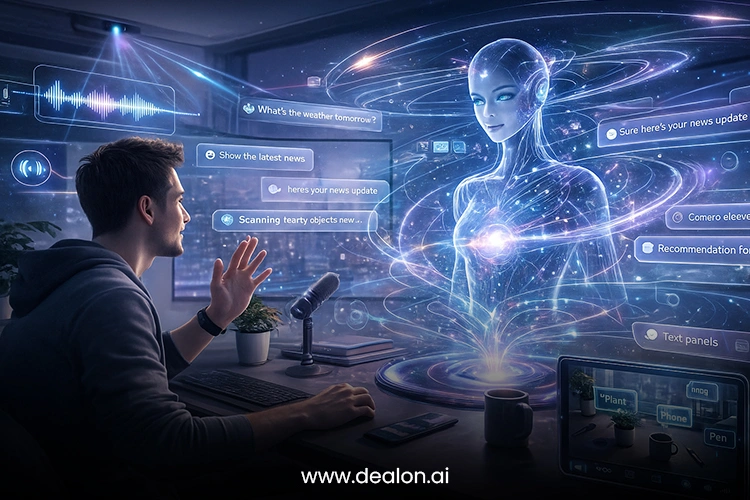
Arguably, the most impactful aspect of multimodal AI is the way in which it revolutionizes personalized content delivery. These systems enable the condition that AI is capable of predicting the user’s wishes, instead of the user themselves having to express it. The fulfillment of such anticipatory actions in real time is possible due to the integration of bi and tri modality—text, audio, and visual data files. Industries like e-commerce, entertainment, and education are now more user-driven than before. Hence, the level of user satisfaction is directly proportional to the degree of personalization offered.
To improve user experiences, e-commerce websites employ multimodal AI tools, which refine outputs based on processed inputs. AI can recommend particular products when users upload images, perform text-based searches, and use voice commands. For instance, if someone asks the AI for “comfortable sneakers for running,” the AI will not only retrieve relevant products based on the user’s previous searches, but also identify and link relevant contextual visual patterns from the product images and various contextual details from their browsing histories to product files. Integration of these distinct forms of information enables the AI to construct more reasonable and intuitive responses, improving the accuracy of its recommendations to align more fully with the user’s unique requirements.
In the entertainment sector, multisense AI is used by both YouTube and Netflix to improve user content discovery. AI is capable of providing much more personalized suggestions when it comes to users’ likes based on provided text, sound, and previously watched shows. For example, if a user has a history with history documentaries and has a history with certain types of specific visuals, the AI will curate a list of content that not only matches the user’s interests but also their stylistic preferences, enhancing the user’s intuitive content viewing experience.
Within education, multimodal AI improves the learning experience by developing video lectures, text documents, and voice-based learning tools addressing various learning styles and more. AI analyzes how students respond to visual and auditory content and restructures the approach. Should the understandings be problematic, the AI can lower the content’s difficulty or suggest other learning materials. This makes the AI personalize the learning journey, and the AI will undoubtedly fit the journey everywhere needed. This fosters engagement and improved learning outcomes. It makes education easier, more effective, and outreach broader.
Improving Health Outcomes through Multimodal AI Diagnostics
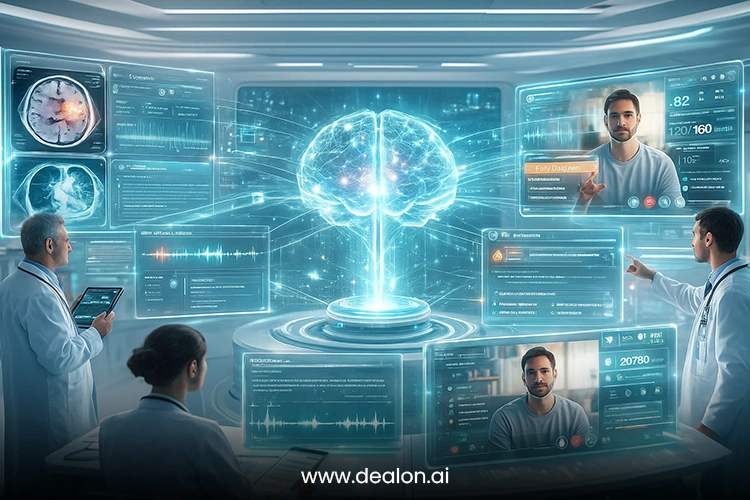
Within the fast-changing healthcare system, AI is integrating text, audio, and visual reporting to impact the way patients are served. Uniquely, the ability to fuse several data streams gives AI tools an advanced understanding of patients’ health, enabling better diagnoses and treatment, and customized e-care. Historically, health personnel worked with fragmented data sets, including digitized medical summaries, different forms of medical school, head imaging, and voice reporting, all of which provided a narrow understanding. The capability to synthesize streams of data significantly improves the prospects of addressing challenging medical issues.
For example, a multimodal AI system can analyze written medical histories, find discrepancies in a patient’s radiology images, and assess the patient’s speech during interviews. Having the ability to analyze a patient’s clinical histories in text format, images like MRIs, and audio data, such as the patient’s speech, helps the AI refine its conclusions about the patient’s well-being. In turn, the system is able to assist in the earlier diagnosis of medical conditions such as concealed tumors in radiographs, and to assess psychosomatic disorders through voice processing, which may be beyond the detection of any single modality.
In such instances, AI can help integrate the speech processing of patients during interviews to increase the efficiency of detecting and ascertaining mental health disorders. Depression, for example, which is usually mainly unclear from clinical signs and self-report questionnaires, can be detected more accurately by AI in attempts to analyze changes in the patient’s voice, such as tone, inflection, tempo, and resonance. Such AI systems can detect emotional and mental disorders that are often concealed in medical files that doctors usually analyze.
In addition to this, telemedicine systems are being improved through the use of AI to allow the detection of faces and even the tracking of patient body movements during video calls. These additional pieces of information allow for better remote decision-making. The combination of AI and international technologies in wearable devices enables the generation of data streams to analyze and identify patients’ possible medical emergencies in real time, allowing medical professionals to intervene before the situation escalates.
Enhancing financial decision-making with AI Insights
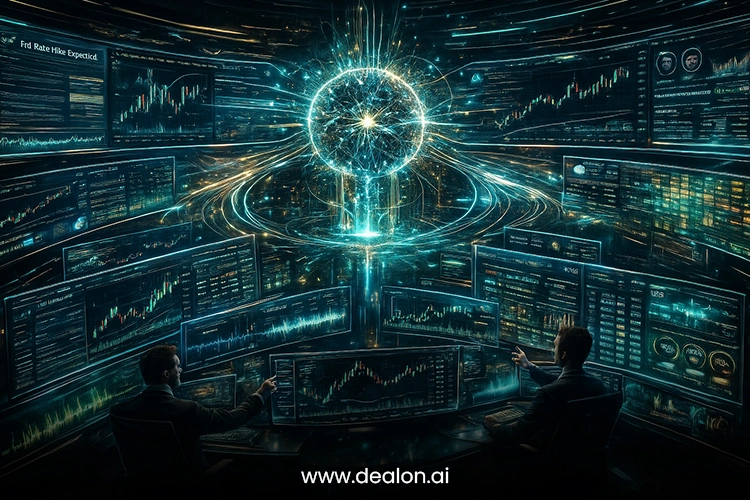
The financial industry has always been data-driven, spending time analyzing historical data to base projections on. Economic decision makers are often faced with the great challenge of having to explore a great deal of information in order to come up with useful predictions. Most data sets, whether they are financial reports based on stock prices, economic figures, or other indicators, are often analyzed in isolation, allowing for the context to be missed entirely.
This context is critical for better, deeper projections to be made. This is where the era of Constructing Advanced Multimodal AI systems begins. These AI devices and systems work to unite different data sets better, be they text, voice, or images, in order to successfully provide useful, integrated, real-time, and practical information to the analyzer.
When it comes to market analysis, AI tools that employ multiple modalities present a significant advancement due to the fusion of diverse forms of data. These tools are able to simultaneously process and interpret large volumes of text data like financial documents, press releases, earnings calls, and news articles, as well as real-time market data like stock charts, price movements, and trading volumes.
Additionally, by processing audio data and sentiment analysis—for instance, from analysts on podcasts or tones of executives during earnings calls—AI systems are able to find patterns and sentiment analysis in data that are usually lost to traditional models. This multimodal functionality equips investors and institutions to understand the market better and act on their insights with greater speed and efficiency.
In trading, AI tools that employ multiple modalities improve the efficiency of analysis and information synthesis, and as a result, improve decision-making. For instance, an AI system can assess the audio of an earnings call during which the speaker is saying specific words, and then correlate them to a particular financial document and stock price movement diagrams during a predetermined timeframe. By combining signals from different modalities, AI can predict potential market movements with a higher degree of confidence, providing investors with sophisticated insights, ultimately improving their trading strategies.
Risk management has immensely benefited from integrating AI and other technologies with the use of multimodal AI. For instance, financial institutions may analyze text data of loan applications, visual collateral assets of the client from videos, and voice recordings to assess client credibility and emotional stress to conclude, client credibility. These analyzed data sets are more insightful, empowering AI to evaluate risk and default mitigation with more efficiency to lessen financial losses.
Unlike other forms of artificial intelligence, analysing complex and suspicious transactions using voice and tape recorders is an example of the more sophisticated utilization of multimodal AI. During a video conference with a client, the AI, for example, can detect inconsistencies in the face and voice and flag the interaction as suspicious. The AI performs the same function in the banking domain as well. The AI suspends and controls account transactions and transfers for loss mitigation until a human assessment is made. This protective measure secures the banking system.
Multimodal AI is reshaping the financial industry, and Decisions becoming more sound have led to greater data-driven insights for more aggressive attempts to enhance operational efficiency and mitigate risks. As these systems evolve, their ability to synthesize complex data will only deepen, further transforming the landscape of the financial industry for the better.
Conclusion
To sum up, integration of text, audio, and visual data, with the use of multimodal artificial intelligence (AI) systems, improves insights across the financial discipline. With the use of AI tools, blending different streams of data augments the asset market analytics, trading strategies and decisions, risk mitigation and management, and fraud detection and prevention systems. Such seamless operation of systems enables financial institutions and businesses to make swift and accurate decisions, thereby improving their competitiveness in the market.
With the passage of time, systems and capabilities of multimodal AI are bound to evolve. Thus, the impact and integration of the systems in the financial disadvantage area will help in devising new merits in the operation systems and risk management navigational systems. Such advanced technologies will help in preserving the financial defense systems and act as smart operations to mitigate risks in the domain.



