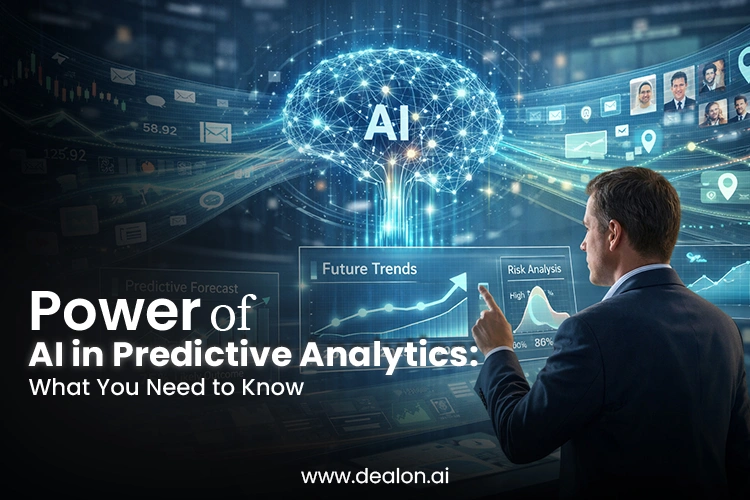

Predictive analytics is significant for organizations today. In today’s world, everything is experience, hypercompetition, and big data. There is also a rise in large volumes of structured and unstructured data and information within organizations. Organizations need to manage this storm of data and make forecasting decisions to accurately predict trends or events in the future. Never before have we had access to such a wide variety of data sets, and hence, predictive analytics has received the ideal opportunity to flourish.
Predictive analytics is a process that involves utilizing data, among other things, to make future predictions. AI can quickly analyze millions of potential patterns at speed from massive amounts of data. It also anticipates the results, taking into account uncertainty, uniqueness, and context. AI’s time and space revolution helps make hyper-informed, ultra-precise predictions and decisions.
Also Read: Decoding AI: A Beginner’s Guide to Understanding Machine Learning
Table of Contents
Understanding Predictive Analytics and AI
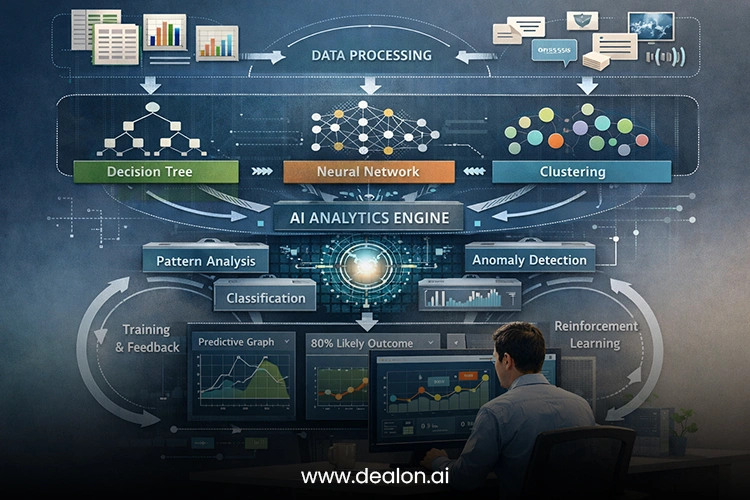
Predictive analytics is a technological innovation that involves obtaining information from data that describes past too-timely events, and through complicated algorithms and mathematical processes, predicts the future state and events. The AI then analyzes data streams to see if any surprises emerge. Machine learning assists predictive handlers to decrease uncertainties and enhance their accuracy.
Through predictive analytics, businesses can gain insights from data. The utilization of AI in predictive analytics is transforming the world. A wide range of variables is used in predictive analytics. The AI helps predictive analytics handlers with classification and segmentation. The harmony of AI and predictive analytics is discussed in this section.
AI challenges itself to create complex machine learning algorithms. The role of learning from experience is also undertaken by predictive analysis; in other words, they will aid with automation in connection with the generation of data patterns and in the classification of said patterns. Deep learning has become a popular method used in the current AI field. Deep learning allows neural networks to recognize abstract and complex concepts. Reinforcement learning will permit machine learning handlers to make the most of this new AI technique. The AI monitoring reinforcement learning algorithms learns from past instances to adjust their actions on a live basis.
Signal processing enables AI to separate signals from noise. The union of AI stuff and predictive analytics gives enterprises excellent tools to assess customer behavior, market trends, capabilities, flaws of the product, threats, and compliance. Predictive analytics is an aspect of artificial intelligence, and is basically used to analyse data (whether historical or current) to predict the future outcome of processes. The predictive analytics goal is to go beyond knowing what happened and to understand what will happen in the future.
Moreover, it also explains why this will happen in times to come. Predictions made by AI are not new. For many years, major companies, including Microsoft, Facebook, and Google, have used it. Netflix and Amazon serve as excellent illustrations of predictive analytics. Netflix uses it to predict how much you will enjoy a movie or TV series. Amazon applies this technology to forecast your subsequent actions.
Applications of AI-Powered Predictive Analytics
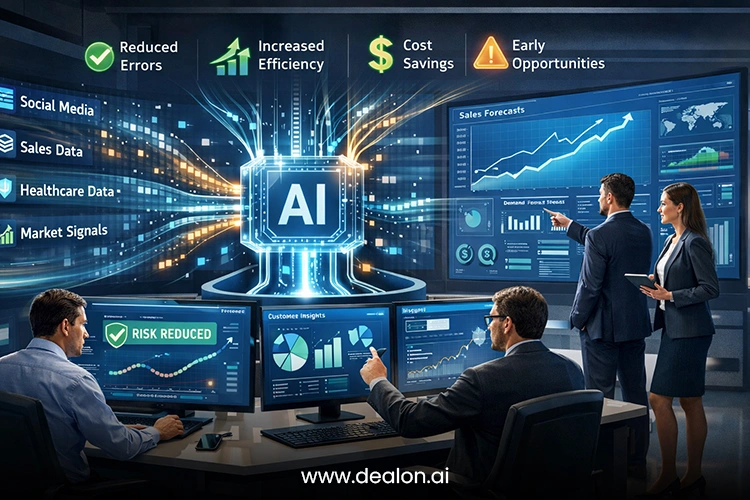
AI-powered predictive analytics has enormous potential in various fields. Sectors, from finance to communication, are banking on AI for predictive analytics to take their operations to the next level. Nevertheless, the applications of AI-powered predictive analytics are far from over. You will be astonished to learn that it is used in many industries. Of course, one of the biggest supporters of predictive analytics is the finance industry.
Algorithms analyze transactional patterns in order to prevent fraud proactively. Financial institutions use predictive analytics to create market volatility risk models and portfolio optimization. Apart from that, these establishments use AI algorithms to run simulations on diverse scenarios. They can take timely action through remedial measures to diminish potential compliance and regulatory risk as a result. In addition, they also leverage predictive analytics powered by AI to model credit risk scores.
Another industry that draws heavy parallels from AI-powered predictive analytics is the healthcare and pharmaceuticals domain. Predictive analytics can accomplish numerous things, which range from forecasting a disease outbreak to assessing the risk factors of a patient. Moreover, healthcare service providers can utilize this technology to determine the ideal conduct or practice for individuals. In addition, AI algorithms are capable of sifting through a vast amount of healthcare data, such as gene sequences, medical records, and images. E-commerce and retail stores are using AI predictive tools to enhance customer engagement.
The applications that are emerging have also included energy management, climate modeling, and urban planning. Artificial intelligence that predicts energy use and grid failure can aid resource optimisation and planning. In the environmental and urban sectors, predictive models can simulate population growth, traffic, and resource use to help with data-based infrastructure planning. Organizations can now leverage protocols and methodologies to implement predictive modelling techniques in artificial intelligence effectively. Consequently, these techniques can bring about successful organizational change.
Benefits of Integrating AI into Predictive Analytics
Artificial intelligence alters the scenario of predictive analytics. Predictive analytics enables anticipating future behavioral intentions based on past behaviors and other data sources, such as social media. As you can see, this is a big data crunching job. Because of its vast computing capabilities, AI is much faster and much more accurate than an expert at doing this job.
In fact, AI and predictive analytics are so compatible that AI is increasingly being regarded as a must-have feature of any predictive analytics tool. To start, one must note that predictive analytics systems are very data-intensive. Consequently, a high-end analytics firm is required for the systems. Often, the firms that accept the job are new to the field and are put in there without any training.
Since the hospital was the first client of the firm, it had to gather all the information from the doctors, nurses, and other staff members involved in the business process. This data is collected in an orderly fashion by requests for the predictive analytics company to use it to the best of its ability. Automated analytical tasks that take a lot of human resources help businesses in reducing human error, automating processes, and strategic remodelling of resources.
An AI-driven predictive analytics solution can also reveal new possibilities for new products, services, or markets that traditional predictive analytics solutions would not uncover. AI-powered predictive analytics identifies new health trends early on, enabling personalized treatment plans and effective intervention, which leads to better outcomes and lower costs. In retail, artificial intelligence can enhance demand forecasting and inventory management, cutting down waste and maximizing profitability.
Challenges and Considerations
AI powers the core of predictive analytics. It can teach computers to make predictions based on datasets using various methods, and is done using AI. In addition, it uses information gathered from multiple sources to predict the future. Therefore, it helps experts to take proper action in order to accomplish the achievement of the business goal. Machine learning, a kind of AI application, comes up in this situation.
In addition, it enables the systems to learn automatically from experience and from data without being programmed explicitly. The key takeaway is that the focus is on analyst measures and research on data, and giving computers learning ability. Moreover, the simulation requires a large quantity of data to train to become accurate, although data mining is less sensitive. Experts use the information to develop a model to help predict unknown future data or unpredictable events. As a result, the software aids in making business decisions that could involve the total sales forecast of next quarter, the number of insurance claims, possible frauds, etc.
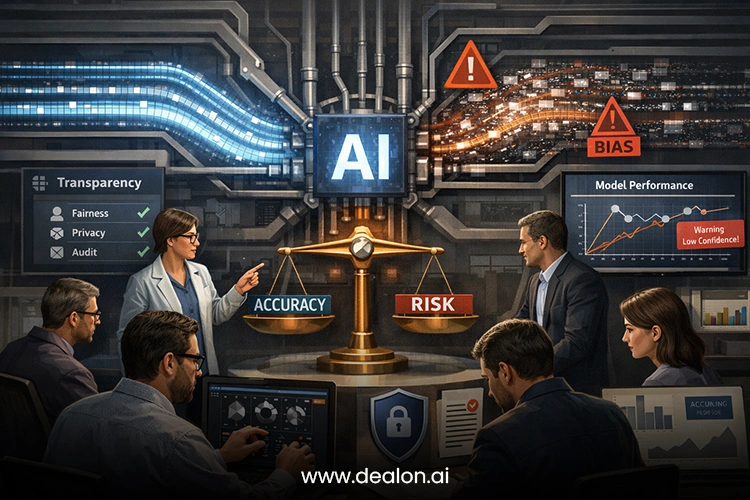
The very applications of AI that drive Predictive Analytics inspire the world in a futuristic manner. It prevents obvious mistakes and serious errors and extends an employee’s vocabulary. Furthermore, it enables industries to take key smart moves within competitive industry conditions. An integrated, broad-based, well-governed, transparent, continuous-monitoring, and responsible road to AI adoption can enable enterprises to realize value from predictive insights, thus enhancing enterprise operational performance & profitability while building the foundation for making sustainable, ethical & future-ready decisions.
Conclusion
The merging of AI with predictive analytics allows businesses to make better decisions using data. It also enables the organization to make quicker and proactive decisions. Furthermore, it employs complex and extensive data sets to ensure that there are no mistakes in the figures and predictions. All these factors make predictive analytics a powerful tool for organizations. Predictive analysis has gone through various stages. The completion of predictive analysis in an organization requires all the phases to be completed successfully.



