
Although artificial intelligence is not associated with creativity, it can lead to unimaginable wonders with the help of human intervention. In recent years, it has been seen how artificial intelligence, when fused with human imagination, produces remarkable results. With convincing graphic designs and musical backtracks, AI has already shown great creative potential. Though machines do not have consciousness or the ability to feel like humans, they are still capable of extraordinary things.
AI algorithms can look at data sets that are massive in size and suggest patterns that humans might otherwise miss. For instance, an AI program can quickly scan through a lengthy match list to generate new material. The uses of AI in creativity are endless and continuously on the rise. In this write-up, we are going to learn about how AI is helping in video, art, and artworks.
Also Read: Autonomous Vehicles: The Role of AI in the Future of Transportation
Table of Contents
Understanding AI-Driven Creativity
The expansion of human creativity through AI has become a reality. The condition requiring agreement from one or more observers that the product is something of creative worth is used to assess this subject. In essence, artificial intelligence is creative by human standards. Contemporary views of artificial intelligence systems, of course, exceed intelligence. They combine original content in a bigger space. Therefore, a system of artificial intelligence integrates intelligence, goals, and creativity in one package. A single personal, unified system can thus achieve complex, high-level cognitive behaviours.
Creative machines help in a variety of tasks. A designer can design machines to create new designs. In addition, artists can receive assistance to generate a large number of ideas and inputs for their works. The creative and generative artificial intelligence-based systems have an impressive implication of their nature. In situations that demand highly innovative and imaginative content, fully automated systems can produce excellent results.
Applications in Art, Music, and Literature
AI-created visuals, which you may have experienced in galleries or on social media, require us to rethink authorship and originality in art. Through the use of GANs, the artists can blend traditional art techniques with modern aesthetics and explore new textures, hues, and forms, enhancing their creativity. An AI painting could mimic the brushwork of a classical master, but not in a replica of the master’s original artwork. It creates a new composition and can inspire the human artist’s creativity.
AI is widely used in music as a creative partner. Machine learning methods are used on music to find underlying patterns in harmonic relationships, rhythm, and melody. Such patterns can help create harmonies. It can also suggest alternate chord progressions. Lastly, it can generate whole new compositions that human artists might choose to adopt or adapt, fueling further creativity. The sound design, audio remastering, and interactive composition experiences using AI-inspired music facilitate the efficiency of the production process along with novel artistic creativity.
In the world of literature, there are AI systems used like brainstorming partners, which can either create a first draft for a human to edit and refine or produce texts catered to the user’s tone and style. Models based on recent advances in natural language processing, leveraging deep neural networks that train on massive amounts of text, can learn conventions of narrative structure, character development, and style, such that they can generate text in ways that can complement the human author’s creativity.
The AI tools are transforming the content creation industry like never before. OpenAI researchers have trained their models on vast amounts of internet text and code. Artificial intelligence will eventually build intelligent machines to observe and problem-solve. AI has helped content creators earn money for their work. AI writing content is gaining prominence in the content marketing world. In the future, generative content would become an automatic feature of Artificial Intelligence.
Even though humans inherit creativity, there are not enough editors to make all that content usable. Recently, speech recognition technology has been emerging. According to reports, in recent times, scientists have tried to use neural networks to control robots, which imitate human creativity and learning ability. Artificial Intelligence is the development of a program that will permit a computer to act without the intervention of man. At present, AI has become a huge part of human life. AI assists in creativity and is not only used in analysis—for example, autonomous health diagnosis and vehicle operation without help.
AI assists employees within an organisation in executing their job functions. Numerous contributors to AI are IBM Watson, Google, Microsoft, Apple, Facebook, Amazon, Etc. AI has also been extensively used in gaming, which has become one of the biggest fields as of now. In this field, there are a lot of critical workers who include testers, writers, debuggers, etc. A company such as Novi has gaming products that boost the software engineering of video games. AI-enabled agents in this domain should possess intelligence and creativity in equal measures so that they do not deviate from the real goals of a game.
AI as a Catalyst for Innovation in Business
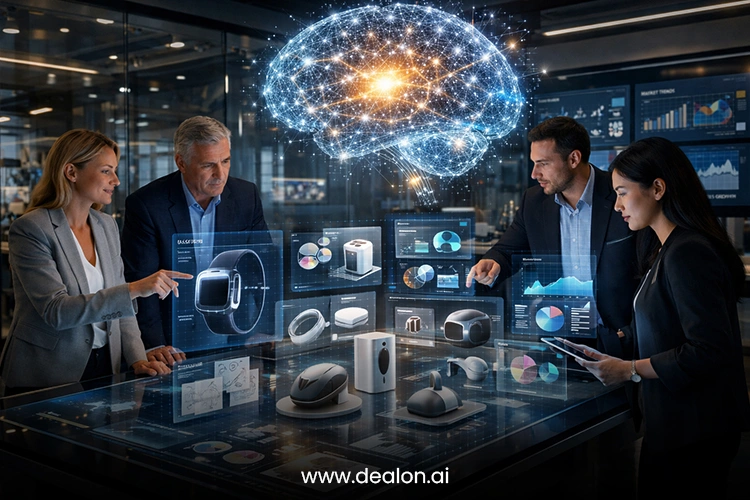
Artificial intelligence has now become a key to innovation for businesses and their new offerings. Artificial Intelligence, also known as AI, is often associated with data analytics, activity automation, and other low-level tasks. However, it could drive creativity at the enterprise level. This allows businesses to reimagine traditional processes, encourage experimentation, and quickly create new products. If given the right prompts, AI can come up with different ideas for the same product, design, and even other versions of the product. Humans can evaluate only a few options, but these models can assess millions of them in the time it takes a person to consider a few.
Studying thousands of product development designs, along with optimising a variety of themes so that the best one is utilised without wasting money or resources, can do wonders for product development. Artificial intelligence can mimic real-world environments and analyse predicted product performance in various situations. In addition, it can contribute to the advancement of engineering, quality, and user insights, which can offer valuable insights that shorten study and error times. This could also lessen the time needed for the development of efficient products, while encouraging companies to experiment and innovate quickly. Another essential business application of AI creativity is marketing and customer engagement functions.
Limitations and Ethical Considerations
AI, during its initial stages, has brought about refreshing changes. For instance, consider a human being, say Leonardo da Vinci, who will keep all the ideas in his head and take mental note of which among them is interesting. However, humans are limited in the capacity to store information, but a machine can store a lot more information, amplifying our creativity. After deep learning Da Vinci’s notebooks, the AI device generated 10,000 novel invention ideas, likely all of which were lodged in its brain.
Generally speaking, AI can help us with an essential shortcoming of human beings, and that is the fact that we cannot hold all of our ideas in our heads. Perhaps even more importantly, we are unable to keep track of which of these ideas are interesting. If you’re looking to innovate, think about using AI to augment yourself and tease out ideas that you would never have imagined, boosting your creativity. By doing this, you can get some pretty cool materials and make use of AI productivity tools to generate your ideas. You can also embed AI into your business concept as an entirely critical element of your creative process.
You must be thinking that augmenting oneself with AI must come with no downside and be an excellent idea. Reality is poles apart from what you think. Humans devote their entire lives to evolving their concepts with the help of machines. But do machines ever look back at what they have learned and analysed? The regulators, the users, and the AIGC business are the critical, impactful groups. These large, influential groups that have a significant impact are not working in silos. They are within an integrated framework. This framework encourages the generation and improvement of data and content security, defence, and industry standards.
Together, they create the environment for effective asset management, intellectual property protection, and the enhancement of content quality. Such a framework stimulates creativity, strengthens data and content security, and improves industry standards. Together, they create the environment for effective asset management, intellectual property protection, and the enhancement of content quality and creative output.
The Future of AI and Creativity
The future of creativity is a sign of transformation in the creative space. Recently, we have witnessed the advent of generative models and neural network-based systems that perform creative tasks adeptly. The future will integrate artificial intelligence and human imagination, giving rise to unprecedented innovative paths. Collaboration between man and machine will achieve things that are impossible. AI will not replace human creativity but will ultimately enhance and augment it to achieve higher levels of creativity and ingenuity. Artificial Intelligence systems are becoming increasingly powerful and capable of performing complex creative tasks.
One example is Google’s DeepDream system, which looks for patterns in images and then uses them to create new images. As a result, advanced AI systems will be able to perform tasks like creating visual art and illustrations, composing fresh tunes with words, developing fresh commercial concepts, formulating scientific hypotheses, etc. Humans must develop higher-level frameworks that determine which ideas to pursue, which to reject, and to assess their ethical implications.
Conclusion
The future we are building is characterised increasingly by artificial intelligence as it becomes one of its features. Any organisation related to business or houses is adopting the change-inducing capabilities of AI. A development made with the assistance of Artificial Intelligence is taking place that could form the basis of tomorrow. Artificial intelligence will help us achieve more by enabling us to do things better. As a result, it helps all of us prepare for the future. Using AI, one can possess higher productivity. Artificial Intelligence has an impact on our creativity and ability to innovate. Thinking involves creating new things or doing something new, which allows us to contemplate more opportunities.



