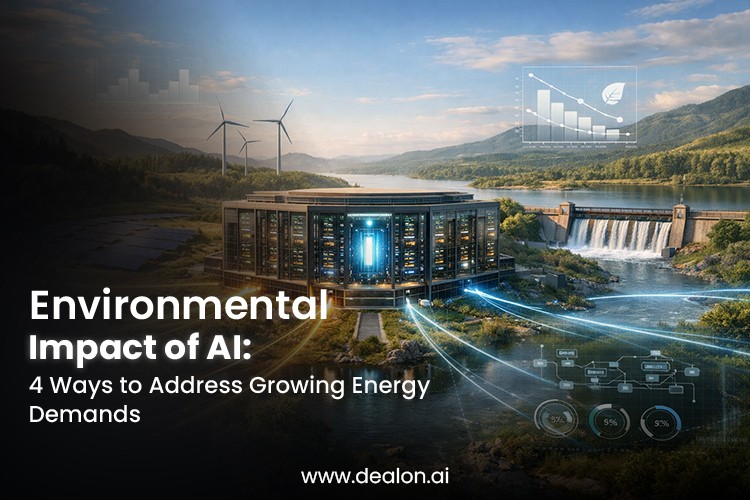

Artificial Intelligence (AI) has become one of the most transformational technologies of the 21st century, with the power to pioneer in sectors such as healthcare, transportation, and agriculture. However, as its impact grows, so does its effect on the environment, especially regarding energy consumption and resource utilization. The possible implications of the AI development are far more significant than the activities in cyberspace: it influences networks worldwide, carbon emissions, the use of hardware resources, and even the utilization of water.
These challenges are what we need to understand and address in the hope that we can use the advantages of AI to protect planetary health. This is a holistic investigation, and we shall break down the environmental impact of AI and present four practical measures that can be put in place to curtail its increasing requirements sustainably.
Also Read: How AI is Making Renewable Energy Smarter and More Efficient
Table of Contents
Understanding AI’s Environmental Footprint
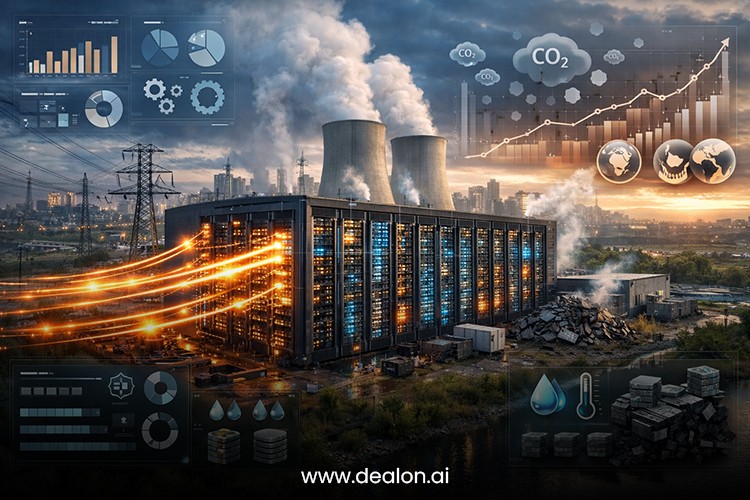
Before we can frame solutions, we need to understand the scope and extent of the environmental impact of AI in the first place. In its most basic form, AI depends on data centers; massive centers full of servers to process and store information, train models, and execute programs. These facilities form the digital keystone of AI, and they are also considerable electricity consumers. According to experts, by the middle of the 2020s, AI may take up close to half of all the data center power consumption across the globe, with the growing need to use more intricate and complex models.
However, the tale does not end there, at energy draws. The AI training stage, which involves models that are trained by using large amounts of data, is intensive in terms of both computational power and resources. Very complicated models, in particular, generative AI systems, may require energy equal to that of whole small cities when being trained. Moreover, the material infrastructure of AI, such as specialized processors, GPUs, and memory chips, depends on the extraction of rare earth elements and energy-intensive manufacturing methods, which are involved in the destruction of habitats and pollution, as well as the waste management issue.
This combination of direct energy consumption, indirect emissions, resource wastage, and e-waste creation makes AI both the facilitator of an improvement and a possible environmental liability. The issue is not so much whether AI exists or not, but the manner in which we will handle its demands in a sustainable manner.
1.Through Smarter Algorithms and Model Optimization

The efficiency of the technology itself is one of the most significant methods of minimizing the environmental impact of AI. Currently, most state-of-the-art AI models are over-parameterized, that is, they have many more computational layers and parameters than are required by the particular task. This bloat is more immediately translated into increased use.
The process of removing redundant or less meaningful parameters of these networks in a manner that does not lead to significant performance loss is called model pruning. Algorithms such as quantization, knowledge distillation, and transfer learning can help developers develop smaller models that can produce similar results at an enormous reduction in computation.
Knowledge distillation trains a smaller student model to mimic the behavior of a teacher model. This smaller model frequently works in a similar manner and consumes a fraction of the energy; the training and inference costs are drastically decreased. Likewise, transfer learning allows using pre-trained models to do several tasks without re-training them, reducing consumption. The combination of these methods can go a long way to reducing the energy necessary to operate advanced AI, and thus, they form the foundations of sustainable AI development.
2. Powering AI With Renewable Energy and Smarter Infrastructure
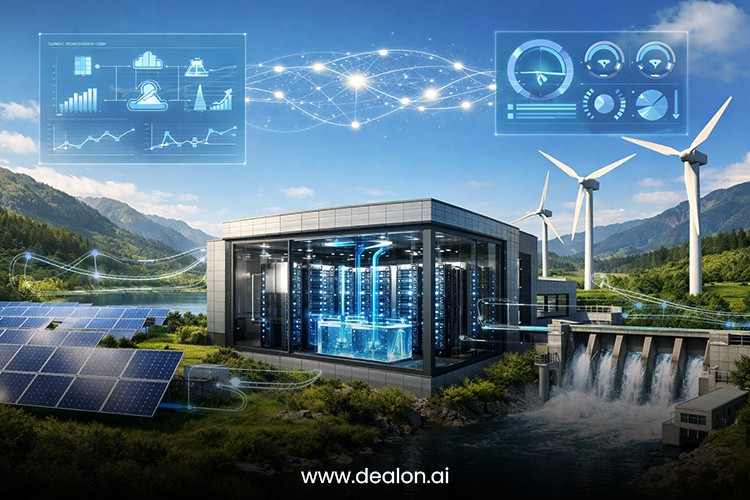
Optimized algorithms also need electricity. As such, a shift to a cleaner energy source that does not use fossil fuels and moving to renewable power sources like solar, wind, and hydroelectric power can be listed as one of the most potent tactics in minimizing the environmental footprint of AI. Large technology firms have already initiated the process of switching their data centers to renewable energy, and these green data centers employ energy procurement techniques that focus on them, such as long-term power purchase agreements (PPAs) with solar and wind farms. Not only does renewable energy reduce direct carbon emissions, but it is also, in many cases, a stable price and long-term advantage.
Geographic load balancing also has the potential to relocate computational work to locations with renewable energy resources at certain times, and in this way, the AI workloads can be executed at times when there is green energy and less dependence on carbon-rich grids. Consumption of data centers is not merely about the electricity required to drive the CPUs and GPUs; it is also a major energy-consuming model to maintain the data centers at optimum operating temperatures.
The old air-cooling systems are known to cause significant power and water consumption. Fancy cooling methods, like liquid cooling or immersion cooling, can reduce the energy required to dissipate heat by a considerable margin, to the extent of creating huge energy savings and a reduced environmental impact. Investing in smarter infrastructure enables AI providers to make sure that computing power is utilized in the most efficient way to minimize the cost and environmental impact.
3. Leveraging AI to Improve Global Energy Systems
Paradoxically, AI could be utilized as one of the potent tools to conserve energy in other industries, compensating for part of the energy it consumes. This contradiction underscores the duality of AI that is both a consumer and a driver of sustainability. AI can also optimize electrical grids, forecasting demand and real-time distribution of power to enable the more efficient use of renewable sources.
As an example, machine learning applications have the capability to predict the output of solar and wind farms according to weather conditions, and thus it becomes convenient to the utility to optimally match the supply and demand of energy. Intelligent grids powered by AI will also be able to incorporate distributed energy sources such as roofline solar panels, EV charging stations, improve grid resilience, and minimize waste. In addition to grids, it is possible to have AI that makes buildings much more efficient, some of the biggest energy consumers in the world.
Smart building management systems apply AI to dynamically optimize the HVAC systems, lighting, and other energy sinks according to the dynamics of the use and environmental data in real-time. Research indicates that AI-based optimization of HVAC can reduce energy consumption by large proportions, which saves not only on emissions but also on the costs of operations. AI has also helped in lowering energy consumption in the farming and transportation industries.
AI minimizes waste and decreases energy consumption in the farming process through optimization of the irrigation cycles, planting schedules, and automation. Machine learning can also be used in logistics and transportation to optimize paths and timetables in order to reduce fuel use and emissions. These applications show that AI can be used as a sustainability multiplier by being deployed strategically to both make systems with high energy requirements more efficient and reduce the footprint of AI itself.
4. Adopting Circular Economy Principles and Sustainable Lifecycle Management
The need to be energy efficient and use renewable energy is crucial, though it only covers a portion of the AI environmental footprint. The physical aspect, including the process of mining and production, as well as the disposal process, is also essential. A circular economy model provides a solution whereby resource wastage is minimized, and resources are able to have a maximum lifecycle. To implement AI hardware, rare earth metals and high-performance processors are required. The extraction of such materials frequently causes degradation of habitat, toxic runoff, and carbon emissions. The old hardware after obsolescence is a contributor to the accumulation of electronic waste, and when well handled, it could expel toxic chemicals into the ecosystem. Solutions include:
- Modular design: Construction of servers and chips in a modular format, which can be upgraded instead of being replaced.
- Renovation and re-use schemes: Old hardware must be recycled in the proper manner, with materials being reused in other devices.
- Material innovation: Investigating other solutions than rare earth that are less toxic to mine and that can be recycled easily.
- Combined, the strategies drive the AI ecosystem towards a more sustainable lifecycle, which decreases the environmental costs of hardware manufacturing and waste.
To comprehensively gauge progress, AI developers and policymakers need to embrace standardized carbon accounting protocols, which cover the full lifecycle of AI systems, i.e., hardware mining, training, and deployment. Clear reporting systems will be used to compare strategies, incentivize energy savings behaviors, and align AI development with sustainability overall.
The Dual Nature of AI: Environmental Challenge and Solution
In this deep dive, AI shows a complex profile in the environment. Its dynamic expansion and energy requirements clearly create sustainability problems, particularly as sophisticated models become more popular and data centres grow. The ability of AI to optimize the energy system, streamline industrial processes, and help in the decarbonization efforts in the world, however, indicates that, when used wisely, AI can become a component of the climate solution, but not a blind threat. It is not the limitation of the development of AI, but directing it to the responsible and sustainable directions- not only algorithmic efficiency and renewable energy, but also its lifecycle management and optimization of the whole system.
Concluding Remarks: A Sustainable Future of AI.
The ecological effects of AI are a complicated and complex interaction between the ambition of technology and environmental factors. Uncaptured, the energy requirements of AI may put pressure on power networks, add to emissions, and worsen resource depletion. Nevertheless, through tactical solutions, such as efficiency, renewable energy, using AI to boost energy infrastructure, and implementing the ideas of the circular economy, we will be able to minimize AI’s footprint and maximize its capabilities to do good for society.
Researchers, industry leaders, policymakers, and civil society will all have to collaborate to help transform the AI ecosystem to be more sustainable. Applying environmental stewardship as a part of technological advancement, we will be able to make sure that AI is not only reshaping the economies and industries, but it is also doing so in a way that is compatible with the planet that we all rely on.



