
Intelligent Artificial Intelligence (AI) has quickly become a fine-tuning technological firmness into a support structure of contemporary enterprise systems. Having progressed in such a way that the AI is now integrated into workflow automation to boost cybersecurity defenses, the use of AI has ensconced itself in the organizational structure. Nevertheless, this popularity is accompanied by an equally high increase in the threat landscape. With the upcoming 2026, AI is not merely an instrument of innovation, but also a goal and in certain instances, a weapon of the advanced cyber threats.
The autonomy, complexity, and scalability of AI systems present their vulnerability, which traditional cybersecurity frameworks are not necessarily adequately suited to respond to. It is therefore important that organizations should properly anticipate and mitigate new AI-specific risks that may undermine data integrity, destabilize operations, and jeopardize trust. This paper will examine five of the most significant AI security threats that any organization should be prepared to face by 2026, and the implications of how to control them by taking strategic actions.
Also Read: Romance in the Age of Algorithms: Can AI Replace Emotional Labor?
Table of Contents
1. Adversarial Attacks: Exploiting the Fragility of Machine Learning Models
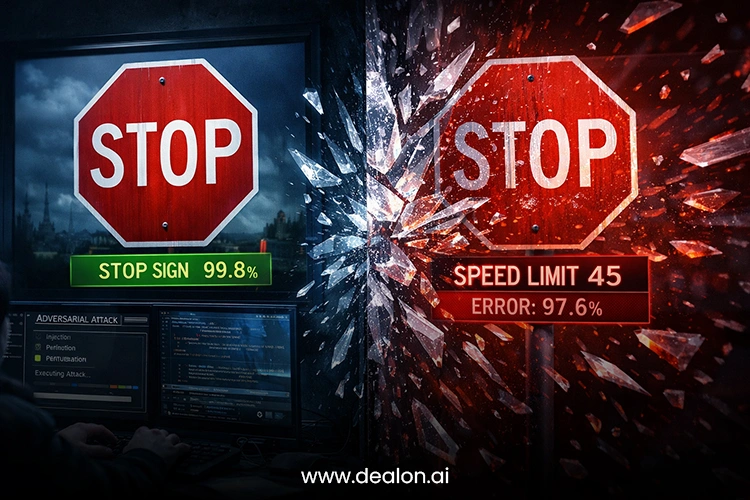
One of the most challenging and risky security threats in AI systems is adversarial attacks. The attacks encompass the manipulation of input data in a very subtle manner in a bid to deceive machine learning models to give erroneous or misleading outputs. Security-wise, the threat of adversarial attacks lies in their delicateness, in the fact that even minor, almost unnoticeable changes can result in drastic changes in results and are hard to avoid and counter.
In the image recognition systems, a small alteration of the pixel values can result in an overall error made by a model classifying an object, which is a serious concern as far as security is concerned. Financial systems can be compromised by using adversarial inputs to hide the fraud detection algorithms and carry out unauthorized payments, thus jeopardizing the security of finances. The consequences are also especially dire in such vital areas of life as healthcare, autonomous transportation, or national security, where security issues may become catastrophic because of compromised security.
The cause of this vulnerability is the interpretation of data by the machine learning models. In contrast to human beings, AI systems are vulnerable to manipulation and hacking because they do not apply context, but mathematical patterns. Moreover, a great number of AI models are black boxes, thus complicating the task of security even more, as it is hard to detect, track, and diagnose adversarial attacks.
To deal with such antagonistic security threats, organizations have to employ powerful defense mechanisms. Such methods as adversarial training, where the models are exposed to distorted data during learning, can enhance the security resilience. Moreover, active monitoring, anomaly detection models, and model explainability are important to better AI security and reduce the risks that come with adversarial attacks.
2. Data Poisoning: Undermining AI at Its Core

AI systems are operated by data, which can be easily affected in terms of its integrity and security, which has far-reaching repercussions. It is used in the data poisoning attack where data with malicious or misdirected information is added to the training datasets, hence poisoning the learning process of a model and undermining the security of a system on the whole.
Data poisoning is also not always overt in nature as compared to the usual cyberattacks because it is usually subtle and cannot be detected immediately, security-wise. With time, the attackers can inject small portions of biased or inaccurate data, therefore making the attack hard to notice under traditional security protocols. It will leave behind a compromised model that produces biased or inaccurate outputs, and this may result in poor decision-making and high security risks.
As an example, in a recommendation system, corrupted data can distort the product ranking or alter the behaviour of the user; therefore, the issues of data security and system integrity can be raised. Poisoned data can negatively affect the ability to detect threats in cybersecurity applications, which will enable bad actors to avoid the current security measures. Such attacks may have irreparable consequences in the long run, as institutions might still be using the hacked models without being aware of the security breach.
Organizations need to adopt rigorous data governance activities that promote security throughout the process to reduce them. This involves checking the sources of data, maintaining secure data pipelines, and carrying out periodic audits to establish data integrity and appropriate compliance with data security. Also, anomaly detection and data provenance tracking can enhance the security framework by detecting anomalies and ensuring that the training datasets can be trusted.
3. Model Theft and Reverse Engineering: Protecting Intellectual Assets

The intellectual property theft of AI models is also the most sought-after one as AI models become more valuable. Model theft, also known as model extraction, is a technique of recreating a machine learning model through a series of systematic queries of the model and response analysis. Attackers have the ability to re-engineer the functionality of the model and, in the long run, steal proprietary technology.
Such an attack not only leads to losses of finances but also vulnerability of sensitive data that is implied in the model. In other instances, the attackers might deduce the details of the training data, which could result in possible privacy invasion. Malicious purposes can also be applied using the stolen model, increasing the risk even more.
The issue is with the availability of AI systems. Most of them are implemented through APIs or cloud platforms, and they are prone to unauthorized access. These interfaces allow attackers to get valuable information without the necessary protection.
The organizations should take effective measures to ensure that access to models is restricted, rate-limited, and encrypted to prevent stealing models. The best methods to add an extra level of security include model watermarking and differential privacy to make sure that intellectual property is not compromised.
4. AI-Driven Social Engineering and Deepfake Attacks
AI not only becomes a victim of cyber threats, but it is also an effective facilitator of cyber threats. The use of AI to complement social engineering attacks is one of the most threatening trends over the last several years. Attackers are able to produce very believable phishing messages, impersonate people, and control human behavior.
In particular, the Deepfake technology is a considerable threat. Attackers can imitate executives, employees, or other individuals in society with extraordinary ease by creating authentic audio and video content. This may be applied in a business environment to approve fraudulent dealings, divulge confidential information, or destroy reputations.
The usefulness of these attacks is that they play on human trust. Social engineering attacks are attacks that target people as opposed to the traditional attacks, which are those that target the systems and thus are difficult to counterattack. The difference between original and artificial media will be more difficult to draw as AI-generated content rises in sophistication.
To address such risks, organizations should take a holistic approach. This involves training the staff on threats arising due to AI, multi-factor authentication, and the verification mechanism of sensitive communications. Furthermore, it is possible to invest in AI-based detection software that will aid in detecting deepfake content and stop fraud.
5. Poor AI Governance and Regulatory Non-Adherence
With the development of AI, the regulatory mechanisms are also developing. Regulatory agencies and governments are putting in place systems to deal with ethical, legal, and security issues that are related to AI. Nonetheless, most organizations find it hard to keep pace with this evolution, hence creating loopholes in governance and compliance.
Poor AI governance may lead to uneven practice and exposure to attacks, as well as failure to adhere to the regulations. This is especially dangerous to industries where strict rules apply, like the healthcare industry, finance, and the protection of data, which are highly regulated.
Data privacy, algorithm transparency, and accountability are some of the issues that regulatory frameworks are currently concentrating on. The inability to meet these standards may result in serious fines, a lawsuit, and a damaged reputation.
The governance of AI needs to be holistic. Companies have to create their policies, define roles and responsibilities, and introduce constant control systems. The development processes of AI should also be considered through ethical considerations, and the systems should be designed in a manner that would be in accordance with the values in society.
With the focus on governance, not only can organizations reduce the risk of security but also win over their stakeholders and regulators, becoming responsible players of the AI-driven economy.
Conclusion
The quickness with which AI is integrated into enterprise systems has created unmatched innovation and efficiency possibilities. Nevertheless, it has also brought another category of security threats that require an urgent solution. When we are moving forward into 2026, organizations should realize that AI security is not an extensional issue; it is a strategic one.
The threats that are described in this article, adversarial attacks, data poisoning, model theft, AI-driven social engineering, and governance issues, demonstrate the complexity of the threat environment. The following risks must be addressed through a multi-layered approach that is proactive and involves technical protection, organizational policy, and human awareness.
Finally, there is an objective of developing robust AI-based systems that can sustain dynamic threats and add value to the company. This is not only in the protection of assets but also in the culture of security and accountability.



