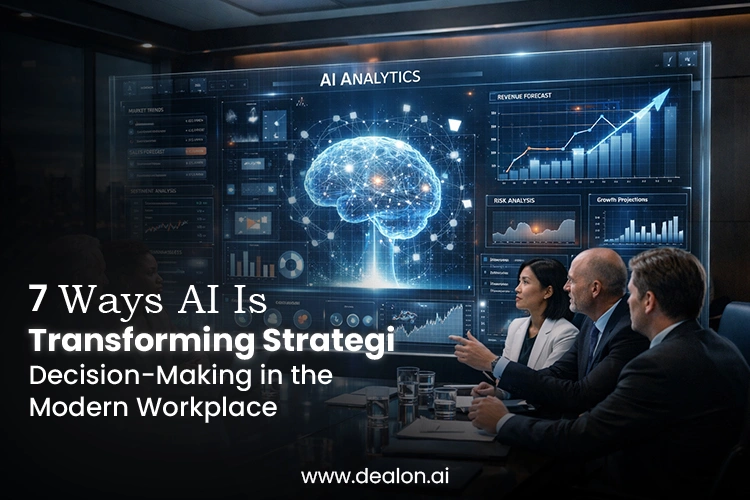

Artificial Intelligence is no longer a far-off and abstract concept, but rather a reality that is changing the way organizations think, plan, and compete. The current hyper-dynamic business environment has witnessed the transformation of strategic decision-making processes from intuition-driven processes into data-driven, algorithmically driven frameworks. Organizations that are using AI are not only streamlining their processes but are also redesigning the structure of work decision intelligence.
Predictive analytics to autonomous systems AIs are empowering leaders to make faster, more precise, and scalable decisions. As recent studies indicate, AI is among the key drivers of better quality of decisions, operational performance, and organizational performance, becoming an essential part of the contemporary enterprise strategy. In this paper, the author examines seven transformative uses of AI in strategic decision-making in the current workplace.
Also Read: 5 Causes of Algorithmic Bias in Advanced AI Systems and How to Fix Them
Table of Contents
1. Data-Driven Intelligence: From Gut Feeling to Evidence-Based Strategy
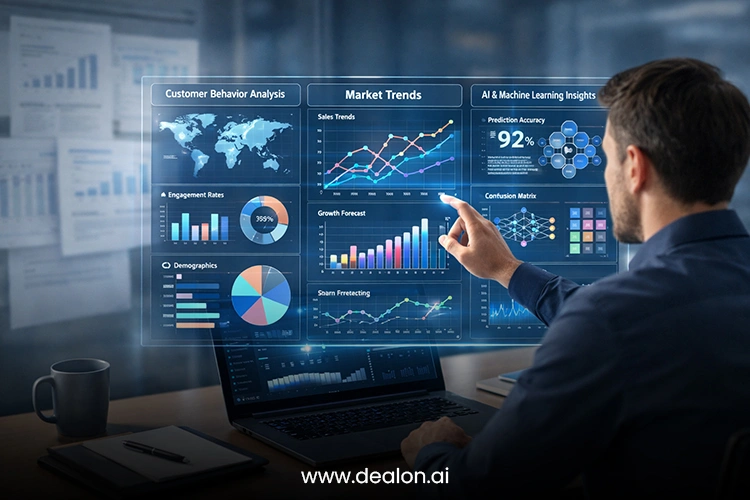
Among the most significant changes that AI can impose on strategic decision-making, one may note the displacement of intuition-based judgments by data-based knowledge. Historically, executives used to be dependent on experience, past trends, and small datasets. However, the AI does analyze large amounts of structured and unstructured data in real time and reveals patterns that otherwise would be undetectable.
The algorithms in machine learning have the capability of examining the market trends, customer behavior, and operational metrics concurrently, which allows companies to possess well-informed decision-making that has never been more accurate. The ability minimizes biases in the cognitive process and improves objectivity in the strategic planning process.
Additionally, AI technologies are also good at predictive analytics, enabling a business to view the future and run simulations prior to making key decisions. The abilities enable the leaders to foresee threats, spot opportunities, and distribute wealth in a more efficient way. Research indicates that AI-based analytics can greatly increase the awareness of customer expectations and improve the success of business processes.
2. Accelerated Decision-Making Through Real-Time Insights

In competitive markets, speed is a resolute determinant. The use of AI in decision-making is highly effective by making it much faster due to providing real-time feedback and automating the complicated analytical procedures. The executives can get actionable intelligence in real-time instead of waiting days or weeks before reports become available.
The AI-driven dashboards and decision-support systems constantly track the key performance indicators, market dynamics, and operational statistics. This live visibility will see to it that organizations will be able to react quickly to the arising challenges and opportunities.
As an example, predictive analytics can detect in real-time the disruption in the supply chain or a change in customer demand, allowing responses to be made proactively. This quick reaction boosts the agility of the organization and ensures that businesses are competitive in rough environments.
The studies have shown that AI can greatly enhance the pace and clarity of the decision-making process of managers in companies, enabling them to work with much accuracy and confidence.
3. Enhanced Strategic Forecasting and Scenario Planning
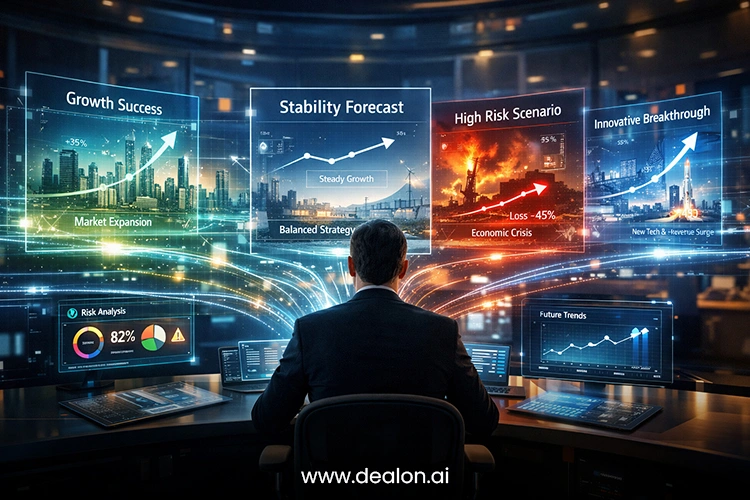
In most instances, strategic decision-making can be characterized by navigating uncertainty. AI can solve this by allowing advanced forecasting and scenario modeling. By using complex algorithms, organizations will be able to model several future scenarios and consider their possibilities.
This can be particularly useful in relatively high-change industries, like finance, health care, and technology. AI models have the ability to evaluate such variables as market volatility, changes in regulatory policies, and consumer behavior to offer a wholesome picture of potential destinations of the future.
Through these insights, the decision-makers will be able to formulate resilient strategies that consider uncertainty and reduce risk. The application of scenario planning using AI turns strategy into a reactive operation and makes it a forward-oriented, dynamic field.
Also, AI systems are able to keep on learning and advancing their projections, and thus make sure that the strategy plans are dynamic and pertinent with time. This repetitive strategy increases decision accuracy and resilience in an organization in the long run.
4. Automation of Routine Decisions for Strategic Focus
Not all decisions entail the intervention of a human. Repetitive and low-value decision-making requires AI to free up human leaders to work on high-impact strategic initiatives.
The AI systems can be used to manage routine processes like scheduling, reporting, and data entry, which eases the operational load and enhances efficiency. The automation enables the managers to spend more time on innovation, leadership, and solving complex problems.
The automation of processes by AI also reduces human error, which leads to consistency and reliability in the decision-making processes. This way, organizations would be able to operate more efficiently and at the same time have high levels of accuracy.
It is indicated that AI-based automation can serve as a strong productivity driver and help employees concentrate on more complicated and strategic activities. This change not only enhances efficiency but also enhances the quality of strategic thinking in organizations.
5. Personalized and Customer-Centric Decision Strategies
Personalization is one of the competitive advantages in the contemporary market. AI allows companies to customize their policies according to the personal preferences, behavior, and needs of customers.
AI systems have the potential to produce insights based on customer data, which can be used in marketing, product development, and customer engagement programs. Such personalization is beneficial in boosting customer satisfaction and loyalty, and eventually increasing revenue.
Recommendation engines, chatbots, and customer analytics tools powered by AI will enable businesses to provide extremely tailored experiences to their customers. These technologies make sure that the strategic decisions are aligned with the customer expectations, making it a more responsive and customer-centric organization.
Studies indicate that AI is a great way to enhance customer experience with its capacity to create personalized communication and expedite service provision. This leads to an organization developing close relationships with its customers and ensuring that the organization has a competitive advantage.
6. Human-AI Collaboration: Augmented Intelligence in Leadership
Collaboration is the best way, as opposed to the fear of AI taking the place of human decision-makers. The AI is an augmentation device that will not replace human intelligence but will increase it.
In strategic situations, AI delivers information-driven insights and recommendations, whereas humans are creative, ethically sound, and have a certain level of understanding of the situation. Such synergy leads to more balanced and efficient decision-making.
In AI systems, several strategic alternatives can be created, and their possible results analyzed, and the best options pointed out. The leaders are then able to apply their knowledge to analyze these insights and make wise decisions.
Research focuses on the fact that the use of AI and human judgment is more effective, which integrates computational accuracy with human intuition. This is a participatory model of strategic leadership.
7. Competitive Advantage Through Innovation and Strategic Agility
Finally, artificial intelligence-related decision-making will give the organization a great competitive advantage. AI will allow business organizations to outsmart their competitors by allowing them to implement faster, smarter, and more adaptive strategies.
When organizations incorporate AI into their daily processes, they are able to become more efficient in terms of innovation, react to changes in the market more effectively, and discover new areas of growth. The AI-driven insights will support the continuous improvement and strategic alignment of the organization on all levels.
Further, AI increases the agility of organizations by increasing fast experimentation and iteration of strategies. Firms are able to experiment, compare outcomes, and improve their strategies on a real-time basis.
According to industry reports, companies that use AI have the benefit of efficiency, innovation, and customer engagement as market leaders in their respective markets. In a disruption era, AI is not a tool; it is a strategic necessity.
Conclusion
The advent of AI into the strategic decision-making process will be a paradigm shift in the operating and competing modes of organizations. Using the force of information, robotization, and predictive analytics, companies will be in a position to make better, more responsive, and more meaningful decisions.
Nevertheless, AI has real potential in combination with human intelligence. Whereas AI is useful in processing data and in recognizing patterns, human leaders apply creativity, empathy, and moral reasoning to the table. They are all the forces of a strong synergy to promote innovation and sustainable development.
With the further development of AI, organizations should be strategic about its application, which should be consistent with business goals and ethical imperatives. Workers who are ready to undergo this change will not only survive but also be successful in the new workplace.
Ultimately, AI is not simply changing the process of decision-making; it is changing the very interpretation of being a strategic leader in the digital era.



