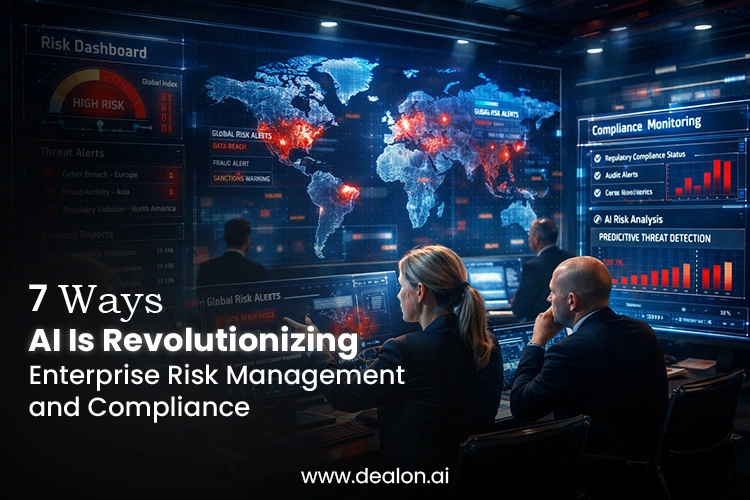

In a world characterized by digital velocity, regulatory complexity on a global scale, and an unprecedented amount of data proliferation, enterprise risk management (ERM) and compliance have ceased being stagnant reactive roles and have come to be viewed as dynamic, strategic requirements. Conventional models, which tend to depend upon periodic evaluations, paper audits, and isolated sets of data, cannot keep abreast with the speed and complexity of contemporary business risks. Nevertheless, Artificial Intelligence (AI) is defining this landscape in a new way.
AI has ceased to be an experimental device; it is now integrated into the very fabric of governance, risk, and compliance (GRC) ecosystem, with organizations being able to move beyond reacting to mitigation measures and towards activating risk intelligence. Enterprises are also not just detecting risks quicker using machine learning, predictive analytics, and automation, but turning compliance into a competitive edge.
This paper discusses seven paradigm shifts through which AI is transforming enterprise risk management and compliance that will provide a comprehensive insight into the strategic implications of AI.
Also Read: 7 Ways AI Is Transforming Strategic Decision-Making in the Modern Workplace
Table of Contents
1. Predictive Risk Intelligence: Moving from Reactive to Proactive Strategies
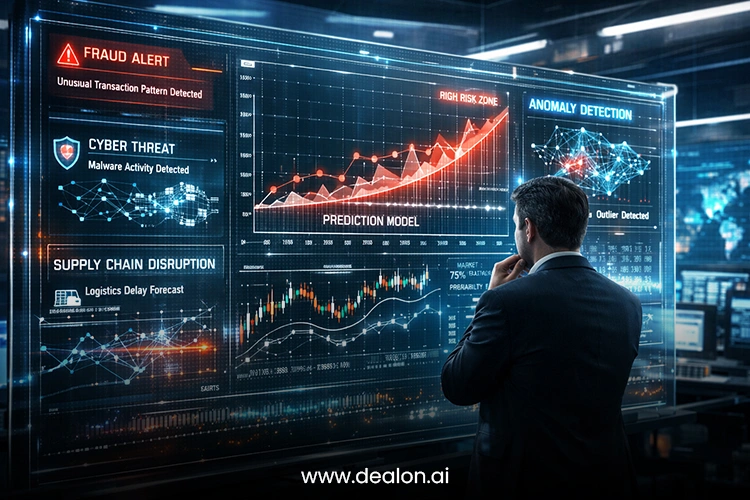
Among the biggest contributions to enterprise risk management that AI has made, we shall mention its ability to predict risks even before they take place. Unlike the traditional systems, which are very reliant on historical data and ex post analysis, the AI systems are used to forecast how a threat may occur in the future, depending on the patterns, anomalies, and external indicators.
The analyses of the large volume of data: financial transactions, measurements of operations, and market trends are done through machine learning algorithms to identify the faint correlation that human analysts would fail to identify. This forecasting ability allows organizations to anticipate the occurrence of any risk, such as fraudsters, hackers, or the chain of supply being upset, to prevent them early on.
Moreover, predictive risk intelligence increases strategic decisions. Executives can also assess risk situations more accurately and tally the business goals and the risk tolerance scales. This vision is not only beneficial in a competitive environment, but it is essential.
2. Real-Time Monitoring and Continuous Compliance
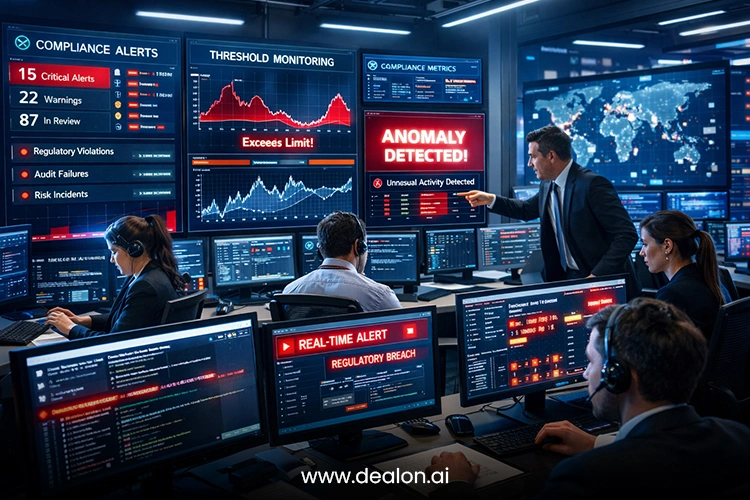
AI has turned compliance into a routine process instead of a checklist-based process performed on a regular schedule. The old systems of compliance are usually run on a quarterly or annual basis, and they have their blind spots where risks have the capacity to breed without awareness. With the assistance of AI, these gaps are eradicated via constant surveillance.
Better AI mechanisms are implemented to assist enterprise systems in analyzing data streams in real-time to detect anomalies and raise an alert when preset thresholds are exceeded. This will guarantee that breaches to compliance, be it in terms of data privacy, financial reporting, or other regulatory standards, are identified and solved immediately.
The rise of AI-based continuous compliance monitoring has been supported by industry estimates that over half of large enterprises will rely on AI-based continuous compliance monitoring.
The transformation to ongoing compliance not only lessens the regulatory fines but enhances organizational credibility, too. There is an increased preference by regulators towards organizations that exhibit proactive oversight, and AI has the infrastructure to respond to these expectations.
3. Automated Risk Identification and Assessment
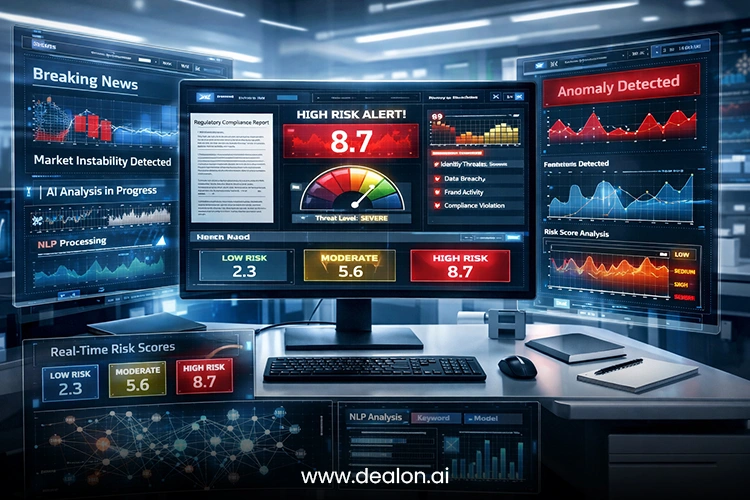
The process of risk identification was traditionally highly labor-intensive and relied on manual data gathering, stakeholder feedback, and subjective estimation. AI makes it easier through the automation of risk discovery and scale-based risk assessment.
The concept of natural language processing (NLP) allows AI systems to scan regulatory documents, news sources, and industry reports to discover the existence of new risks. The machine learning models analyze internal data at the same time to identify trends that may reflect operational or financial weaknesses.
AI is also now able to improve risk assessment by providing dynamic scores, based on many factors, such as previous occurrences, effectiveness of measures, and external threat intelligence. The scores are constantly being updated because new information is constantly coming in, and risk evaluations are kept up to date.
This automation not only lessens the workload of the risk management teams but also increases the rigor of risk identification. Instead of having data on a small sample, organizations can study 100% of their information, which reduces blind spots in addition to improving resilience.
4. Intelligent Fraud Detection and Cybersecurity Enhancement
The modern type of fraud and cybersecurity dangers are more advanced and demand the corresponding sophisticated detection systems. In this regard, artificial intelligence is exceptional as it identifies anomalies and suspicious actions in real-time.
Machine learning algorithms can identify abnormal behavior, i.e., abnormal transaction patterns or unauthorized system access, in the span of milliseconds. This helps organizations to avert fraud even before they become huge financial or reputational losses.
AI can assist in the process of improving threat detection of network traffic, malware signature detection, and anticipating potential attack vectors. Unlike the conventional security models that are based on a set of rules, AI responds to the changing threats, and this keeps enhancing its detection mechanisms.
Implementation of AI in detecting fraud and cybersecurity not only enhances the alleviation of risk but also minimizes the operational expenses involved in responding to the events. In order to avoid breaches, organizations will save significant financial losses and fines imposed by regulatory bodies.
5. Data-Driven Decision-Making and Risk Governance
AI is completely revolutionizing the approach to governance by organizations as it allows making decisions based on data. In conventional ERM models, decision-making is usually affected by partial information or biased interpretation. AI helps to remove all of these restrictions as it offers exhaustive and real-time insights.
AI-driven dashboards combine information from various sources and provide a comprehensive picture of enterprise risks. These dashboards allow work executives and board members to see the risk exposure, monitor the major risk indicators, and evaluate the efficiency of the mitigation strategies.
Furthermore, AI leads to better governance, standardization of risk assessment methodology, and consistency within the department. This is especially useful in large organizations that are based in numerous jurisdictions, as regulatory requirements might differ greatly.
Through the development of a data-driven culture, AI helps organizations to make informative decisions that are consistent with strategic goals and regulatory requirements.
6. Streamlining Regulatory Compliance and Audit Processes
Complexity, resource intensity, and dynamic evolution are often described as regulatory compliance. This is the scenario that AI makes less complex through automation of compliance procedures and less administrative overhead.
Artificial intelligence can automatically create audit records, create compliance reports, and ensure compliance with regulatory requirements. This automation not only speeds up the processes of audit, but also increases accuracy, limiting chances of human error.
Also, compliance tools that are powered by AI can evolve according to newly introduced policies, as they constantly revise their structures. This makes organizations still in line with the changing regulatory requirements.
The productivity realized with the help of AI is tremendous. Organizations are able to record high levels of compliance and save a lot of time and costs. More to the point, AI is changing compliance, as it is no longer a reactionary necessity, but rather, it is a business-enhancing capability.
7. Enhancing Transparency, Accountability, and Ethical Compliance
With AI becoming a part of risk management and compliance, other concerns, such as transparency, accountability, and ethics, arise. It is necessary to overcome these difficulties to gain the trust of stakeholders and regulators.
AI-based systems are able to improve transparency and offer a comprehensive audit trail and explainable insights into the decision-making processes. This makes sure that organizations are able to defend their position and prove that they are acting within the ethical and regulatory boundaries.
In addition, the responsible AI frameworks are focused on fairness, mitigation of bias, and data governance. With such frameworks in place, organizations will be able to minimize any likelihood of discriminatory results and make sure that AI systems do not cross the line.
Ethical considerations should not be incorporated in AI-related risk management just because it is a regulatory mandate, but because it is also strategic. Companies that emphasize transparency and accountability have a greater chance of generating trust, improving reputation, and becoming successful in the long run.
Conclusion
Artificial Intelligence is not merely adding to enterprise risk management and compliance, but it is transforming them. AIs are changing all aspects of the risk environment, including predictive risk intelligence and real-time monitoring, automated assessment, and ethical governance.
Risk management based on AI implementation is no longer a choice as organizations are moving through an environment that is more complex and volatile than ever. It is a strategic requirement that allows businesses to predict threats, establish compliance, and have a competitive advantage.
Nevertheless, the implementation of AI should be done with care and responsibility. Good governance, best data management systems, and adherence to moral values are the key to the most effective utilization of AI and its effective reduction of hazards.
As a result, the future of enterprise risk management is a perfect combination of human experience and artificial intelligence. Their combination establishes a strong, dynamic, and proactive risk management methodology, one that not only keeps organizations safe but also enables them to survive in a risky world.



