
Artificial Intelligence is a technology that has very quickly moved past being a fringe technology innovation to a cornerstone of contemporary enterprise innovation. With the growth of machine learning models, deep learning architectures, and real-time data analytics systems in organizations, the need to have a strong and efficient AI infrastructure has become highly demanded. In the age of cloud computing, where scalability and flexibility are the key factors, optimization of the AI infrastructure is no longer a choice but a strategic necessity.
Cloud computing platforms have democratized the high-performance computing resources where businesses of any scale are able to build, train, and scale AI models. However, without maximization, these infrastructures may be costly, inefficient, and difficult to control. Computational bottlenecks and data latency, among other problems, can greatly prevent AI performance and ROI.
The blog discusses eight key best practices that companies can adopt to maximize their AI infrastructure during the cloud age. Those strategies are performance, scalability-friendly, as well as cost-efficient, secure, and long-term sustainable.
Also Read: 7 Ways AI Is Revolutionizing Enterprise Risk Management and Compliance
Table of Contents
Leverage Scalable Cloud Architectures

Cloud computing is inherently scalable, and that is one of the greatest edges of cloud computing. AI workloads are frequently irregular, and their requirements vary with training cycles, data processing requirements, and inference workloads. Using scalable cloud systems enables organizations to deploy resources in response to real-time needs dynamically.
The scaling of AI applications can be done seamlessly with the help of auto-scaling groups, serverless computing, and container orchestration systems, including Kubernetes. Using the microservice-based architecture, the business will be able to decouple the various elements of their AI systems, such that each module is capable of scaling separately. This not only enhances efficiency but also fault tolerance.
Besides, horizontal scaling, which involves the addition of more machines instead of enhancing the power of a given machine, can substantially decrease the chances of a system failure, and the performance remains consistent.
Optimize Data Pipelines for High Throughput
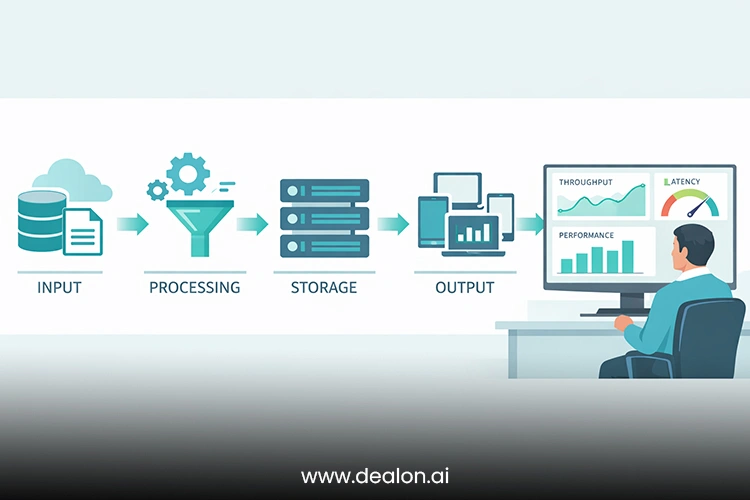
AI systems are dependent on data. Nevertheless, ineffective data pipelines may cause bottlenecks that slow down the process of training and inference of models. The high throughput and low latency need optimization of data ingestion, transformation, and storage.
Apache Spark is a framework that should be used in organizations that need to process big data. Also, the data partitioning and indexing strategies may be effective in enhancing access speeds. Data lakes and cloud-native storage solutions are used to guarantee the smooth integration with AI workflows.
Reducing data movement is another important factor. Storing data near compute resources minimizes latency and improves the performance of the system overall. It is also possible to use edge computing to handle data where it is produced, which in turn can minimize the burden on the central cloud systems.
Utilize Specialized Hardware for AI Workloads
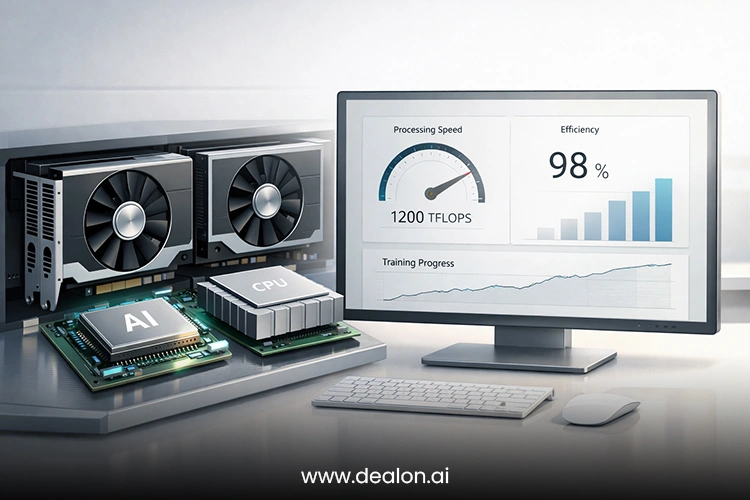
AI workloads (in particular, deep learning models) are computationally expensive and require special hardware to execute best. Special-purpose devices to perform matrix calculations and parallel processing are Graphics Processing Units (GPUs), Tensor Processing Units (TPUs), and Field-programmable gate arrays (FPGAs).
These hardware accelerators are made available on demand by the cloud providers, and this way, organizations are able to train complex models with greater speed and efficiency. Hardware choice, depending on the workload needs, is important. An example is that GPUs are good at neural network training of deep learning, and TPUs are good at neural network tensor operations.
Also, taking advantage of hardware-sensitive optimization algorithms like mixed-precision training can be used to improve performance and minimize computational expense.
Implement Cost Optimization Strategies
Although the cloud is the most flexible, it leads to runaway costs when not properly handled. AI infrastructure, with its high computational demands, can easily get costly. Cost optimization strategies should thus be implemented.
Reserved instances and spot instances should be used by organizations to minimize the cost of computing. Cost management dashboards and monitoring tools can be used to determine how resources are used and identify areas of inefficiency. Resource rightsizing, or making sure that workloads are not over- or under-provisioned, may go a long way in cutting down on unnecessary spending.
The next recommended approach is to schedule workloads at off-peak times when cloud resources are at a lower cost. Wastage is also avoided through automated shutdown of idle resources, and this leads to cost efficiency.
Enhance Model Efficiency and Performance
It is not only the case that optimization of AI infrastructure is related to hardware and cloud resources; it also includes the optimization of the models. Model pruning, knowledge distillation, and quantization are some of the techniques that can dramatically decrease the size of the model and the computation cost without affecting accuracy.
These processes can be automated using model optimization frameworks, allowing them to be deployed more quickly and with low inference latency. Also, transfer learning can be embraced by organizations to use existing models, which will save the hassle of having to train the models.
Monitoring of model performance should also be done continuously. The analysis of performance measures should be conducted at regular intervals to determine possible deterioration and to take the required measures.
Strengthen Security and Compliance Measures
Since AI systems handle large volumes of sensitive data, it is essential to ensure security and compliance. Cloud computing brings forth new security risks such as data breaches, unauthorized access, and regulatory compliance.
Effective identity and access management (IAM) policies make sure that only authorized staff can gain access to important resources. Encryption of data during storage and transit will be necessary to secure sensitive data. In addition, secure APIs, as well as network configurations, can also counter unauthorized access to data.
Automate Infrastructure Management with AI Ops
AI Operations (AIOps) is one of the new strategies to optimize IT infrastructure with the use of AI. AIOps can also significantly reduce efficiency by automating repetitive tasks such as monitoring, detecting anomalies, and allocating resources.
Machine learning software can read through system logs and performance data to forecast possible failure and prescribe remedial measures. This preventive measure helps to save time and to maintain the continuity of the system’s functioning.
Infrastructure management can also be automated with the help of Infrastructure as Code (IaC) tools such as Terraform and AWS CloudFormation because they allow infrastructure to be configured automatically. This reduces errors by human beings and encourages consistency within environments.
Adopt a Multi-Cloud or Hybrid Cloud Strategy
Using one cloud provider is a restrictive approach that would reduce flexibility and make vendor lock-in more likely. A multi-cloud or hybrid cloud approach enables organizations to have the benefits of multiple providers and still have the ability to have more control over their infrastructure.
The multi-cloud approach enables the distribution of the load of the different platforms and improves resiliency and redundancy. Hybrid clouds, in which the on-premises infrastructure is connected to cloud services, offer a higher level of flexibility for sensitive data and legacy systems.
Nonetheless, the process of controlling multi-cloud environments is impossible without strong orchestration and monitoring tools. Interoperability and smooth integration among various platforms should be ensured in order to maximize the benefits of this approach.
Conclusion
AI infrastructure optimization in the cloud era is a complex task that demands a measured combination of technological advancement, efficiency, and cost control. All these eight best practices (scalable architectures and optimized data pipelines, advanced security measures, and multi-cloud strategies, etc.) help organizations to achieve the full potential of their AI initiatives.
With the further evolution of AI, the significance of the optimized infrastructure will expand. Companies that invest in strong and efficient systems today shall stand in a better position to innovate, compete, and succeed in the ever-data-driven world. Finally, the trick is to keep optimizing, be flexible, and have a futuristic attitude toward AI infrastructure management.



