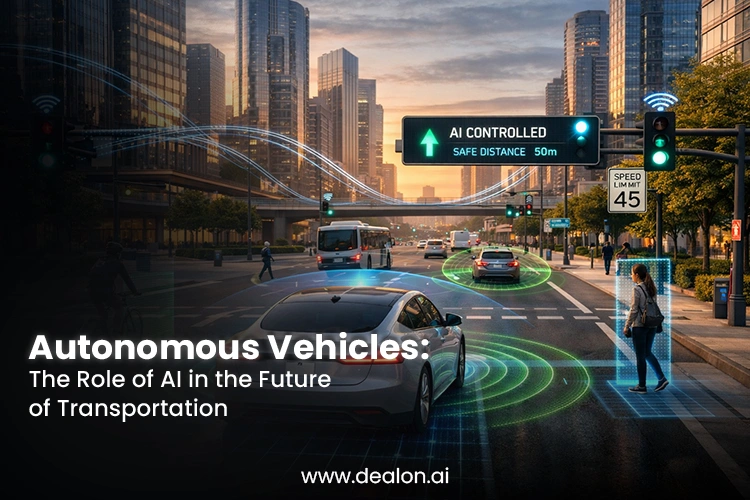

The global automobile industry is about to undergo a dramatic transformation due to the strong infusion of AI. Self-driving cars are a complete reengineering programme for mobility rather than just an experiment. Machines can now see, learn, and act to a degree. Artificial Intelligence helps cars navigate through cities like a pro It uses advanced algorithms to make their own smart decisions in real-time to be safe and efficient.
Self-driving automobiles would not only offer convenience but would also tackle over a dozen global challenges, ranging from traffic congestion to road accidents to environmental pollution. These autonomous systems can change cities into smarter and more sustainable ecosystems by enhancing the movement of people and goods. As the velocity of innovations picks up, the part artificial intelligence is playing in autonomous vehicles is not just an upgrade but the driver of the future of intelligent, connected, and resilient transport networks.
Also Read: From Automation to Innovation: How AI Is Reshaping the Modern Business World
Understanding Autonomous Vehicles and Artificial Intelligence
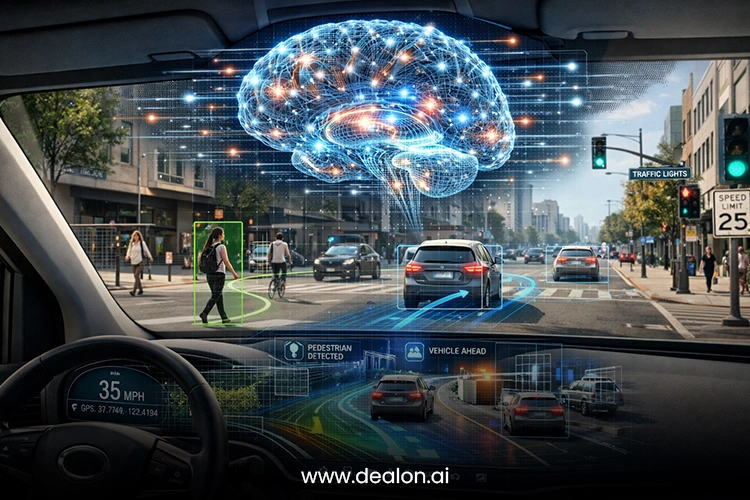
An autonomous vehicle refers to a self-driving vehicle system that drives itself—an article on a combination of different technologies in a robot. The AI inside these machines helps them to see, interpret, and react to complex driving situations with great skill. While typical vehicles expect a human driver to observe every split second, identify dangerous situations, and make a decision, AVs (automated vehicles) rely on Artificial Intelligence (AI) to do so, in a safe, efficient manner and within seconds.
Competent AI systems are able to soak up a large volume of data from a variety of sensors: LiDAR, radar, high-resolution cameras, and GPS. By utilizing sensor fusion techniques, the data inputs accurately reflect the vehicle’s surroundings in real time. Through repeated learning from observations, they can spot and track a variety of patterns in the natural world and produce future simulations.
In addition, the vehicle will learn during its driving or while in simulation scenarios to better deal with new or unexpected conditions like bad weather, erratic pedestrians, and busy urban intersections. Self-driving cars, enabled by fully automated driving techniques, are expected to change the nature of mobility, help save lives on the roads, and make the transportation system more sustainable through adaptive intelligence.
AI as the Backbone of Self-Driving Technology
ML and Deep Neural Networks
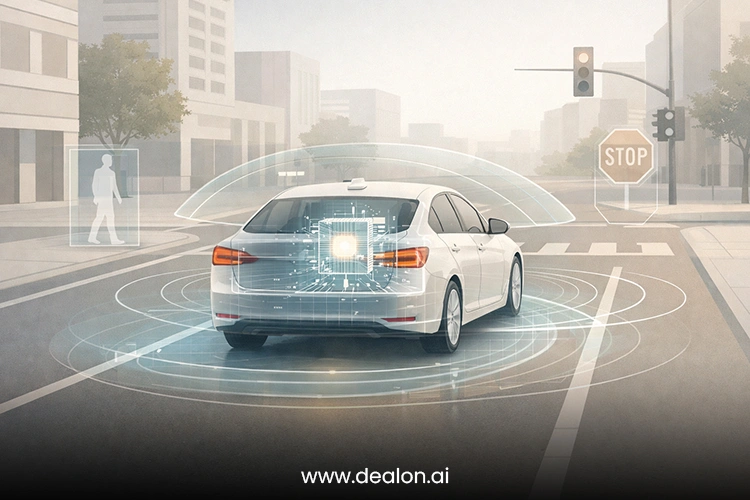
Autonomous cars depend on machine learning to learn from large data sets and experience behind the wheel. Self-driving car systems rely on advanced deep neural networks to simulate millions of different driving situations, right from ordinary urban travel to unexpected emergencies. Through the use of these networks, the recognition of objects, lane-keeping, and route-optimizing is possible. The models are getting better at predicting so that vehicles can easily adapt to a variety of environments, traffic conditions, and driving styles. Through the use of AI, vehicles will be able to predict risk factors instead of simply reacting to them. This shows a level of thinking beyond humans.
Computer Vision for Environmental Awareness
An autonomous vehicle, through computer vision, is able to ‘see’. It can transform pixel data into higher-level visual understanding. Cameras and AI are used to identify pedestrians, cyclists, vehicles, and railway signals, as well as subtle changes in the road. This ability to perceive enables real-time decisions for navigation as well as safety-critical interventions, which reduces human error and the occurrence of accidents.
Sensor Fusion and Real-Time Decision Making
By using AI technology, sensor fusion combines LiDAR, radar, cameras, and GPS inputs into a high-fidelity representation of the environment. By collecting and using information from different sources, the system gains a full awareness of the situation so that you can brake suddenly, swerve away from danger, or slow down. The claim is that autonomous vehicles are capable of acting in a reliable, efficient, and resilient manner in complex traffic ecosystems in a manner that is anticipatory.
Enhancing Road Safety Through Intelligent Automation
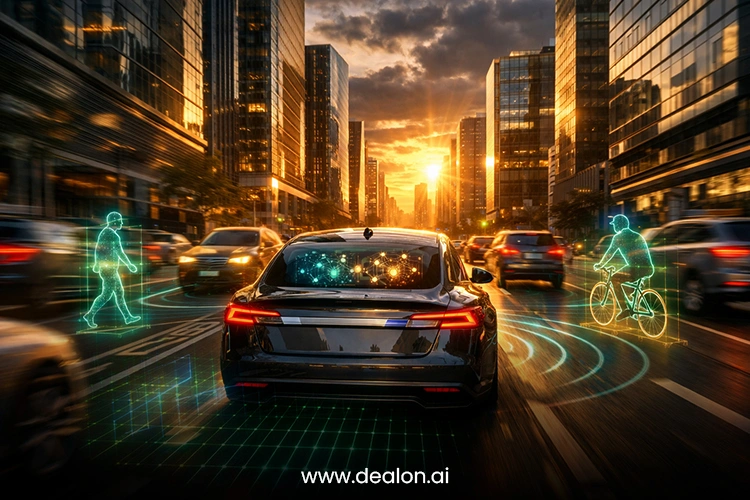
Most road traffic accidents occur due to human error. Further, a large number of road accidents result in injuries due to collisions between vehicles and pedestrians, and sometimes animals. Driven by AI, autonomous vehicles help reduce the blame humans receive for car accidents. AI-based systems will never get tired. They will never get distracted, and their judgment will not be clouded. By processing data from different sensors like LiDAR, radar, and cameras in real-time, a self-driving car, for instance, can detect possible hazards; predict actions of pedestrians, cyclists, and motorists; and take precise actions within milliseconds.
AI has the ability to predict things. Through historical traffic examination, environmental conditions, and driver behaviours, an autonomous system can predict high-risk events and adjust system speed, path, and lane changes to avoid a collision. In addition, algorithms monitor that traffic laws are not broken and no dangerous maneuvers are attempted. For instance, cars do not speed, change lanes abruptly, or fail to yield to others. All of these are extremely common causes of car accidents. The increasing use of self-driving cars can lead to extensive incorporation of these vehicles in the future, which might significantly reduce accidents due to strong driving skill capabilities. This can be instrumental in saving lives and also result in a safe network overall.
Environmental Sustainability and Traffic Efficiency
What more can AI-powered autonomous vehicles do besides making roads safe? Eco-Friendly and Efficient Urban Mobility. Algorithms can improve congestion and avoid long waiting times. Enhancing vehicular movement also cuts down on polluting emissions and fuel costs. An AI-enabled speed-up and slow-down control system smoothens the driving style to further achieve energy efficiency, as well as less wear and tear of the infrastructure.
Autonomous systems offer a solution to urban pollution and climate change, especially when combined with electric vehicle technology. Self-driving electric vehicles could create smart and efficient fleets that manage their own ride-sharing, delivery services, and public transport to prevent repeated trips and ensure full loads. By promoting urban greening, cities are also playing their part in reducing carbon footprints globally and achieving the Sustainable Development Goals. The convergence of artificial intelligence, autonomy, and electrification is happening in transportation in a way that safety, efficiency, and environmental protection are coming together in an accessible and assured way to influence mobility yet again.
Economic and Social Implications of Autonomous Transportation
The rise of AI-supported self-driving cars will change economic structures and social patterns, ushering in a new era of intelligent mobility. Self-driving freight vehicles and autonomous logistics systems can reduce costs significantly in the supply chain while offering real-time tracking, predictive maintenance, and accurate route optimization, among others. The operational efficiencies could drive costs down, reduce the delay in delivery, and help manage inventory better, making it a more agile commercial space. AI integration in public transportation leads to dynamic scheduling, predictive maintenance, and adaptive routing. This will make mass transport systems more efficient, reliable, and cost-effective. Innovations like these can enhance accessibility in cities, decrease traffic, and enrich the quality of life in specifically well-populated cities.
Nonetheless, the evolution towards self-directed commuting is not without contrasts. Phrasing 30 words – the massive upgrade to AI like ChatGPT is shifting traditional jobs in delivery, trucking, and public transport. We need to train existing workers for AI oversight, smart vehicles maintenance, smart data evaluation, and more in this rebound. Policymakers need to create new regulatory frameworks to allocate liability, ensure safety compliance, and manage fleets operating in different jurisdictions.
Challenges and Ethical Considerations
Autonomous vehicles face a host of technical and ethical challenges despite technological progress. Data security is critical because an attack might prevent a vehicle from being connected to the larger data exchange. The concern of algorithmic bias affects the response to rare instances. It is equally essential in situations of unavoidable collision to bring about decision-making accountability; in other words, the AI framework must be transparent and ethical.
To inspire public confidence and ensure equitable benefits, governments, industry players, and researchers must work in tandem. Developing rigorous safeguards for security, privacy, and the ethical use of AI is essential to building confidence and acceptance in society. Also, inclusive policies should ensure equal access to autonomous technologies, enabling benefits to be enjoyed at all economic levels. If efforts are made to resolve these economic, social, and ethical problems regarding Autonomous Transportation, this technology can significantly transform and enhance the functioning of cities regarding efficiency and safety, along with equity and resilience.
The Road Ahead: AI as the Architect of Future Mobility
Changes in human transport through artificial intelligence are a big deal. The automated vehicle will change the way we commute. More details are required before the self-driving systems become highly assured, adaptable, and contextual advanced systems through the application of AI algorithms, so that they can navigate through unobtrusive environments. With smart city solutions and high-accuracy road traffic analytics, one can move toward the full integration of the entire system by way of traffic, road system, and city. A connected ecosystem allows autonomous vehicles to evaluate traffic jams, manage energy flow, and respond to other relevant elements.
As AI-driven transportation is not one more ‘thing’, but a ‘radical’ change in mobility. The capacity to fuse data from multiple sensors along with predictive analytics and machine learning makes it possible for autonomous systems to prevent incidents from happening rather than simply to respond to them when they do occur. The projected benefits of PRT are reduced accidents, smoother traffic, and better access for emergency ambulances. In addition, the combination of self-driving technology, electric drive, and renewable energy infrastructure will enable urban green low-emission mobility.
Conclusion
Autonomous vehicles represent the digital dynamism of cars and artificial intelligence. The journey towards driverless transport is speeding up and will be beneficial for safety, efficiency, and sustainability. To fulfill this vision, we must dress responsibly, ethically, and equitably. Through the collaboration of technology builders, politicians, and urban planners, society can use AI infrastructure to develop safer, cleaner, and smarter cities. In this new era, self-driving vehicles are not just a tool. They are the builders of a smart, resilient, and sustainable transport future.



