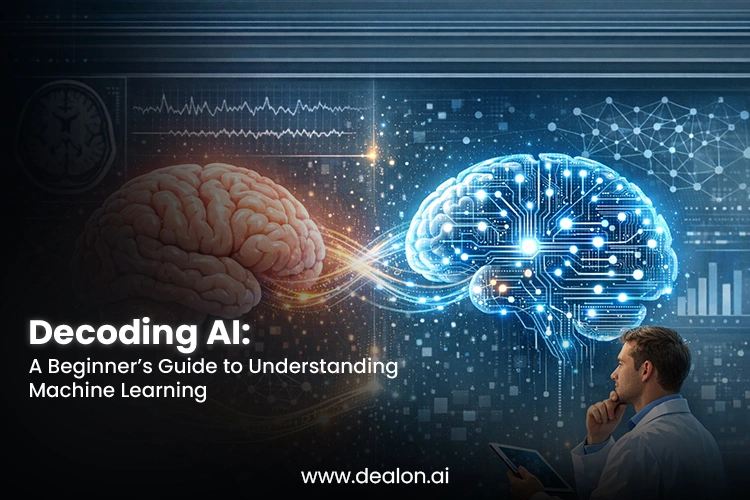

To begin this fun trip into artificial intelligence, let us look at some facts first. The Japanese K, the world’s most powerful computer, capable of 10 petaflops, is being utilized for simulations of the human brain. Another more ambitious project, the Blue Brain Project, based in Geneva, aspires to create a biologically accurate model of a human brain. Experiments are done on “haverimice”, which are virtual clones of real mice that have pathologies like those of a human.
Technologies such as EEG, PET, and NMR are allowing scientists to image the brain with a very high precision on a year-to-year basis. All these facts suggest that a new trend is emerging: Brain Mimicry. Recognizing the many scientific approaches and initiatives close to neuroinformatics and brain simulation, deliberations are proceeding on exactly what may and may not be accomplished with our day and near-term innovation. The simulation of mammalian brains at a cutting-edge level can be benchmarked at the scale of a minimum single-layer cortical loop.
Also Read: The Rise of Multimodal AI: Key Methods of Integrating Data for Dialogue Interaction
What is Artificial Intelligence?
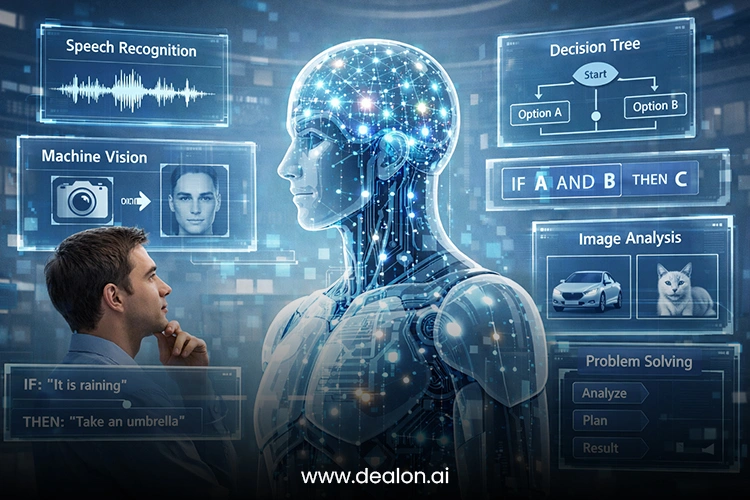
Artificial intelligence refers to a broad subfield of computer science that concentrates on creating intelligent agents. Further, these intelligent agents can perform tasks that usually require human intelligence. Artificial Intelligence means intelligence demonstrated by means other than humans. But humans and other animals also have intelligence that is not part of AI. Some applications of AI include expert systems, speech recognition, and machine vision. In the computer science community, the term AI means strong artificial intelligence, or systems with generalized human cognitive abilities. This means that, when presented with an unfamiliar task, a strong AI can find a solution without human intervention.
An intelligent agent refers to an entity that is able to take actions based on the perception of its environment. Intelligent agents can be classified into four types. A simple reflex agent uses the current percept to choose an action while ignoring the rest of the percept history. A model-based reflex agent is an agent that maintains an internal state that relies on the history and reflects the unobserved aspects of the current state. Goal-based agents have more capabilities.
Understanding Machine Learning
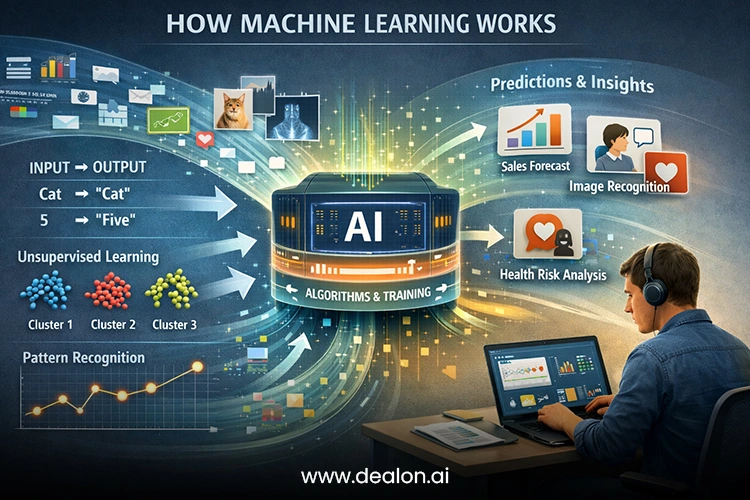
Machine learning is the engine of most AI applications today. ML algorithms allow computers to learn how to accomplish tasks with data without being programmed to do so. Doing this helps the computer system recognise patterns, predict outcomes, and improve its functions automatically. This section will talk about how machine learning works and its main types of ML algorithms. Through statistical training, computers can learn from data using machine learning.
Systems can learn and improve automatically through experience without intervention. An important aspect of machine learning algorithms is to use the training set to make inferences. Furthermore, in our world, there are many data sets. This data approximates an underlying structure that traditional statistics and the human mind are unable to resolve. Nevertheless, one can utilize ML for this. The ML algorithms can find patterns in the data that are helpful for the business or any other purpose.
During supervised learning, the algorithm gets input and its corresponding required output. The algorithm improves by examining the difference between its actual output and the correct output. By learning from its mistakes, it will improve with time. In addition, the most commonly used type of machine learning is supervised learning. This strategy has other uses, which include image classification, sentiment analysis, forecasting, and predictive maintenance.
A few examples of this are decision trees, support vector machines, naive Bayes, and neural networks. An algorithm gets data in unsupervised learning. It is possible to enhance human decision-making using the power of AI and ML. A data scientist can implement and analyze business issues in the form of data databases, data platforms, and data visualizations.
Applications of Machine Learning in Everyday Life

In recent times, machine learning (ML) has evolved significantly, and it’s one of the most proclaimed terms in different sectors and domains. Nonetheless, a question that consistently arises in the minds of individuals is, “What is machine learning, and why is it important?” You must observe that you have been recommended a smart gadget for your use.
Your mobile phone, computer, tablet, smart television, refrigerator, and washing machine are all smart devices. You may or may not know this, but all of them already come embedded with some kind of smart intelligence. This is what machine learning is, and one thing is for sure: more and more companies and entities are becoming dependent on this issue. The impact of machine learning is taking decision-making to a different level.
In other words, Machine Learning is a method that automates analytical model building. The essential concept surrounding machine learning is to allow computers to learn automatically and a lot more without human intervention. Machine learning is AI that learns from the data behavior and builds mathematical models for that data. Three learning tasks in machine learning are reinforcement learning, supervised learning, and unsupervised learning. Through deploying ML in an accurate, repeatable, and automated manner that reduces downtime and cost, systems predictive maintenance applies to even complex industrial processes to know when equipment is at risk of failure.
The Future of AI and Machine Learning
The future of AI and ML is extensively discussed. Can we control the development of these areas? It is impossible; in fact, artificial intelligence and machine learning are emerging every day on a day-to-day basis. What does the future hold for these domains? There is no doubt that artificial intelligence and machine learning are two domains that have changed the way the world works. In this domain, new inventions take place every day, which is spellbinding.
The pace of advancement of these technologies is unprecedented and will not slow down in the near future. As AI and ML technologies are changing rapidly, the impact can be seen in the face of the ever-evolving technologies. It won’t be long before the phone changes the whole structure of society.
Computers will, by default, know what users need so that no human will be necessary for interaction. The artificial intelligence will manage other systems like the blockchain, the cloud system, the Internet of Things, robotics automation process, and many more. Technologies of the future will also take place in AI and ML, for example, mobile cloud computing, which is the combination of mobile computing and cloud computing. So, mobile cloud computing makes it possible now to use all the high-end cloud resources on mobile devices, for example, sharing and storing data, etc.
Getting Started with Machine Learning
Anyone wishing to get into AI should first build programming skills. Python or R are the programming languages of choice in many industries and are suitable for beginners. Every child must participate in one of the heels and learn the basics of Machine Learning on the playground, and get to know the machines that are becoming famous for ML itself. Interactive exercises are carried out by them, which are relevant to classification, prediction, and others.
To be familiar with the utilization of computations, researchers must know the basic methods of ML for foothold exploitation. You will assist in the creation of numerous labor exploitation interview questions. This fourth principle involves iterative experimentation and the development of a data-centric approach to learning. Building ML-based systems requires extensive trading experience. Many legislators develop this situation at advanced stages in the life cycle. A web-based analysis framework for concoction process devised using a key dynamic analysis framework on concoction within social networks.
Conclusion
Becoming knowledgeable in AI and machine learning is increasingly essential in today’s world of tech advancement and usage. Machine learning converts raw data in its unstructured format into valuable information. The importance of machine learning as a catalyst for strategic decisions and innovative capabilities is undeniable. It also increases efficiency in processes and operations. Through machine learning, you can create intelligent systems, intelligent machines that can work autonomously and efficiently, and better than human beings. Through the knowledge of machine learning, learners can learn how to create robust systems that are beneficial to society.



