
AI has become a form of experimental innovation and has moved to enterprise infrastructure. AI-driven systems are used to make high-stakes decisions by organizations in the fields of finance, healthcare, retail, cybersecurity, logistics, and public administration. However, growing more complex in terms of models, they become more opaque. Deep neural networks, learning ensemble systems, and generative architectures are commonly non-transparent black-box systems that provide their results without explanations.
Explainable AI (XAI) has, in this regard, become not only a compliance tool, but it has also become one of the strategies of differentiation. Businesses that focus on the transparency of AI, its interpretability, and accountability are finding out that explainability is not a limit to innovations in business- it is a competitive feature. Making customers trust and regulation strong will rely more on the possibilities to explain how AI systems arrive at their conclusions in 2026 and beyond.
The six major reasons why Explainable AI is becoming a technical dream to a strategic business edge are listed below.
Also Read: 5 Ways Responsible AI Is Redefining Trust in Automated Systems
1. Building Consumer Trust in an Era of Algorithmic Skepticism

The digital economy is now trading in trust. Consumers are becoming more sensitized to the fact that algorithms determine what they are buying, what loans they obtain, what medical diagnoses they get, and even what news they hear. But it is knowledge that has been coupled with cynicism. The public lost confidence in automated systems due to high-profile examples of biased decision-making, unclear recommendation engines, and denial-of-service denials without any explanation.
Explainable AI goes directly to this lack of trust. Opaque processes are made responsible through the delivery of clear and intelligible explanations about algorithmic decisions by organizations. The bank explaining why a loan was rejected, a medical facility explaining how an AI identified a tumor, and an online shopping site showing why some products are suggested show respect towards user agency.
Credibility is developed through transparency. When customers can comprehend the logic of the decisions made on their behalf, they tend to trust the AI-powered services more and will be keen to interact with them. Instead of seeing AI as an authoritative tool, they consider it as an analytical aid that is driven by rational standards. This trust will eventually lead to loyalty, advocacy, and reputational strength.
Trust is setting itself apart in competitive markets. Institutions that are capable of explaining their AI decision lines are able to have a reputational advantage over rivals who engage in unintelligible systems.
2. Navigating Regulatory Complexity with Confidence

The legal environment of artificial intelligence is developing fast. International organizations and governments are enacting risk-based models and structures, which require high-impact AI systems accountability, documentation, and management. Financial services, healthcare technologies, autonomous systems, and recruitment platforms are under more and more scrutiny.
Explainable AI offers a well-organized channel of compliance. Transparent models are also easier to audit with, and it is through this that organizations can prove that they have observed fairness standards, bias mitigation measures, and safety standards. Recording of feature significance, choice logic, and model conduct enables regulators to evaluate systems much more effectively and precisely.
Strategically, explainability is a less risky legal exposure. Organizations that are able to prove the decision-making path will have a better chance of countering litigation, handling dissatisfaction, and correcting mistakes. Conversely, transparent systems are open to suspicion and regulatory fines.
The ones that make investments in Explainable AI infrastructures at an early stage are future-proofing their businesses. Instead of responding to regulatory requirements, they are on the offensive and include compliance in the lifecycle of explainable AI. Such foresight facilitates easier market entry in cross-jurisdictions and confidence in the stakeholders.
Explainability is not an option in a global world where AI actions are becoming increasingly more restrictive; explainability is core to the continued growth.
3. Enhancing Decision Quality and Model Performance
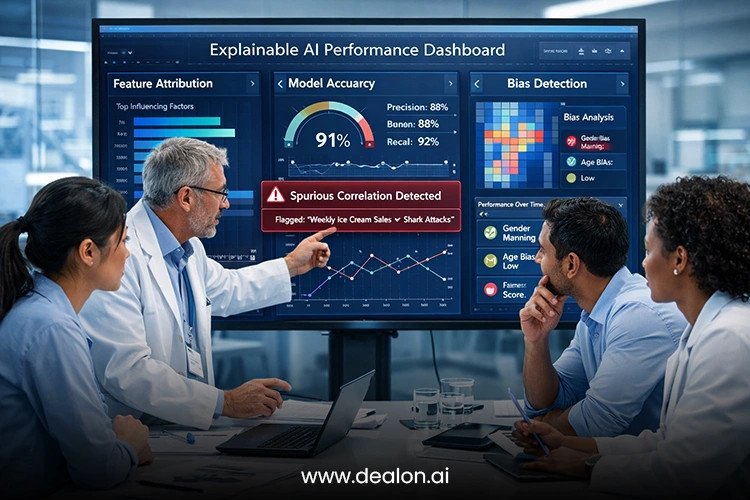
Under explainable AI, performance is enhanced both in the presence of external stakeholders and in internal performance. Through model analysis, data scientists are able to learn more about the interactions of features, bias, and anomaly. Interpretability methods like local explanation techniques and feature attribution techniques help to shed light on which variables are driving.
Such visibility facilitates progressive improvement. Developers are able to detect spurious relationships, the tendency to overfit, and the lack of data quality. To give an example, in case an employment screening model focuses on irrelevant variables in detail, the explainability mechanisms would reveal the disproportion, and the measures to correct the situation would be taken.
In this regard, explainable AI not only enhances transparency, but accuracy as well. It changes the AI generation process of blind optimization to informed calibration. The reasoning behind the models can be fine-tuned by the organizations that know the reasoning of their models, making them more accurate, fair, and strong.
When it comes to explainable systems, cross-functional collaboration is also built. The output of models can be interpreted by business executives, compliance officers, and domain professionals without the need to have sophisticated technical skills. This mutual comprehension makes the alignment of the strategy easier and helps to make explainable AI efforts work towards the goals of the organization instead of acting independently.
An increase in performance and a decrease in the number of errors and deepening cross-disciplinary communication all reinforce the competitive positioning.
4. Strengthening Human-AI Collaboration
Human-machine interaction becomes the key factor as the explainable AI systems continue to supplement professional processes. The AI tools in the sphere of healthcare, finance, engineering, and cybersecurity create recommendations that humans should validate. When human operators are, however, unable to understand algorithmic logic, collaboration will fail, though.
Explainable AI fills this gap. When practitioners know why a system has given them a certain diagnosis, investment plan, and risk assessment, they can assess the credibility of the system and incorporate it into their decision-making processes. Transparency gives the users the ability to engage, refine, or override AI outputs where required.
This movement strengthens the human agency. Instead of considering explainable AI as a substitute for expertise, professionals consider it as a collaborator that provides data-oriented insights. Trust in explainable AI recommendations is more likely to rise with the visible reasoning, which leads to adoption within teams.
In addition, explainability promotes training and skill development. AI feedback trains employees because they know which variables affect results and the pattern detection methods. This learning relationship becomes strong through time, making organizations smarter.
The smooth fusion of human and artificial intelligence in competitive industries boosts innovation and efficiency of operations. Companies that are explainable build a culture in which automation not only develops but also increases professional judgment.
5. Differentiating Brand Identity Through Ethical Leadership
Modern brands are becoming characterized by ethical technology. It is becoming apparent that consumers, investors, and employees are defining organizations by how much they are committed to responsible innovation. Explainable AI fits well within this larger account of ethical conduct and heralds transparency, accountability, and respect to stakeholders.
Those organizations that promote their dedication to explainability set themselves to be leaders in the industry. Efficient communication regarding explainable AI governance systems, equity reviews, and interpretability programs increases brand perception. This ethical signaling takes effect specifically on the younger demographics and socially aware investors who put up more emphasis on corporate responsibility.
Moreover, ethical distinction brings the best talent. Proficient workers are after work environments that match them. When being incorporated into technological strategies of the companies, Explainable AI provides a long-term perspective and integrity, which is why it is more appealing to engineers, researchers, and policy professionals.
The competitive advantage in 2026 is no longer exclusively technological expertise. It includes ethical credibility. Organizations express themselves as being explainable as a core attribute of their brand, which allows them to stand out in crowded markets where confidence and openness are key factors in deciding on purchasing and investing.
6. Mitigating Risk and Preventing Reputational Crises
Flawed explainable AI systems can cause reputational harm rather quickly and harshly. The use of discriminatory algorithms in hiring, biased facial recognition, or faulty medical forecasts may spark public opposition and losses. Negative incidents have a high rate of propagation in a hyperconnected media environment, which disrupts years of brand equity.
Explainable AI will serve as a preventative measure to such crises. Constant effort on monitoring and interpretability enables organizations to identify irregularities at an earlier stage, with problems reduced before they get out of control. Knowing the dynamic behavior of models, the companies will be able to intervene when the outputs are not within reasonable parameters.
Moreover, transparency minimizes suspicion in an investigation. Organizations that have elaborate elaborations can respond swiftly and with arguments when the stakeholders seek clarifications. This receptiveness shows responsibility and averts a reputation blowup.
Risk mitigation goes beyond the perception of the people. Explainability is a method of improving cybersecurity resilience since it exposes abnormal behavior by a model that can show signs of adversarial attacks or data poisoning. Organizations bolster their defensive stance against malicious exploitation by shedding light on the happenings within them.
In unstable markets, the ability to survive is a competitive advantage. Organizations that foresee and handle risks associated with AI continue to operate and have confidence among the stakeholders.
The Strategic Imperative of Explainable AI
Explainable AI is no longer limited to academic discussion or regulation. It is becoming a strategic differentiation base. Companies that value transparency build trust, maneuver regulations in their favor, improve performance, empower teamwork, build brand recognition, and reduce risk. The artificial intelligence competitive situation is changing. Being sophisticated is not enough to be successful. Stakeholders require accountability, fairness, and visibility. Increased consequentiality of AI systems makes them less opaque, which is a negative attribute.
Progressive enterprises are aware that explainability is not a limitation to innovation, but a way to improve it. Through bringing light to decision paths, they open up new horizons, enhance cross-disciplinary collaboration, and establish long-term relationships with both customers and regulators. The market leaders will not just use powerful AI systems in the coming years. They will be using intelligible ones. Explainable AI will turn automation into a force to be understood and will reinvent trust in automation and competitive stance. The organizations that are able to articulate their intelligence will eventually surpass those who are not in a world where algorithms play a greater role.



