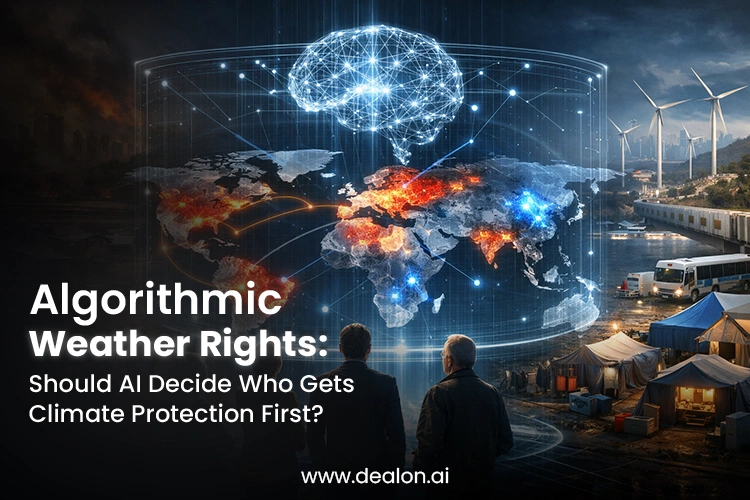

Climate change has turned from a far-off environmental issue into a political, ethical, and humanitarian emergency of the twenty-first century. Extreme weather events, which were previously a rare occurrence, have become constant, compelling governments and international organizations to face an equally uncomfortable question: in situations where protection cannot be afforded to all, how should entities be prioritized to ensure the protection is afforded to all? It is in this quandary that the idea of Algorithmic Weather Rights is presented, whereby artificial intelligence could be utilized to give climate protection a top priority, depending on data-based evaluations of risk, vulnerability, and resilience.
The concept of Algorithmic Weather Rights is that AI-based systems might be used to direct or even define the allocation of limited climate protection resources, including funds to disaster relief, support in evacuation, climate-resilient infrastructure, and early warning systems, to the population. Algorithms are claimed to be efficient, scalable, and seemingly objective, unlike conventional decision-making that often extensively depends on political bargaining, human judgment, or bureaucracy. They work by combining climate models, demographics, economic factors, and previous disaster effects to come up with suggestions on who is at greater risk and thus most worthy of immediate safeguarding.
The appeal to the word rights, however, pushes this debate out of the technological optimization. The rights have connotations of moral rights founded on dignity, justice, and equality. In cases where algorithms are set up as the protectors of the game, the game is much greater than efficiency.
The question arises as to whether mathematical models can be legitimate players in decisions that influence the survival of humans and social equity on the basis of mathematical models that are developed by humans, have been trained on imperfect data, and are being optimized to achieve specific results. Algorithmic Weather Rights, therefore, rests at the uncomfortable place of the technology governance and climate justice in which innovation crashes into the ethical accountability.
Also Read: Vibe Coding: 3 Reasons Why AI-Driven Development Is Changing the Future of Programming
The AI Promising Future of Climate Protection and Disaster Response

It is already evident that AI can be used to transform climate science and disaster preparedness. Machine learning systems are now better at weather prediction, flood forecasting, wildfire detection, and heatwave detection than conventional systems. These developments have saved lives as more accurate risk determination and early warning could be made, and human eyes can only follow it.
The potential of AI in climate protection is mainly based on speed and analytical ability. Climate crises are quick and can sometimes leave the decision-makers without complete information or data that contradict each other. AI systems are capable of addressing vast amounts of real-time data: satellite images and atmospheric sensors, socioeconomic statistics, etc., and enable authorities to foresee a crisis rather than respond to one. This predictive ability can be used to intervene proactively, e.g., by strengthening infrastructure in hazardous regions before a disaster strikes or by stocking up resources in areas where the occurrence of extreme weather is expected.
One more intriguing argument of pro-algorithms prioritizing is the pledge of information-based impartiality. The political interests, the power of the media, or the past power inequality can often be a force behind human decision-making at the institutional level. The AI, when well developed, may find the neglected populations by measuring the vulnerability using objective measurements that include poverty rates, access to healthcare, housing conditions, and climatic risks.
According to its proponents, algorithms have the potential to address the existing imbalances by targeting communities that are systematically overlooked in protection. Moreover, AI systems can be sliced across geographies and hence are especially appealing in a global climate emergency that goes beyond borders.
Ethical Risks: The Frontiers of Algorithmic Decision-Making

Even though AI systems are technically advanced, they are not neutral. They bring to their training data and design processes their assumptions, limitations, and biases inherent in the training data. This poses a fundamental ethical dilemma because, when algorithms are prioritized to safeguard the climate, this means that the tabula rasa marginalized communities are already disadvantaged in formal data systems.
The most burning issue is algorithmic bias. There are numerous vulnerable groups, including informal settlements, rural communities, Indigenous peoples, and dislocated people in data shadows. Their existence is underrepresented in official statistics, and so they are statistically undetectable by AI applications. Consequently, algorithms can fail to fully acknowledge their vulnerability or may not even be taken into account in the prioritization of vulnerabilities, which only strengthens the inequities that climate protection attempts to address.
Another critical problem is transparency. Complex AI models are usually black boxes that do not give any explanations on how they generate their results. The lack of reasonable explanations whereby an algorithm concludes that one community gets flood defenses and the other one does not destroys accountability and the trust of the population. Human beings whose lives are subject to such decisions have the moral right to understand the reasons why decisions are and were given priority or deprived and challenge the decisions that might influence their lives and livelihoods.
Climate Justice and Human Rights: Is It Machines First?

The core issue in the controversy surrounding the concept of Algorithmic Weather Rights is a very philosophical question: is it permissible to use machine involvement in choices that will save or end the life and destiny of the person? Climate change impacts unevenly those who have contributed most to the disaster, and climate protection cannot be discussed outside of issues of justice, responsibility, and reparative ethics.
Human rights models are based on universality, equality, and non-discrimination. They understand that vulnerability is not only a product of exposure but also an aspect of social constructions that is the result of colonialism, economic exploitation, and political marginalization. However, algorithms are not able to capture these historical and moral aspects. They work with existing datasets, commonly out of the context of systemic vulnerability reasons.
Giving AI the power to determine the priorities in climate protection is a danger of promoting the refocusing of rights as a contingent result, instead of a natural right. Instead of having the right to protection by mere virtue of being human and sharing the same humanity, protection becomes an earned right that depends on algorithmic scores. This is a dangerous movement, particularly in the aspects of the communities where individuals lack the power by virtue of structural injustice and not necessarily by measurement criteria alone.
In addition, machines should not make such decisions since they can dilute the democratic responsibility. Climate governance should become the topic of popular discourse, ethical debate, and political responsibility. In the cases where algorithms take control in the decision-making, no one can tell who is responsible when it causes harm, whether it be the developers, the policymakers, or the technology itself. This devolution of responsibility proves to be detrimental to the moral clarity that is needed to deal with climate injustice.
Ethical Climate Governance in the Future: Human-AI Cooperation
The solution is not the avoidance of AI, as well as the loss of ethical control to the machines. Instead, the future of climate governance must be participatory in that AI is employed as a decision support tool instead of an ethical adjudicator. The algorithms in this paradigm are used to complement human judgment and identify risks, discover patterns, and present evidence-based information. Still, the decision is always made with an ethical logic and democratic checks.
It is necessary to incorporate human rights in AI systems. This involves the creation of models that are focused on fairness, the use of diverse datasets, and a bias and exclusion audit of results. The concept of transparency has to be non-negotiable, and the communities need to know and question the algorithmic suggestions that influence their life.
Participatory governance is also essential. Vulnerable communities are not to be simply a subject in an algorithmic analysis but active participants in the design and use of these systems. Local insight and cultural values, as well as lived experience, can be used to address the constraints of data-driven strategies and build trust.
On a global scale, there is an urgent need for international standards of AI on climate governance. In the absence of harmonized ethical structures, algorithm systems would cause greater disparities between countries that have high technological ability and those that do not. The issue of climate protection should not be another field where power inequality becomes a survival factor.
Finally, Algorithmic Weather Rights is not supposed to be the process of substituting the human factor with technological efficiency. There must be a chance to reconsider the possibilities of technology to promote justice, dignity, and solidarity in a climate of uncertainty. It will not be the degree of smartness of machines distributing resources in a way that will count as an accurate measure of progress, but rather the degree of wisdom in human choices of how to control resources.
Conclusion
The opportunity in technology and also a moral challenge is the algorithms’ right to Weather. Even though artificial intelligence could enhance preparedness for climate, augmenting speed, quantity, and predictive quality, the ethical aspect cannot be replaced with artificial intelligence because of human dignity and fairness. The safeguarding of the climate is not just a logistical issue but a moral need that has been established by history, inequality, and responsibility. The responsibility should be humanized by not letting AI make decisions, but rather making suggestions. The future of climate governance should be the balance between innovation and conscience, where the technology is used to reinforce equity as opposed to covering the injustice with the veil of algorithmic power.



