
Programming has never been out of time. Since the punch cards and assembly language, every technological wave transformed the way humans interact with machines; object-oriented paradigms, cloud-native architectures, etc. Nowadays, the software sector is on the edge of another discontinuity, which may not be based on new syntaxes or new structures, but rather on AI-led creation. This movement has become known as vibe coding.
Vibe coding is a radical alteration of the conceptualization, writing, and refinement of software. Rather than the developers having to translate ideas manually into strict, code-based lines, AI systems can help to comprehend intent, write logic, optimize performance, and even anticipate possible errors. It is not about mechanical execution anymore, but about creative problem-solving; memorizing syntax is not about the purpose but about articulating it.
This blog discusses three fundamental reasons why AI-driven development is altering the future of programming and why the concept of vibe coding is transforming the role of programmers, speeding up the innovation process, and altering the very definition of software engineering.
Also Read: AI and SEO: 7 Ways Generative AI Is Shaping Content Creation and Search Optimization
Understanding Vibe Coding: A New Development Philosophy
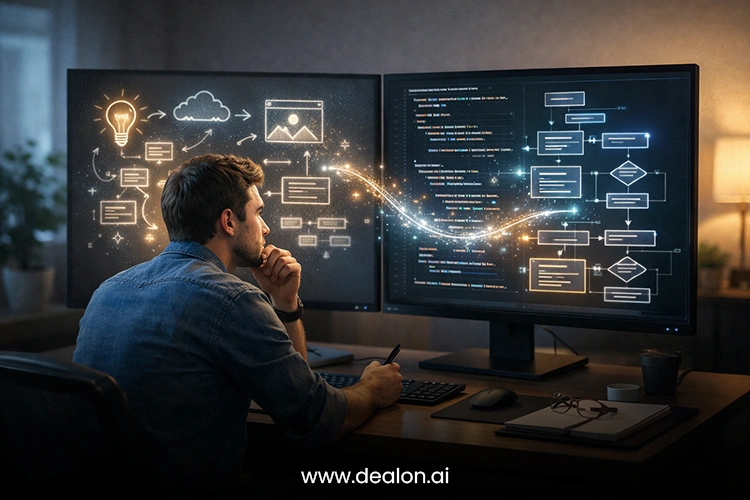
It is worth knowing what vibe coding is before delving into its transformational effects. Vibe coding is not just another effort to use AI tools to write code faster. It is an approach to development in which the developer is concentrated on purpose, reason, and desired results, and much of the technical translation and optimization is managed by AI systems.
In high-level programming, syntax, language-specific rules, and low-level implementation details limit the developers. Conversely, vibe coding enables developers to express ideas using a natural or semi-structured language, and developers depend on AI models to make sense of the ideas being expressed and come up with the code. This practice significantly minimizes the human and machine conflicts of human creativity and execution.
Vibe coding is not a programming elimination technique; on the contrary, it glorifies programming skills. The developers are designers of logic and experience, as opposed to coders who type. The change preconditions the radical transformation of the software development lifecycle.
Reason 1: Reinventing the Programmer
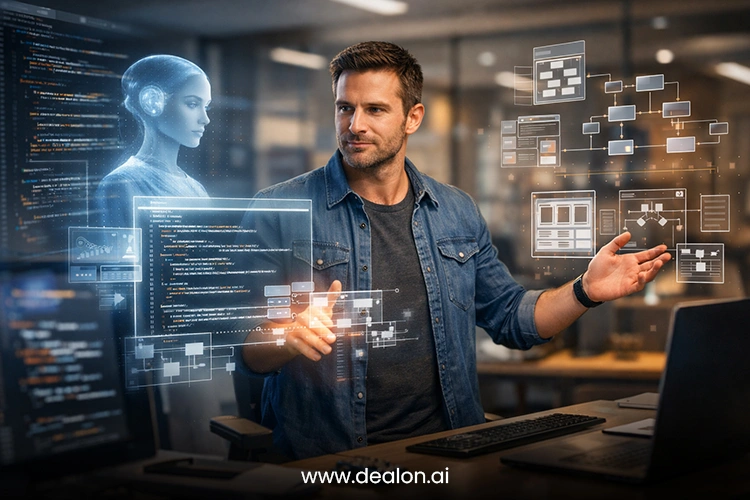
Programming education in the decades focused on syntax mastery, memorization of language constructs, and the strict compliance with the conventions of a framework. Though these skills are still helpful, AI-oriented development is radically changing the concept of a programmer. In vibe coding, developers do not have to worry about obsessively writing boilerplate code, repetitive structures, and trivial implementation details. AI systems are capable of producing functions, classes, APIs, and even application scaffolds, out of high-level descriptions. This allows the developers to focus on system design, logic flow, edge cases, and user experience.
The role of the programmer is undergoing a change that is no longer one of the syntaxist but that of an architect of the problem, someone who knows the requirements inside and out and can express them. In this paradigm, understandability is a greater virtue than automatism. Among the most significant effects of AI-based development, accessibility can be mentioned. The barrier to new entry is low with vibe coding since it reduces the fear of entry through a complex syntax and tooling. Novices have a chance to concentrate on their understanding of concepts and logic, whereas AI helps with the implementation.
Meanwhile, this does not undermine the seasoned developers. Quite the contrary, the senior programmers become leveraged. Their knowledge of the domain, architectural expertise, and long-term thinking are all more essential. AI enhances knowledge but does not eliminate it. Basically, vibe coding makes development democratic, but at the same time, it praises the richness of insight. AI is powerful in recognition of patterns, optimization, and consistency.
Human beings are more artistic, abstract, and contextual in judgment. Vibe coding is one such collaboration, with each party introducing its strong points. The developers inform AI on the direction forward and restrictions, whereas AI returns with specific, optimized solutions. Such synergy enables teams to create stronger systems with the minimal number of errors and cognitive fatigue. Programming is no longer about struggling with machines, but it is instead about the co-creation of solutions.
Reason 2: Faster Innovation and Productivity
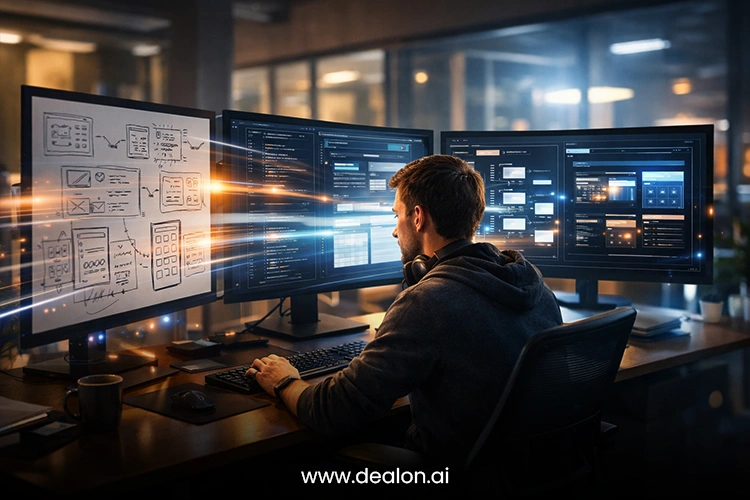
Conventional development cycles can be characterized by tedious activities: developing similar functions, setting up environments, fixing common bugs, and writing and refactoring old code. These processes are time-consuming, mind-consuming, and slow down innovation. The use of AI enhances these processes by a significant margin. The developer is able to produce volumes of quality code in minutes and not days through vibe coding. Using AI systems, refactored algorithms with optimized algorithms being suggested, ineffective logic can be refactored, and even bugs can be identified before a single line of code is run.
This rush does not necessarily result in quality reduction. Under the proper guidance, AI will produce sustainable, well-organized, and coherent code. There is control on the part of the developers who have the opportunity to look at the output and keep on refining it instead of beginning all over again. Experimentation is the key to innovation, which is not encouraged by traditional development because of a lack of resources and time. These barriers are eliminated through vibe coding. The developers are able to quickly prototype, experiment with various approaches, and iterate on them without too much overhead.
It is beneficial in startups, research teams, and product teams that are moving very quickly. Thoughts that used to appear too expensive or unsafe to execute are now able to be thought about at a minimal investment. Consequently, AI-based development creates an atmosphere of creativism and rational risk-taking. Software development is a mentally challenging process. Cognitive overload and burnout are caused by constant context switching, debugging, and syntax handling.
Vibe coding takes much of this pressure off by leaving routine and repetitive tasks to AI. By releasing developers from mechanical tasks, they will be able to work on significant problems that evoke creativity and gratification. Not only does this increase productivity, but it also improves the wellbeing of developers, a largely ignored yet essential aspect of sustainable innovation.
Reason 3: Transforming the Software Quality and Maintainability
Ensuring quality consistency in large code bases is one of the longstanding issues in programming. People developers differ in style, experience, and attention to detail, creating inconsistencies with each other over time. The creation of AI creates a new level of uniformity. The best practices can be applied to the code automatically using AI systems that have been trained on huge repositories of high-quality code and can impose engineering rules and minimize performance. Vibe coding also makes sure that even the complex systems follow the architectural principles without the need for manual supervision.
One of the most time-consuming parts of the development is traditionally debugging. AI changes this procedure, detecting the possible problems beforehand. Pattern analysis and contextual perception can be applied to identify the vulnerabilities, logic bugs, and performance bottlenecks, while these are pointed out by AI before turning into significant problems. The processes of vibe coding have less reactive and more proactive debugging. Its developers are provided with suggestions and warnings in real-time, which enables them to respond to problems before the development cycle is completed.
This dramatically minimizes the technical debt and upkeep expenses. The pace of technological change is high, and software systems have to be changed. The future-proofing aspect of AI-driven development allows refactoring, modernization, and migration to become easier. AI has the capacity to scan through the old code and propose better translations to new frameworks and languages. Such flexibility makes super-software resilient and up-to-date in the dynamic technological environment. Vibe coding, therefore, helps in not only quick development but also sustainability.
The Cultural Change: Programming as a Form of Creativity
Vibe coding is a change in culture in addition to the technical consequences of the practice. The field of development is more and more considered a creative profession, one that combines logic, design, psychology, and storytelling. This view is supported by the fact that AI-based development enables the developer to work on ideas and experiences instead of mechanical implementation.
The process of coding develops more into music composition or architectural design: a practice that is directed by vision, polished through response, and improved with intelligent tools. The same cultural development can also affect the way programming can be taught, appreciated, and applied to other disciplines. The more AI paves the way to technical changes, the more programming is a common language of innovation, not a niche factor of end-user specialists.
Vibe Coding Ethical and Strategic Considerations
Although the advantages of AI-based development are significant, there is a need to adopt it responsibly. Lack of knowledge on fundamental reasoning may result in superficial expertise and concealed weaknesses. Developers are required to be active, alert, and aware. It is essential to have transparency, accountability, and ethical use of AI. The organizations need to see AI as an additional tool, but not an absolute command. The most critical part of decision-making should always be the human judgment, especially in sensitive or high-stakes applications. Vibe coding prospers in the event of the balanced working of human intelligence and artificial intelligence.
Conclusion
Vibe coding is not a trend, but it is an essential shift in the direction of the construction of software. The development of AIs is turning programming more natural, more approachable, and more in line with human imagination. The role of the programmer is undergoing a transformation in which AI will accelerate the pace of innovation and improve the quality of software development, among other things, transforming the future of development in a significant manner.
The most effective developers and organizations will be those that adopt this change strategically, use the power of AI, and still maintain human insight and responsibility. With the shift of programming towards intent, syntax, and meaning over mechanics, it is one truth that programmers do not supplant AI-driven growth; it is enhancing them to create the future in a more distinct, faster, and imaginative manner than they ever did before.



