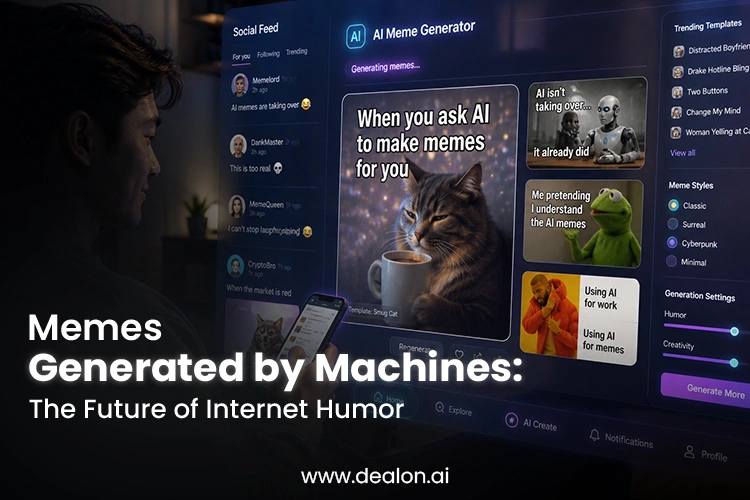

Humor was regarded as one of the most human features, a fine blend of timing, culture, emotion, and intellect. However, in an age of artificial intelligence, even laughter is not the prerogative of humans only. The rise of machine-generated memes is an interesting nexus of both computational ability and cultural production, whereby not only are algorithms decoding for humor, but also generating it.
With ridiculous image captions and creepily correct social commentary, AI-made memes are changing the experience and share of humor on the internet. Previously created manually by the users of the internet, these digital artifacts are now produced in greater quantities by advanced models that are trained on large data sets of jokes, trends, and linguistic patterns. Whether machines will produce humor or not is no longer a question, but rather how well they can reproduce, even recreate, the very nature of comedic expression.
This article will discuss how AI-generated memes came into existence, the technology behind them, the cultural aspects of the issue, and how the nature of the interaction in the context of internet humor is changing.
Also Read: AI Tutors vs Human Teachers: Redefining Education in the Age of Intelligent Automation
Table of Contents
The Mechanics of Machine-Generated Memes
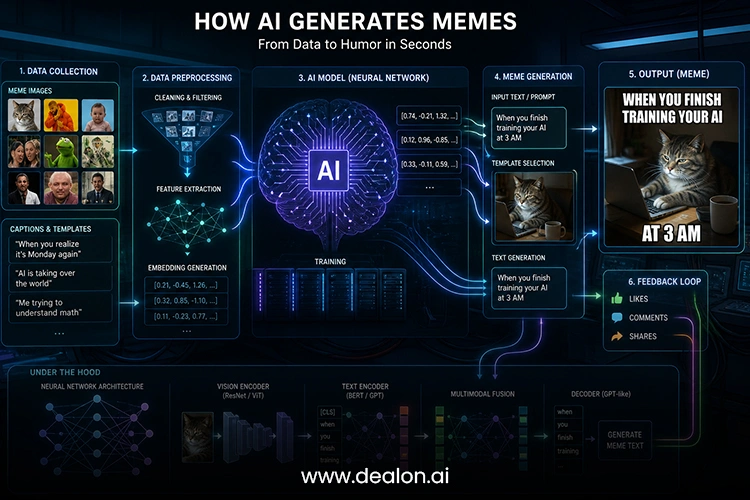
The natural language processing, computer vision, and deep learning algorithms are the main elements of AI-generated memes. These systems are educated using a large amount of data containing millions of images, captions, and context interactions. Through studies in humor patterns, including irony, exaggeration, and incongruity, AI models are trained to produce content that is consistent with the known comedic patterns.
Current systems that generate memes use transformer-based systems, which can comprehend the context and generate consistent and frequently humorous captions. Combined with image recognition technologies, such models can be used to read visual content and produce text that either supplements or subverts the meaning of the image. The outcome is a smooth combination of visual and textual humor that resembles human imagination.
Speed and scalability are two of the characteristic features of machine-generated memes. Compared to human creators, who have to use inspiration and manual labor, AI can be used to generate thousands of variations of memes within seconds. This feature makes quick experimentation possible, which allows for identifying extremely interesting content as a result of data optimization.
Moreover, AI systems are capable of changing according to the trends. Their output is also relevant because they are able to track the new formats, linguistic tendencies, and cultural allusions by constantly monitoring social media platforms. This versatility makes AI a threat to the rapidly evolving ecosystem of internet humor.
Why AI Memes Are Gaining Popularity?
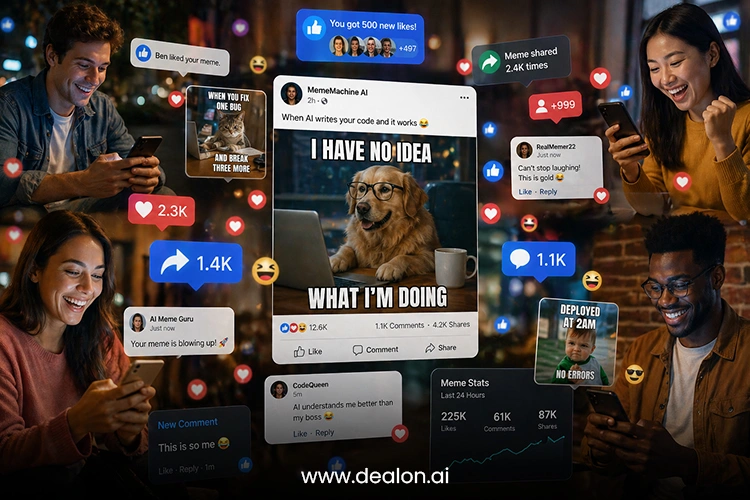
The increasing popularity of machine-generated memes can be explained by a number of persuasive factors, the first of which is novelty. The concept of machines producing humor is naturally appealing to the audience, something that is disruptive to the common vision of creativity. It is also typically entertaining because individuals are taken aback by the quality of the jokes generated by AI and the technological advancement that brought it into existence.
Another significant force is access. AI-based content generators drive the democratization of memes, as any person possessing insignificant levels of creative abilities can make an engaging meme. This lowers the barrier to entry, and the digital culture is more permissive and participatory. All one has to do is to input a prompt or select an image, and the AI takes care of the rest.
There is consistency and volume as well. The creators of the content, marketers, and social media managers can utilize AI in order to maintain an uninterrupted stream of memes, which can be used to make sure that the audience is engaged at all times. This is particularly helpful when competing in the digital arena, where presence depends on timely content updates and frequency.
Furthermore, the AI-generated memes are likely to possess a unique style of their own, which is surrealistic and unpredictable. Having machines working on the data does not mean that the work will be processed in the same way as human beings; this is why the outcome of the work can be strange, new, and untried humor. This individuality renders them viral, since individuals are likely to distribute content that is striking.
The Cultural Impact of AI-Driven Humor
The spread of machine-generated memes is not only a technological effect, but it is a tremendous cultural change. Memes have always been a type of social commentary that captures shared experiences, political moods, and cultural fashions. With AI entering this process, they start to affect the discourses that determine the online conversation.
Among the effects, one must mention the increase in meme cycles. Trends come and go faster than ever before, and with AI capable of creating content at unheard-of speeds, it is possible to have new ones and have them fade quickly. This hyper-velocity changes the rhythm of the internet culture, which becomes more and more temporary and dynamic.
Besides, memes created by AI disrupt the idea of authorship and originality. When a machine comes up with a viral meme, the question of ownership and credit for creation arises. Is it the creator, the developer, the user who prompted, or is it the AI? This uncertainty makes the digital intellectual property more complex.
The use of AI in humor is also associated with the issue of cultural sensitivity and context. Algorithms may be used to spot trends, but lack a sense of subtle cultural allusions or social divisions. This may lead to accidentally offensive and unsuitable content, which emphasizes the need to have ethical control.
On the aspect of positivity, AI can be used to close the cultural differences through the creation of humor that will be appreciated by different people. Through the analysis of the global data sets, machine-generated memes can include a broad spectrum of viewpoints, which contributes to cross-cultural interaction and the development of comprehension.
Human Creativity vs. Machine Intelligence: A Collaborative Future
Regardless of the incredible abilities of AI, human creativity and machine-generated humor do not necessarily have an antagonistic relationship with one another. Rather, it is being more and more defined as collaborative. Humans are associated with emotional intelligence, cultural awareness, and intentionality, whereas AI is efficient, scalable, and data-driven.
Moreover, human control is still necessary in the process of making sure that AI-generated memes are morally acceptable and meet the expectations of the audience. Curation and contextualization of machine output enable creators to be authentic and relevant.
The interaction of human and machine creativity also opens new possibilities of artistic expression. The hybrid memes (when human intuition is mixed with algorithms) may lead to the creation of new types of humor, which do not have the traditional limits. Such a mixture of points of view enriches the digital space, providing viewers with a wide range of funny experiences.
Ethical Challenges and the Future of AI Humor
Like any other revolutionary technology, the emergence of AI-generated memes is surrounded by ethical issues that need to be addressed. The possibility of misinformation is one of the main issues. By definition, memes are very viral and can shape the opinion of the masses. AI memes might spread fake stories or misinformation when they are created irresponsibly.
The other problem is the threat of homogenization. Although AI is capable of generating large amounts of content, it is possible that the use of similar datasets and algorithms will result in repetitive or formulaic humor. To maintain the diversity and originality in the culture of memes, the process of constant innovation and human involvement will be necessary.
The other important concern is privacy. The AI systems, which are trained on the content that is provided by the users, are to be responsible for personal data. Laws and ethics. Unlawful utilization of pictures or data might cause legal and ethical issues.
In the future, the future of AI humor will have become more advanced. Multimodal AI will allow much easier text, image, audio, and video integration, which will create more immersive and richer comedic content. Individualized generation of memes, depending on personal tastes and behavioral patterns, can become a common tool, and it will make users more engaged.
Conclusion
The rise of machine-generated memes is an indication of a sea shift in the arena of internet humor. What was initially a strictly human process has developed into a joint process of creativity and computation. The ability to create, reproduce, and invent humor has shown an exceptional aspect of AI that questions our concept of funniness.
Instead of killing the human creators, the AI-generated memes are broadening the limits of comic expression. They provide us with new tools, views, and opportunities, and expand the digital ecosystem in ways never seen before. As we keep on toying with this cross-road between technology and humor, one thing is evident: the future of laughter is not necessarily human or machine, it will be a dynamic blend of the two.
By adopting this change, we are not giving up our creativity but re-inventing it, and finding new methods of connecting, entertaining, and finding pleasure in a more digital world.



