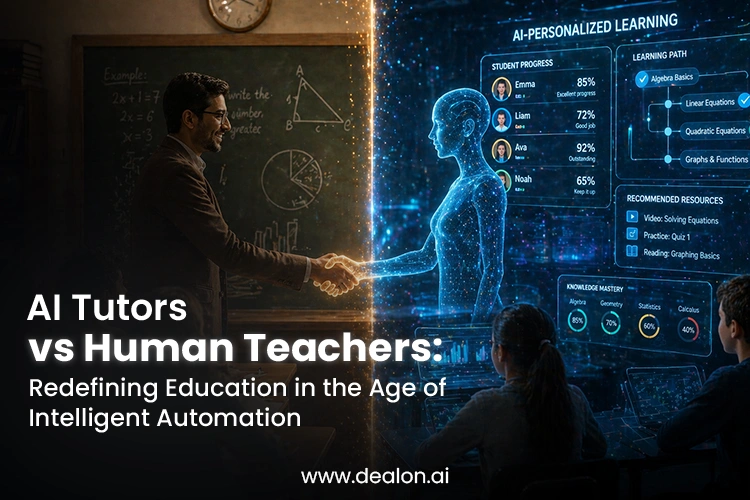

The educational landscape is in the midst of a radical change as artificial intelligence (AI) is still penetrating the classroom settings, online education platforms, and self-guided learning environments. The field of intelligent tutoring systems that are able to provide customized instructions at scale has been complementing and, in some cases, replacing the former monopoly of human educators. The question that this paradigm shift provokes is vital: will the AI tutors replace the human teachers or work in a symbiotic educational environment?
With the speeding up of automation in industries, education is at a crossroads. The emergence of AI tutors is not only a technological breakthrough but a complete reconsideration of the way knowledge is being taught, learned, and evaluated. The relationship between AI tutors and human teachers is a dynamic force that can be examined according to their strengths, weaknesses, and the future of education in a more automated world with AI.
Also Read: 6 Challenges of AI Regulation vs Innovation and How to Navigate Them
Table of Contents
The Emergence of AI tutors: 1-to-1 Learning at Scale
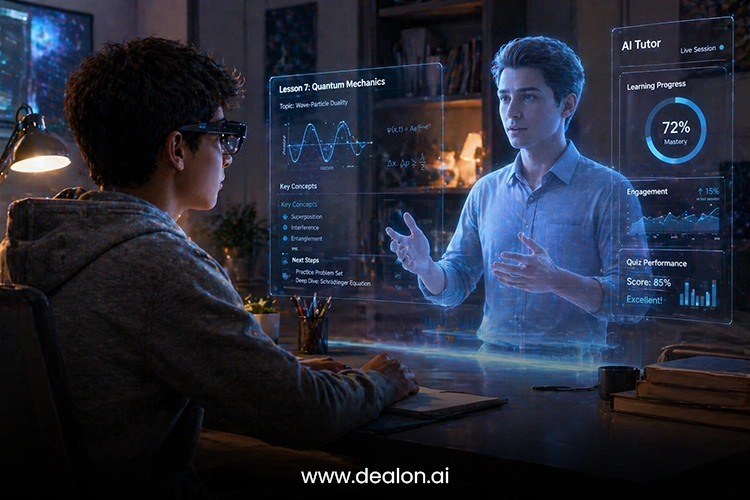
Tutoring systems powered by AI have quickly transformed from primitive chatbots to advanced platforms that can change based on learning styles, cognitive skills, and progress patterns. These systems seek to deliver very personalized learning experiences.
Real-time feedback and the provision of ongoing assessment are two of the most powerful benefits of AI tutors. In comparison to traditional classrooms, where a teacher is forced to distribute attention among dozens of students, the AI systems have an opportunity to pay attention to each learner. This type of individualization allows the students to work at their own speed, reviewing complicated ideas and speeding up with the content they already know.
Besides, AI tutors are not tied to time and space, as they can work 24/7. Learners in remote or underserved areas would be able to access quality learning materials without necessarily having to invest in physical infrastructure. This can democratize education and close learning gaps across the world, and make education more equal.
Nevertheless, AI tutors are not as efficient as human educators because they do not have the same level of emotional intelligence and the understanding of context that human educators can offer to the learning process. They might not be very effective at inspiring, motivating, or meeting the delicate psychological needs of students, although they are good at delivering content.
Human Teachers: The Irreplaceable Role of Empathy and Mentorship
The qualities of human teachers are much more than just the transfer of knowledge. They act as mentors, role models, and sources of emotions, not only intellectual but also social and emotional growth. The classroom is not about learning facts but an active environment in which students learn to think critically, learn to work in groups, and learn to be ethical.
Empathy is the biggest difference between human and AI tutors. An experienced teacher is able to tell when a student is not doing well, not only in school but also in personal life, and offer personalized care that is not necessarily a part of standardized education. This human relationship is instrumental towards confidence, resilience, and learning love.
Moreover, the teachers introduce innovativeness and flexibility in the classroom. They are able to change the lesson plans on the spur of the moment, bring in real-world examples, and make students have substantive conversations that provoke more insight. These are the qualities that AI can hardly imitate because it is based on predefined algorithms and data-driven insights.
However, human teachers have no restrictions. Their potential to offer individualized attention may be hampered by large class sizes, administrative burden, and constraints on resources. In this regard, AI tutors can be good partners, but not competitors.
AI vs Human Teachers: A Comparative Analysis of Strengths and Limitations
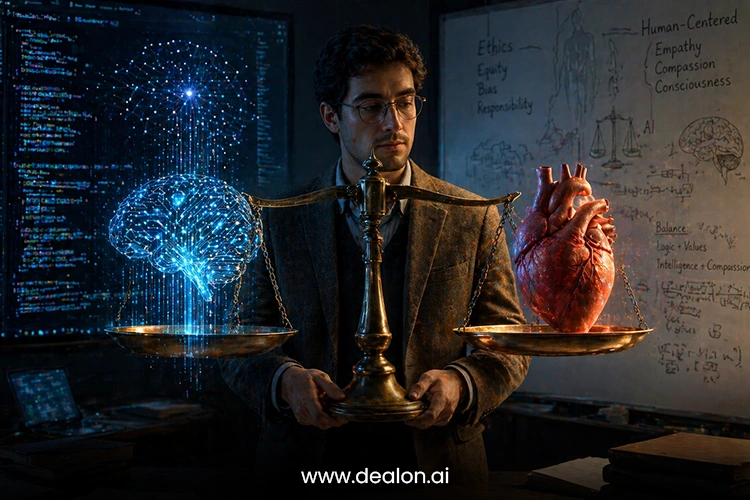
The argument between AI tutors and human teachers is usually based on polar opposition, yet the truth is much more complex. They are not mutually exclusive and are complementary since each has its own strengths and challenges.
AI tutors are also highly scalable, consistent, and data-driven. They are able to examine large quantities of data on students to determine learning gaps and prescribe specific interventions. The fact that they are able to give instant feedback will mean that students can rectify their errors immediately, which will bolster retention and understanding.
Human teachers, in their turn, give context, emotional richness, and moral guidance. They would be in a position to comprehend non-verbal communication and establish a teamwork learning environment, as well as gain knowledge of critical thinking, which is not memorized.
The reliance on the quality of data is one of the most important weaknesses of AI tutors. Biased or partial data may give false evaluations and strengthen the existing disparities. Also, the overuse of AI can decrease the possibility of social interactions, which is a key to holistic development.
On the other hand, human educators might not be able to keep up with the fast-changing curriculum and technological progress. A solution to these issues by integrating AI into the classroom is to automate repetitive functions like grading and administration, which enables educators to devote more time to other areas of significance.
The Hybrid Model: Integrating AI and Human Expertise
Neither AI tutors nor human teachers are likely to take up the future of education. Rather, a hybrid model that integrates the advantages of the two is becoming the most feasible solution. As a part of this integrated approach, AI is an effective tool that complements, but does not substitute, human teaching.
As a case in point, AI will be able to perform tedious tasks like assessing grading assignments, monitoring student progress, and creating individual learning plans. This will permit the teachers to spend more time in mentorship, creative teaching, and to treat students individually. The outcome is a more efficient and effective educational system that uses technology without losing human touch.
The blended learning settings where students will have access to both the AI systems and human instructors are already on the rise. The models provide the advantages of self-paced learning with the advantages of guided instruction. Students can use AI tutors to brush up on their learning and train skills, where teachers give context, discussion, and emotional support.
Moreover, AI-based integration could help in making data-driven decisions in education. Detailed analytics on student performance are made available to teachers so that they can better customize their teaching strategies. This combination of the human sense and the intelligence of machines can transform the result of learning.
Conclusion
In the midst of the digital era, the question is not whether AI tutors will take the place of human teachers, but how the two forces can coexist to provide a more robust and inclusive education system. Collaboration and not competition is the future of education.
AI tutors are efficient, have a high degree of scalability, and are more personalized, leading to better access to education and its subsequent flexibility. On their part, human teachers offer the empathy, imagination, and moral guidance that are needed to achieve all-around growth. Their collaboration makes them an influential team that has the potential to meet the many needs of learners in the dynamically evolving world.
To achieve this potential to the fullest, stakeholders have to invest in educator training to collaborate with AI technologies, create ethical frameworks to regulate their implementation, and provide equal access to digital resources. The policymakers, institutions, and technology developers need to work together in order to develop an ecosystem that balances the aspects of innovation and human values.
Finally, with automation, human teaching will not die; it will only change. With the integration of the best of the AI tutor and the human teacher, we can create a smarter, more caring, more inclusive, more effective educational future. The next-generation classroom is not going to be characterized by machines or people, but a combination of both.



