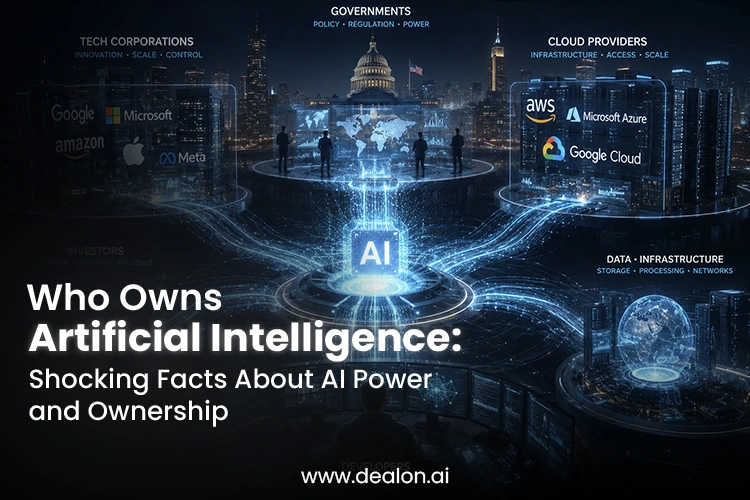

AI is revolutionizing the modern world. AI systems have become a part of nearly every aspect of life, from healthcare and banking to education, cybersecurity, and entertainment. However, there is another issue that remains up for debate between governments, industries, and the public: who owns Artificial Intelligence?
The answer is not a simple one, as many think. There is no company, country, or person controlling AI. Rather, power is split between tech companies, investors, governments, cloud service providers, and developers who develop and run these systems. The ownership of AI is crucial since who owns Artificial Intelligence is who benefits, who controls data, and who is going to influence the future of human beings.
In today’s world, AI is emerging as one of the most valuable resources in the world economy. The countries are jockeying for position in the AI race, and businesses are spending billions on R&D. Ownership is not only a technology issue anymore; it’s an economic, political, and moral one.
Also Read: Conversational AI vs Generative AI: Paramount Differences Driving the Future of Automation
Table of Contents
The Real Meaning of AI Ownership
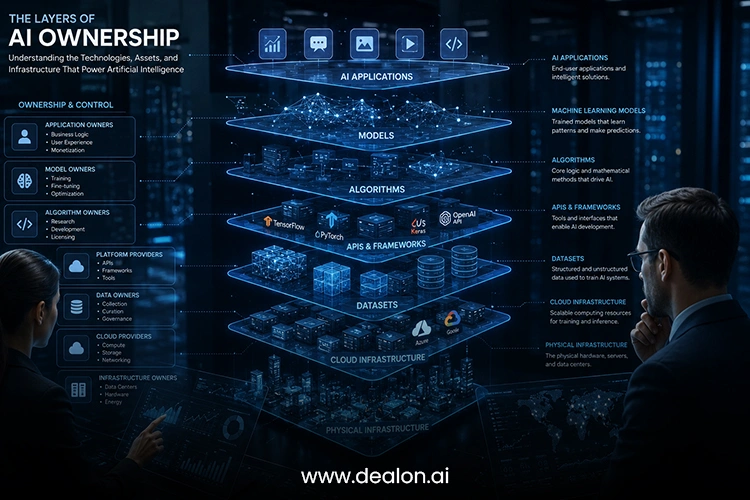
It’s important to first have an understanding of what ownership of AI means before considering who owns AI. AI is not one product to be owned and operated by a single individual. AI, on the other hand, is a collection of various components that are interconnected, such as algorithms, machine learning models, training data, hardware infrastructure, and cloud computing systems.
Ownership can be distributed along various aspects of the AI ecosystem. For example:
- The software code of the AI model can be the property of a company.
- The information that is used to train that system could be owned by another organization.
- AI may be running on a cloud server that the cloud provider can manage.
- Governments can control the use of the technology.
The debate about who owns AI has been a controversial one, due to its complex structure. Some say that the companies that run the infrastructure of AI are the most powerful ones, and others say that it’s data that has the power.
The next step is to be more difficult in determining ownership as AI systems continue to evolve. Generative AI can produce text, images, music, and videos based on information it’s been given from millions of publicly available sources. This opens legal and ethical issues regarding IP rights and the use of digital content.
Who Owns Artificial Intelligence in Today’s World?
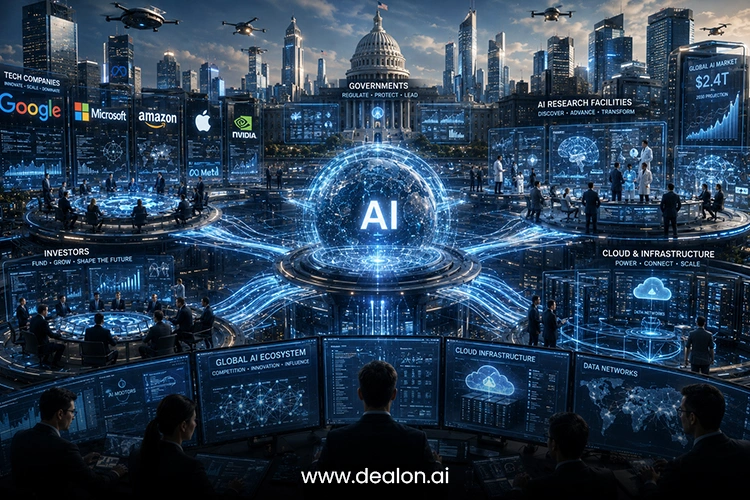
The question, ‘Who owns Artificial Intelligence,’ is typically about the major technology firms pioneering AI. These firms have a huge advantage over others in terms of access to extensive amounts of data, powerful research teams, and immense computing power, which enables them to lead the global market in AI.
These firms indeed invest billions of dollars in creating AI annually. They’re not only about software, but they have investments in cloud platforms, data centers, and digital ecosystems that are having a global impact when it comes to the deployment of AI. Here are some of the key players that are affecting AI at the moment:
Big Tech Corporations
Technology giants have a large share of the AI infrastructure in place throughout the industry. They’re owned through patents, proprietary algorithms, cloud computing networks, and strategic investments.
These businesses also shape the landscape of who is leading the development of AI systems by recruiting leading research scientists and developing platforms for the use of AI tools. They are so dominating that they have led to concerns about monopolies and undue competition in the market.
Governments and National AI Programs
The USA, China, and the European Union are investing in the development of AI. AI is seen as a strategic technology that can enhance national security, military capabilities, and economic competitiveness, and governments are aware that this is the case.
Many governments partner with private industry to catalyze innovations in AI. This collaboration presents another challenge to the question of who owns Artificial Intelligence, since publicly funded innovations can lead to privately owned products.
Investors & Venture Capitalists
Venture capital companies and institutional investors play a central part in the development of artificial intelligence startups. While financial backers might not build AI systems themselves, they have an impact on the strategies and technology priorities of the businesses they invest in.
Investment companies are becoming increasingly powerful in the direction of AI in the future, as it is becoming more profitable.
How Data Shapes AI Ownership
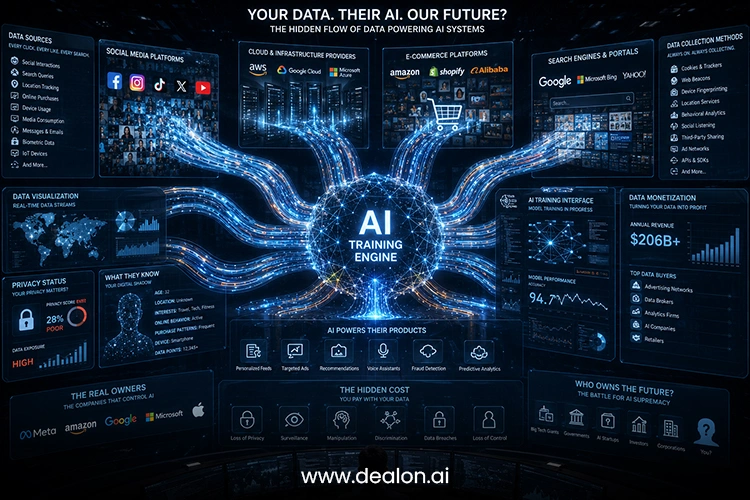
Data is among the most important factors of AI ownership. The learning process of AI systems involves examining vast and extensive amounts of information. Even the most sophisticated AI tools can’t operate without quality data.
This implies that organizations that gather and manage user data have a huge amount of power in the AI economy. Big data is being collected by social media, search engines, ecommerce and mobile apps on a daily basis, collecting vast quantities of consumer data.
Data ownership is important because it influences:
- The training process for AI systems.
- What are the possible biases in the outputs?
- What are the competitive advantages for which industries?
- The protection of the privacy of users
People often don’t know that they are helping to power the development of AI systems today! This has led to a worldwide debate on digital privacy, consent, and the ethics of AI development.
The advent of output AI technologies has exacerbated these worries. With the emergence of output AI technologies, these concerns have been amplified. Now, AI-generated content can be written, drawn, videoed, and produced as voice recordings. In many countries, copyright issues and issues addressing compensation for creators are not yet settled.
Who Runs AI Behind the Scenes?
Understanding who is operating the AI day to day is another key question that goes hand in hand with who owns Artificial Intelligence. Whilst corporations can own the systems, they are designed, monitored, and improved by a human expert. Multiple specialized groups are essential for developing AI:
AI Researchers
Machine learning models are developed, and algorithms are optimized—their contribution to innovation in natural language processing, robotics, and automation.
Data Scientists
Data Scientists create datasets, discover patterns, and organize the training of AI. They are very important in minimizing bias and in enhancing the accuracy of the model.
Cloud Infrastructure Providers
AI applications rely on cloud-based servers and computational systems. If it weren’t for massive cloud infrastructure, large-scale AI wouldn’t be.
Policymakers and Regulators
Governments and regulators set ethics, privacy, and safety guidelines for AI. They shape the use of AI technologies throughout society.
It turns out that not everything is autonomous in the world of AI, as understanding who runs AI can help you make sense of this. It is still very much the product of human choices in how it is designed, and its capabilities and constraints.
The Global Battle for AI Power
Every year, the competition for the leadership of AI technologies rages around the world. The countries see leadership in AI as a means of achieving economic supremacy and geopolitical influence.
Nowadays, the competition for the Superpowers of the world is on in the international AI race, with China and the United States at the forefront. American companies dominate commercial AI, and China is aggressively expanding its government-backed AI initiatives. American companies dominate commercial AI, and China is aggressively pushing forward on its government-backed AI initiatives.
Whether or not nations will be able to own AI could be a determining factor in shaping the global economy of the next few decades. AI’s prospect for influence is expected to be felt in different sectors like defense, health, transport, education, and finance.
Ethical Concerns About AI Ownership
While this debate over ownership of AI rages on, ethical issues are beginning to be ignored. Proponents of regulation are concerned that a few companies would control too much of the AI power, which poses significant risks. The largest issues are:
- Violation of user privacy
- Increased surveillance
- Algorithmic bias
- Unemployment resulting from automation.
- The way one shapes public opinion.
- Inaccessibility of AI technologies for everyone.
Tools are expanding, so is the concern with misinformation and deep fakes. The generation of media through AI can sometimes make it difficult to tell the difference between real and fake, leaving digital trust ever more tenuous.
As AI technologies continue to advance, experts believe they will need to be regulated transparently and supervised ethically to prevent misuse.
Can Artificial Intelligence Truly Be Owned?
Many experts have recently called into doubt whether anyone should be the complete owner of AI. AI should be a public good, like electricity or the internet, according to some.
This concept of open-source AI communities believes that knowledge and innovation should be open to everyone and not be dominated by a handful of companies. But private businesses say innovation should be rewarded with a profit and the security of intellectual property rights.
It is this debate that is at the core of all discussions today on who owns Artificial Intelligence and whether AI should be more decentralized or centralized.
The future might be a blended approach of government, business, and open-source communities working together to develop and govern AIs.
Conclusion
As AI technology transforms society, the question of who owns Artificial Intelligence will be even more significant. The software industry is clearly not alone in owning; the list also includes governments, investors, cloud providers, and organizations that have valuable data resources.
Who owns Artificial Intelligence can give insight into the distribution of power, profit, and influence in the digital age. The more intelligent AI grows, the world’s societies will have to choose whether AI will be more open and regulated technology or kept in the hands of a few big companies.
The advance of AI will not just be about technology. It will be based on the person or persons controlling it, who will profit from it, and the manner in which it is used in the future by generations of people.



