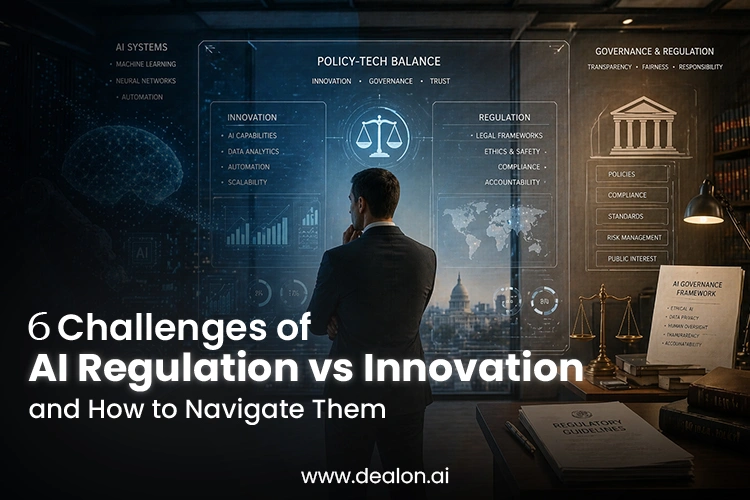

Artificial Intelligence (AI) is the leader of the technological revolution of the modern age that changes the industry, redefines human abilities, and rethinks the scope of possibilities. The impact of AI is immense and ubiquitous, as seen in the field of healthcare diagnostics and in autonomous systems and generative content creation. Nonetheless, there exists a pressing dilemma to such transformative power that needs to be regulated, but not to death, as it is the innovation that drives the AI into growth.
The policymakers, governments, and leaders of industry are struggling with this complex balancing act. Excessive regulation may impede technological development, deter investment, and slow down economic growth. On the other hand, the lack of regulation may result in moral breaches, misuse of data, and unforeseen effects on society. This blog evaluates six important issues in AI regulation and innovation and offers strategic thinking on how stakeholders can find their way through this difficult landscape.
Also Read: 8 Best Practices for Optimizing AI Infrastructure in the Cloud Era
Table of Contents
1. The Speed Mismatch: Regulation Lags Behind Innovation

The difference between the fast speed of technological development and the slow and more gradual process of regulatory development is one of the most grave issues in AI governance. The development of AI is exponential, and the breakthroughs happen so fast that lawmakers are unable to keep up with them.
This lag provides a regulatory gap in which new technologies can be used without any clear guidelines. As an example, generative AI systems and autonomous decision-making systems tend to be faster than the legal systems that are supposed to regulate them. Consequently, the policymakers are often responding to the innovations instead of actively determining their direction.
How to Navigate It:
Regulators need to be innovative and progressive to counter this imbalance. Governments should use loose structures instead of strict regulations, including so-called sandbox environments, in which companies can experiment with AI innovations under regulatory oversight. Also, the ongoing consultations between the technologists and policymakers are likely to ensure that the regulations are updated according to technological advances.
2. Ethical Ambiguity and Bias in AI Systems

The AI systems are as unbiased as the data they are trained on. Regrettably, historical data usually includes certain biases to provide discriminatory results in such aspects as employment, borrowing, and policing. It is difficult to control the use of ethical AI as the issue of fairness is subjective, and it is hard to establish some universal ethical norms.
Different cultures, societies, and legal systems have different definitions of ethics, thus making it hard to develop internationally recognized ethics. What is deemed to be fair in a certain region might not be similar to the virtues of another area.
How to Navigate It:
To ensure ethical AI design, organizations need to establish fairness audits and bias detection tools as well as transparent algorithms. Explainability and accountability should be mandated in AI systems by regulatory bodies such that decisions are understandable and can be challenged. More balanced and inclusive AI systems can also be established by establishing interdisciplinary ethics committees, which include technologists, sociologists, and legal experts.
3. Data Privacy vs Data Accessibility

AI thrives on data. The closer it is to the truth, the more data it possesses, the more accurate and efficient it is. Nevertheless, this addiction poses a conflict between privacy and innovation. Tough data protection regulations, though necessary in protecting user rights, may restrict access to large datasets that are necessary in the training of sophisticated AI models.
Laws like the localization of data and consent policies may pose obstacles to the firms aiming to build scalable AI. Meanwhile, loose data policies may cause breaches, abuse, and loss of the trust of the people.
How to Navigate It:
It is necessary to take a middle ground. Federated learning and differential privacy are some of the techniques that enable AI systems to learn without violating the privacy of individuals. The use of anonymized datasets should be promoted by the policy makers, and clear rules on data sharing need to be set to ensure the safety of users and innovation. Trust may also be developed among consumers through transparency in the data usage policies.
4. Global Fragmentation of AI Regulations
AI is a phenomenon that is global, although its regulation is frequently fragmented along national and regional borders. The strategies used in different nations depend on the political, economic, and cultural backgrounds. This is not harmonized, which poses a problem to multinational companies that have to work through a tangled maze of compliance regulations.
As one example, a company that functions in more than one jurisdiction can experience conflicting laws about the use of data, the transparency of algorithms, and responsibility. This disintegration not only escalates the cost of operation but also the use of AI technologies on a global scale.
How to Navigate It:
The solution to this problem is international cooperation. Governments and agencies ought to strive to come up with international guidelines and optimal approaches to AI governance. The efforts, e.g., cross-border regulation systems and international AI partnerships, can facilitate uniformity and lessen the compliance overheads. Firms should also invest in strong compliance teams that are able to adjust to various regulatory environments.
5. Innovation Suppression Due to Overregulation
Although the regulation is needed to secure safety and responsibility, over-regulation will discourage innovation and investment. Smaller businesses, especially startups, might not be able to satisfy high compliance standards and can not easily compete with larger and better-resourced organizations.
Excess regulation may also deter experimentation, without which no technological breakthroughs will happen. When developers are limited by way too strict rules, such risk-taking that leads to innovation is limited greatly.
How to Navigate It:
The policymakers need to balance between control and liberty. Unnecessary burdens can be avoided by proportionate regulation, in which the rules will be adapted depending on the level of risk posed by the AI application. As an example, application types such as medical diagnostics could be under tight control, whereas low-risk tools could be controlled with less strictness. Innovation can also be boosted by providing grants, tax breaks, and policies to start-ups.
6. Accountability and Liability in Autonomous Systems
The more autonomous the AI systems are, the more complicated the accountability and regulation are to establish. Who is to be blamed when an AI system makes such a decision, leading to harm, e.g., an AI-driven car crash or a medical error? Is it the developer, the user, or the artificial intelligence itself?
Conventional legal systems are not well prepared to address such scenarios, especially where the law has not kept up with technological advancement. This loophole in regulation puts businesses and consumers in the dark. In turn, such uncertainty can retard adoption and inhibit innovation.
How to Navigate It:
It should have clear regulatory frameworks and liability structures, which clearly establish who is responsible when AI-driven outcomes occur. The government is supposed to come up with strict rules and regulations that will bring a sense of responsibility to each stakeholder, depending on the extent of influence and involvement. Additionally, the threat of adverse consequences may be reduced by the strict testing, validation, and continuous monitoring systems in accordance with the regulations. Dedicated insurance schemes that are modeled according to AI regulation frameworks can also insure against unexpected events.
Conclusion
The conflict between the regulation of AI and innovation is not a zero-sum game. Instead, it is a dynamic process which should be regulated carefully, constantly altered, and shared commitment to ethical development. The above-discussed issues reveal the challenges of managing a technology that is both powerful and unpredictable at the same time.
These challenges require an all-inclusive approach. Focus should be on adaptive regulation and future-oriented approaches by policymakers, whereas organizations need to be more responsible, transparent, and adherent to the changing regulatory standards. International, inter-industry, and inter-disciplinary cooperation will be necessary in the creation of a world where AI is regulated and does not devalue human values.
After all, it is not to decide between regulation and innovation but to facilitate their reconciliation. We can transform the full potential of AI sustainably and fairly by creating an ecosystem that is based on intelligent regulation and promotes creativity and accountability. With us at the brink of an AI-controlled world, every regulation choice we make now will determine the course of technological advancement in generations to come.



