
Table of Contents
What Is Scientific Machine Learning and Who Should Use It?
Scientific Machine Learning (SciML) is an emerging domain that combines machine learning with domain-specific knowledge from physics, chemistry, biology, and engineering. SciML is not just about fitting data to a model, but also about creating models that learn while respecting the governing laws and principles of scientific systems.
But if you’ve ever attempted to train a neural network on a physics problem and failed to get predictions that conform to basic conservation laws, then SciML may be the answer.
| Audience | Why Scientific Machine Learning Matters |
| Researchers | Accelerate simulations and discover new scientific patterns with limited experimental data |
| Engineers | Build faster and more accurate predictive models for complex physical systems |
| Data Scientists | Combine statistical ML with domain knowledge to improve model reliability |
| Industries | Optimize complex systems, reduce experimentation costs, and enable real-time decisions |
| Students | Future-proof skills for AI-driven science and next-generation research careers |
SciML is in use today for a range of applications such as climate modeling, drug discovery, aerospace design, battery optimization, and materials science. It’s not just a research curiosity, but a field ripe for production use, changing the way humanity conducts science.
Also Read: AI in Industrial Automation: The Ultimate Guide to Smarter Industrial Growth
The Core Philosophy — Traditional ML vs Scientific Machine Learning
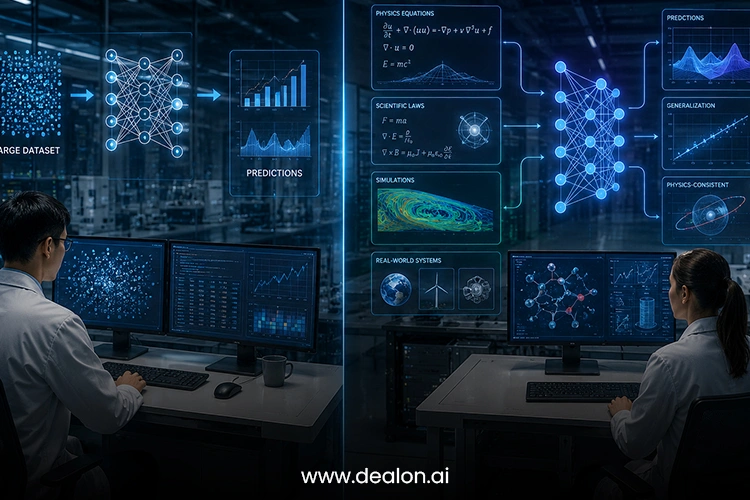
The most critical part of the knowledge of SciML is not the technology; it is the mind. In order to understand why SciML is needed, it is necessary to consider what it is that traditional machine learning is not capable of doing.
Traditional Machine Learning
Standard ML focuses on learning statistical patterns from data. Give it a lot of examples, and it will approximate a function defined in terms of inputs and outputs. There is no physics in the model, nor any awareness of conservation, and the model’s predictions aren’t guaranteed to be physically plausible.
There are three major shortcomings to this approach:
- Learns only patterns from data, without being aware of the underlying system
- Needs a large, labeled, and costly set of data in science
- Thinks of all problems in terms of prediction rather than explanation
Scientific Machine Learning
SciML infuses scientific knowledge into the learning process. The model needs to be both capable of fitting the data and solving the governing equations of the system. There are 3 profound impacts: 1) the models need far less data to learn from; 2) predictions are physically consistent at all times; and 3) there is a much greater generalization ability that goes beyond what is seen in the training distribution.
How Scientific Machine Learning Actually Works
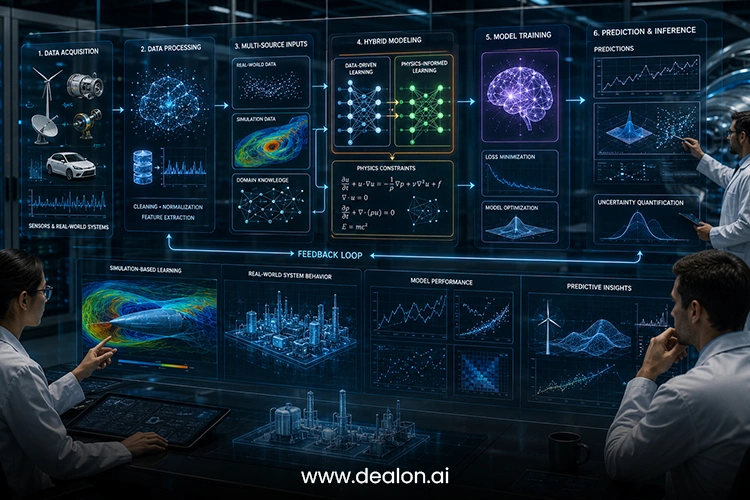
SciML is not one algorithm, but a family of algorithms that differ in how they use data and physics. The knowledge of architecture involves knowledge of which tool to use when.
Data-Driven Learning
The baseline: train model from observed measurements. Even without a knowledge of the physical equations, or when they are too complex to encode, pure data-driven SciML can still be powerful if the training data is sufficiently rich to capture the system’s behavior.
Physics-Informed Learning
In this case, the differential equations governing the problem are built into the loss function—each step of the gradient results in a decrease in both the data error and the equation residual.
Hybrid Modeling
In some parts of a system, knowledge is available (encoded as equations), and some parts are not (learned from data). Hybrid models have a mixture of mechanistic models and learned parts, with a higher accuracy than would have been possible using either approach alone.
Simulation-Based Learning
Numerical simulations cost a lot of money when they are of high fidelity. In simulation-based SciML, one uses a simulator to generate training data and trains a surrogate model that can predict orders of magnitude faster. The behavior of the simulator was learned by the surrogate from the outputs.
The Mathematics Behind Scientific Machine Learning
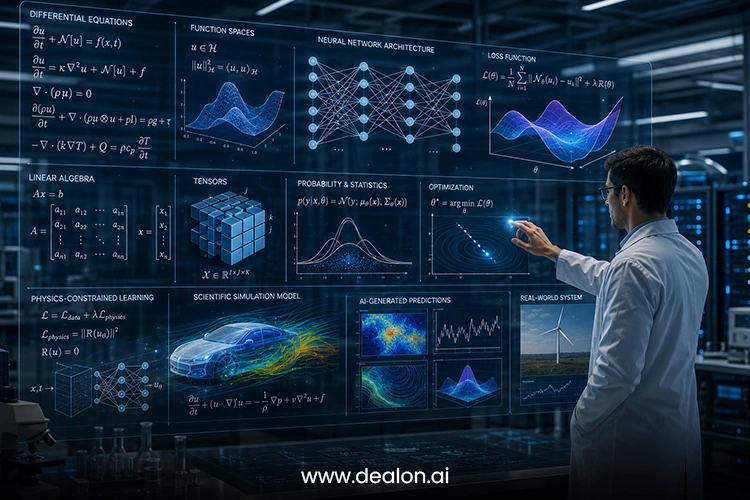
In conventional ML, the reward is proportional to the difficulty level, whereas in SciML, the difficulty level is much greater. Mathematical foundations are not barriers, but enabling ones.
Differential Equations — Teaching AI How Systems Change
Most physical systems are modeled with differential equations, which are relationships between quantities and how they change. ODEs or PDEs apply to: Heat diffusion, fluid flow, population dynamics, chemical reactions, and so on. These equations are directly encoded into the neural network training, making it learn to honor the evolution of the system in time and space.
Linear Algebra — Representing Scientific Data
Scientific data is seldom a single number. It is an array of measurements in space and time: an array of fields, tensors, and matrices of measurements across time and space. The mathematics of linear algebra is used to describe these structures, to transform them, and to reduce high-dimensional observations into learnable structures.
Optimization — How Models Improve
Training a SciML model is the same as optimizing a loss function that is composed of multiple loss terms from both the data and physics. The physics-informed losses also have a very different landscape than typical deep learning losses, which makes the employment of advanced optimization techniques, such as second-order methods like L-BFGS and adaptive gradient methods like Adam, necessary.
Handling uncertainty: Probability and Statistics
Scientific measurements are inaccurate. The parameters of the models are unknown. Confidence intervals, rather than point estimates, should be used for predictions. Bayesian methods and uncertainty quantification have become more and more at the heart of SciML, and models are valuable for the decisions made in the real world.
Why maths is more important in SciML than in standard ML: In standard deep learning, sometimes the model is considered a black box, and good results can be achieved even if there is no understanding of the model.
Physics-Informed Neural Networks (PINNs): The Breakthrough Behind SciML
The Physics-Informed Neural Network is arguably SciML’s most revolutionary idea that kick-started the modern science and machine learning community. PINNs were introduced by Raissi, Perdikaris, and Karniadakis in 2019, and represent a core paradigm shift in the way neural networks are used to interact with physical laws.
What Are PINNs?
This is a neural network that is trained to satisfy two objectives: (1) to match the observed data, and (2) to satisfy the governing differential equations of the underlying physical system. The physical equations are computed at the collocation points across the domain, and the residual is included in the training loss. The network learns a solution that is consistent with the observations and physics.
Why is traditional ML not suitable?
It is not suitable for low-data scientific regimes, such as those in traditional ML. Even with a few boundary measurements, a PINN system is able to reconstruct an entire fluid flow field — because physics can fill in the gaps that data cannot. These equations can be used as an endless source of further supervision, noiseless.
Scientific Machine Learning vs Traditional Simulation: Which Approach Wins?
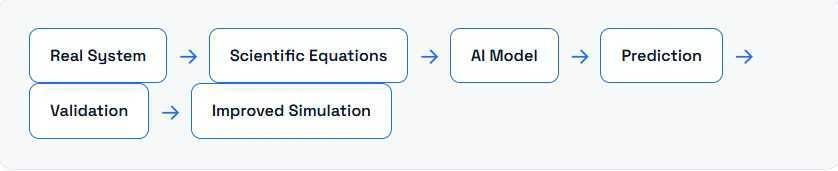
The tried-and-true method of scientific prediction for decades has been numerical simulation: discretize the domain, solve the governing equations iteratively, and wait for the computer to complete. This is not SciML’s intention to replace this process, but instead, completely alter the economics.
| Feature | Traditional Simulation | Scientific Machine Learning |
| Prediction speed | Hours to days per run | Milliseconds after training |
| Physical accuracy | Very high | High with proper constraints |
| Data requirement | Low (equations drive it) | Moderate (some observations needed) |
| Scalability | Computationally expensive at scale | Highly scalable at inference |
| Real-time use | Rarely feasible | Achievable with surrogate models |
| Interpretability | High — every step is visible | Moderate — partially a black box |
| Handling uncertainty | Requires ensemble runs | Can incorporate Bayesian methods |
The strategic insight: “Simulate once, learn forever.” Create a rich training set with expensive high-fidelity simulations, and then train a surrogate model of the simulation that can be used in milliseconds, using SciML. A pattern that is changing engineering design, real-time control, and digital twin deployment is the offline computation and online intelligence.
Real-World Applications of Scientific Machine Learning
Healthcare and Drug Discovery
SciML is revolutionizing the way we can perceive biological systems. Molecular models based on the physics-informed models of protein folding now predict the structures of molecules that took decades to be experimentally determined. To predict efficacy and the toxicity of a drug before any synthesis is carried out, drug-interaction models are used that incorporate biochemical equations with clinical data. Personalized dosing, surgical planning, chronic disease diagnosis, and management are being made possible with digital twins of individual patients – virtual models calibrated from personal health data.
Climate and Weather Forecasting
Climate models are highly mathematical systems, the most mathematically intricate that man has ever constructed. Ensemble forecasting previously was unfeasible because of the high computational cost of running global circulation models, but can be emulated at much lower cost using SciML surrogate models.
Aerospace and Engineering
The computational fluid dynamics (CFD) simulations used in the design of aircraft are very expensive. Using an existing CFD database, SciML models can quickly be used to test new aerodynamic configurations, allowing optimization cycles that could have taken months to complete to be performed in real time. These models have been integrated right into the design software that is used by the big aerospace manufacturers.
Energy Sector
SciML models that include measurement data from past observations, along with atmospheric physics, can improve the performance of renewable energy forecasts, which are more than just predictions of solar irradiance and wind speed hours in advance. Battery management systems can now be used to increase battery pack life and forecast battery failure weeks ahead of time, thanks to the battery degradation models trained using electrochemical equations with operational telemetry.
Manufacturing and Robotics
SciML is used in predictive maintenance systems, which carry out models of the degradation of machinery, including material fatigue equations, in conjunction with streams of sensor data, and use this to predict failure before it occurs. Smart factories are now using digital twins of the entire production line, which are continually updated from real-time data from sensors, to allow for virtual experiments to be conducted without stopping production lines.
Scientific Machine Learning in 2026 — The AI Revolution in Research
Things have changed dramatically in the field over the last 2 years! SciML has advanced from being a science proof-of-concept to being used to deploy science at scale. There are a number of trends in the here and now.
Development of science models
In the scientific field, large pre-trained models, similar to GPT for language, are currently being developed. Pre-trained models, which are trained on a large library of physics simulations, can then be fine-tuned for specific applications in hours, as opposed to weeks. The science modeling world is seeing its “foundation model moment.
Autonomous Laboratories
Thousands of experiments are being conducted in robotic labs driven by Artificial Intelligence every day, with the models from SciML making sense of the results and updating hypotheses, and then designing the next experiment autonomously. Previously, a decade-long process has now been reduced to months in the drug discovery process.
Scientific Machine Learning Models and Frameworks You Should Know
There have been many improvements in the tooling ecosystem for SciML. These are the frameworks that are influencing the field.
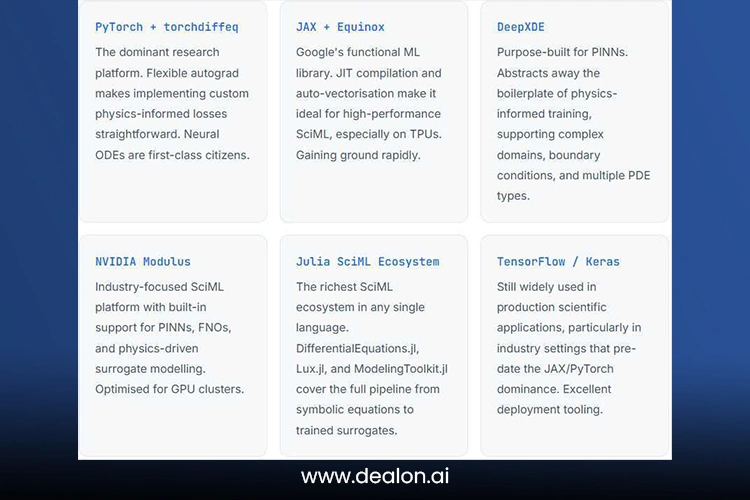
Scientific Machine Learning vs Artificial Intelligence vs Deep Learning
The terms are often used interchangeably, which leads people to misconceptions about what SciML is and does. The distinctions matter.
| Technology | Main Goal | Relationship to Science | Typical Data Need |
| Artificial Intelligence | Simulate intelligent behavior | Agnostic — can be applied anywhere | Varies widely |
| Machine Learning | Learn patterns from data | Treats science problems as data problems | High |
| Deep Learning | Learn complex representations via neural networks | Powerful but physics-agnostic | Very high |
| Scientific ML | Combine AI with scientific knowledge | Physics, equations, and constraints are core | Low to moderate |
It’s all about thinking in the following way: Deep Learning is a tool. Machine Learning is an approach to solving a problem. Scientific Machine Learning is a mental approach to modeling — one that says that intelligence and physical understanding can not go head-to-head; they must work together.
Challenges and Limitations of Scientific Machine Learning
There is a need to recognize the limits of what SciML cannot do, in order to be intellectually honest. Rather than arguments against the field, these are open problems that form the frontiers of the field.
Data Quality Problems
SciML does not eliminate the need to use data, but it does decrease the amount of data required when used in conjunction with standard ML. Biased and noisy measurements can affect the physics loss and data loss, both of which are not easy to diagnose and separate. The cost of scientific data collection is high, and poorly-designed data collection campaigns are still a bottleneck.
Computational Cost
Training physics-informed models is more time-consuming than training conventional neural networks of similar size. Computing PDE residuals at thousands of collocation points per gradient step costs a lot. Difficult problems to train at scale are still a challenge, such as full 3D fluid dynamics.
Model Interpretability
Of course, SciML models can be interpreted more easily than black-box models, but they are still more difficult to interpret than traditional numerical simulations. Clear mechanistic explanations needed by regulators and the safety-critical industries are not always provided by learned models, even those informed by physics.
Balancing Physics and Data
If the physical model is slightly inaccurate, if the governing equations are approximations, then it can actually adversely affect performance by forcing the learned model away from the true solution. The selection of physics complexity and balancing the amount of physics-to-data loss weighting is an art form that requires a high level of domain knowledge.
Validation and Trust
Numerical simulators can be tested against analytical solutions and test cases with long experience, which are well known and understood. This is not the culture that has come into being for SciML models. Establishing community trust for using SciML predictions to guide decisions in real-world safety-critical environments continues to be a challenge.
Scientific Machine Learning Across Industries — Adoption Breakdown
| Industry | Current Impact | Future Potential |
| Healthcare | Drug discovery acceleration, protein structure prediction, and imaging analysis | Personalized medicine, real-time digital twins of patients |
| Aerospace | CFD surrogate models, structural optimization, flight simulation | Fully autonomous design exploration, self-optimizing systems |
| Energy | Renewable forecasting, battery degradation modeling, and grid management | AI-designed materials for energy storage, smart grid autonomy |
| Automotive | Crash simulation surrogates, engine optimization, and NVH prediction | Continuously self-optimizing vehicle systems |
| Climate | Regional climate downscaling, extreme event prediction, ocean modeling | Climate intervention planning, planetary-scale digital twins |
| Manufacturing | Predictive maintenance, process optimization, quality control | Zero-defect factories, fully autonomous process control |
How Scientists and Engineers Can Start Learning Scientific Machine Learning
SciML is an interdisciplinary project, and as such, the learning path is interdisciplinary. The good news is, you don’t have to know everything at once. This is a roadmap arranged in a structured manner.
| 1 | Learn ML Foundations Know about supervised learning, training of neural networks, loss functions, and backpropagation. A good introduction is provided by the courses from fast.ai or Andrew Ng’s Deep Learning Specialization. |
| 2 | Strengthen the Mathematics Concentrate on ordinary and partial differential equations, linear algebra, and numerical methods. No need for a PhD in mathematics, but you should be able to read and manipulate equations. |
| 3 | Understand Scientific Computing Understand finite difference methods, finite element methods, and traditional numerical solvers. Only in this context can one understand when and how to swap them for learned models. |
| 4 | Build Your First PINN Generate and use a simple PINN to resolve a 1D heat equation or Burgers equation. Take advantage of DeepXDE or PyTorch. Make comparisons with the analytical solution. At this point, it’s intuition, and not theory anymore. |
| 5 | Apply to Real Scientific Problems Select a problem from your own subject area—small-scale, careful testing and publishing. The SciML community is very active, collaborative, and interested in new applications and case studies. |
The Future of Scientific Machine Learning — From Prediction to Discovery
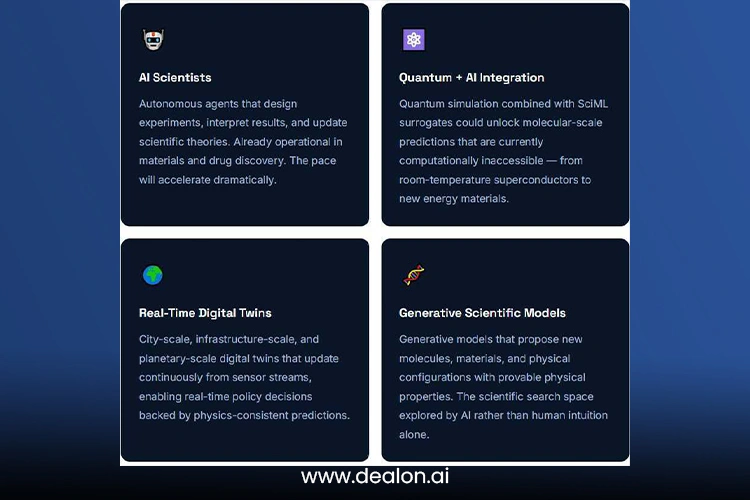
SciML has demonstrated its ability to predict. Whether it can be discovered or not will be decided in the next 10 years. Fitting known systems into the framework of known science and proposing new scientific knowledge is the challenge of the field.
Frequently Asked Questions
1. What is Scientific Machine Learning?
Scientific Machine Learning aims to leverage AI, data, and scientific laws to tackle challenging problems and enhance scientific modeling.
2. What are the differences between scientific machine learning and traditional machine learning?
While Sciml combines data and scientific principles and equations, Standard ML learns only from data.
3. What are Physics-informed neural networks (PINNs)?
Using both data and physical laws, PINNs are AI models that can make accurate scientific predictions.
4. Is scientific machine learning the future of AI research?
Of course, SciML will have a significant impact on the future of AI research for smartening up scientific discovery and simulations.
5. What are some of the industries where scientific machine learning is being applied?
SciML is applied in healthcare, aerospace, energy, climate science, manufacturing, and engineering.
6. Is a certain level of expertise in mathematics required?
Although initial knowledge of calculus, linear algebra, statistics, and physics is helpful, it is not necessary upfront.
7. Which programming languages are used in this?
Usually using Python, Julia, MATLAB, and C++.
8. What are the best tools used for scientific machine learning?
Some of the popular tools include PyTorch, TensorFlow, NVIDIA Modulus, DeepXDE, and Julia SciML.
9. Can the traditional simulations be replaced by scientific machine learning?
No, it’s not a replacement for traditional simulations, but it makes them quicker and more efficient.
10. How to start a career in scientific machine learning?
Knowledge about machine learning, math, programming, and creating projects using SciML frameworks.



