
Table of Contents
How is AI revolutionizing Industrial Automation?
While robotics is one of the obvious areas in which AI is making a significant contribution to industrial automation, it’s not the only one. In the modern era, industries are leveraging AI to forecast failures and enhance their products, to optimize resources, and make rapid decisions. Here are some of the major industries that are transforming through the use of AI:
| Industrial Area | AI Application | Main Benefit |
| Manufacturing | Smart factories | Higher productivity |
| Maintenance | Predictive analytics | Reduced downtime |
| Quality control | Computer vision | Fewer defects |
| Supply chain | AI forecasting | Better planning |
| Robotics | Autonomous systems | Faster operations |
| Energy | AI optimization | Lower costs |
What is AI in Industrial Automation?
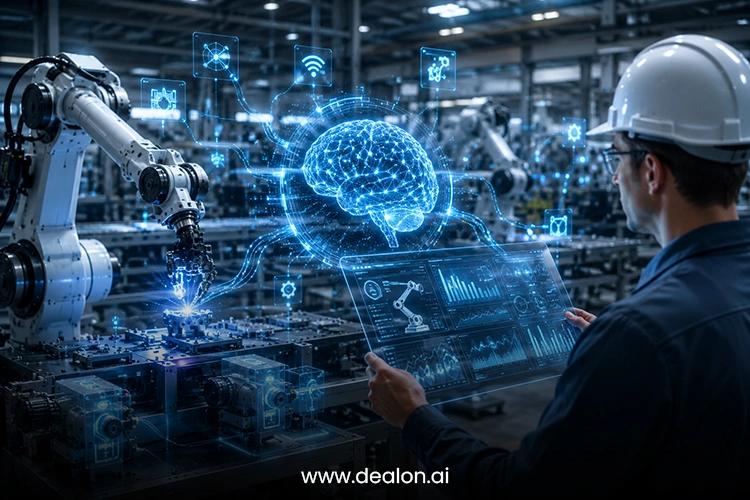
Industrial automation has always been about making tedious, hazardous, and accuracy-demanding jobs more efficient. However, the inclusion of AI takes the game to a whole new level. Rule-based automation is the type of automation that has been used in factories since the 1970s, and it performs a predetermined sequence of instructions. It cannot adapt to changing environments or improve its efficiency without human intervention.
AI-driven automation brings in the machine learning systems that can analyze the operational data all the time, identify patterns that would be unattainable for a human operator to see, and make choices that haven’t been programmed for all potential situations.
This includes multiple interwoven fields such as industrial AI (AI models trained from operational and engineering data), smart manufacturing (production systems that are connected and self-optimizing), and autonomous decision-making (AI without human approval within a defined risk boundary).
Also Read: Grok vs Gemini: 7 Proven Differences That Matter in 2026
From Industrial 1.0 to Industrial 5.0: The Evolution of AI
Pre-1970s
Manual Industrial Processes
They relied heavily on manual labor to complete tasks; workers were skilled in assembly, inspection, and material handling tasks in the production lines. Consistency was human-limited.
1970s–1990s
PLC-Based Automation
Programmable Logic Controllers (PLCs) introduced deterministic repeatable machine control. Robots welded the bodies of vehicles; a CNC machine cut metal to specification. Strong and very inflexible. Change the product, re-program from scratch.
2000s–2015
Industry 4.0 and Connected Factories
The adoption of sensors, networking, and cloud computing brought about the Internet of Things in the factory. Machines began to produce data, but a lot was collected without any analysis.
2016–2024
AI-Powered Autonomous Industry
These are the powerful tools of deep learning, computer vision, and massive data processing that made true industrial AI a reality—the shift from theory to deployment of predictive maintenance.
2025–present
Industry 5.0 — Human + AI Collaboration
Human-centricity is the direction of the pendulum in AI-enhancing manufacturing. The story of collaborative robots, AI decision-support tools, and workforce augmentation takes the place of the pure automation story—the objective: sustainable and resilient, first for humans, and AI to complement, not supplant.
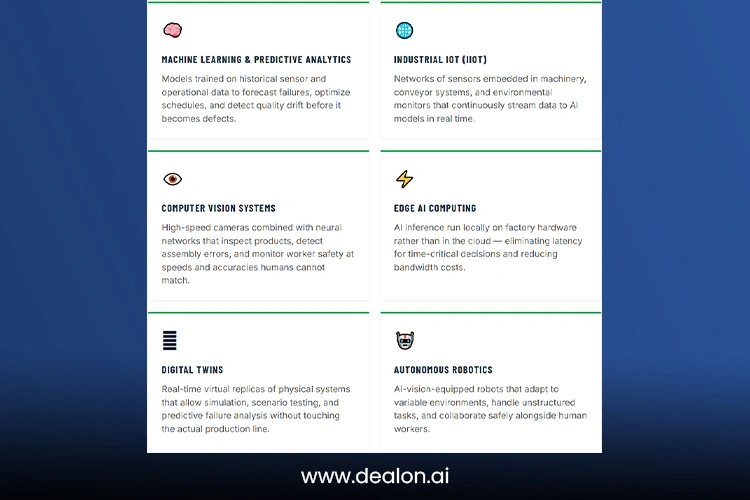
Understanding the technologies that power AI in industrial automation
The smart factory is not powered by an individual AI system; it’s a multi-layered technology system where one element boosts the performance of another.
15 Powerful Ways AI Is Transforming Industrial Operations
| USE CASE 01
Predictive Maintenance AI enables the monitoring of vibration, temperature, and acoustic signal from equipment to detect faults hours or days before they happen, thus preventing unwanted, expensive machine downtimes. |
| USE CASE 02
Automated Quality Inspection Computer vision systems are able to scan and measure all of the units in a production line in a matter of milliseconds and can identify micro-defects that are invisible to the human eye at production speeds that can outperform human teams significantly. |
| USE CASE 03
Smart Robotics AI-powered robots quickly and intelligently reconfigure the lines, reposition the parts, and learn new tasks without extensive reprogramming — significantly reducing changeover time. |
| USE CASE 04
Production Optimization AI models constantly update production plans, resource allocation, and machine load based on the real-time demand signals or constraints. |
| USE CASE 05
Supply Chain Intelligence AI demand forecasting models analyze weather, economic indicators, social media trends, and past orders to forecast stock requirements weeks ahead of time. |
| USE CASE 06
Energy Optimization AI analyzes real-time energy use of equipment, and automatically adjusts high-power use to more efficient times of day to reduce energy costs by significantly. |
| USE CASE 07
Workplace Safety Monitoring Vision systems and wearable sensors identify unsafe behavior, proximity violations to heavy machinery, and ergonomic risks, identifying hazards before they happen. |
| USE CASE 08
Real-Time Decision Making AI dashboards aggregate data from thousands of sensors and prioritize operational insights to plant managers in seconds and not atthe end of the shiftt. |
| USE CASE 09
Autonomous Guided Vehicles AI-guided AGVs navigate the factory, moving materials around dynamically, avoiding obstacles and humans in real time. |
| USE CASE 10
Demand-Driven Manufacturing AI connects sales and order information in real-time with production plans, allowing for “Just-In-Time” (JIT) manufacturing with minimal buffer stock. |
| USE CASE 11
Process Parameter Optimization As conditions change over time, AI is constantly adjusting the machine’s parameters—temperature, pressure, speed, and tool wear compensation—to ensure maximum output and quality. |
| USE CASE 12
Digital Twin Simulation Virtually testing various production configurations, tooling changes, and layout redesigns, before making any physical changes, saves cost and time from doing things the hard way. |
| USE CASE 13
Waste Reduction AI’s ability to recognize patterns in material waste around the cutting, molding, and assembly process and make recommendations for process improvements to drastically lower scrap rates. |
| USE CASE 14
Automated Documentation Operational data is automatically translated into compliance reports, quality certificates, and maintenance logs with the help of AI, thereby reducing the administrative workload for engineers. |
| USE CASE 15
Supplier Risk Intelligence AI is used to track supplier performance, geopolitical indicators, and logistics data, and to alert to any supply chain issues that could halt production. |
Smart Factories: How AI Is Building the Future of Manufacturing
A smart factory is one in which AI optimizes all machine, system, and process data, connections, and monitoring. The physical factory turns into a cyber-physical system in which data can flow freely.
Analyzing real-time data and enabling actions for Connected Machines
The machines (CNC, robots, conveyor, and environment control) in a smart factory provide a constant exchange of information about their operation. AI platforms are able to consolidate it and identify anomalies, inefficiencies, and optimization opportunities in real time, as opposed to at the end of the shift.
Autonomous Production Lines
At BMW and Toyota, AI systems are employed to coordinate multiple robots in multi-robot assembly cells that self-coordinate, self-inspect, and self-correct without any humans involved. In certain Samsung facilities, the production shift is so “lights-out” that electronics manufacturers like Samsung operate where automated systems perform tasks with limited human intervention.
Predictive Maintenance: The Biggest Industrial AI Use Case
| Traditional Maintenance | AI Predictive Maintenance |
| Fix the equipment after failure | Predict failures before they occur |
| Scheduled checks on fixed intervals | Real-time condition monitoring |
| High unplanned downtime costs | Downtime reduced significantly |
| Parts replaced on schedule, no need | Parts replaced when data says so |
| Reactive — damage already done | Proactive — failure prevented |
Simply put, the mechanical principles involve vibration monitors, thermal cameras, acoustic monitors, and power consumption meters that provide ongoing measurements. Machine learning models that are trained to look at historical failure signatures are able to detect the early signs of bearing wear, lubrication breakdown, and electrical fault — typically 72–168 hours in advance of catastrophic failure. Priority Work Orders are automatically generated for Maintenance teams.
An unplanned equipment failure in heavy industry, such as steel, oil refinery, and paper mills, can cost a lot of money. Predictive AI can be a very cost-effective investment, especially when it can help you save time and effort.
AI Robotics: From Automated Machines to Intelligent Workers
In the 1990s, the industrial robot was a strong but highly rigid machine, which was programmed to perform precise movements in a carefully controlled environment. If they did not play out of pattern, it didn’t work. Overall, AI has revolutionized robotics, particularly in its capacity to enhance the capabilities of intelligent machines.
Industrial Robots
Today, traditional articulated robots incorporate AI vision systems to cope with multiple part locations, adjust their grasp force to material properties, and self-calibrate for tool wear.
Autonomous Mobile Robots (AMRs)
AMRs are different from the fixed-route AGVs of previous decades, navigating dynamically in spaces that shift, obstacles move, and shared spaces with humans—using LIDAR, cameras, and AI path-planning.
Digital Twins: The Hidden Technology Behind Smart Industries
A digital twin is an ongoing virtual copy of a real machine, production line, or even factory. It consumes live data from its physical equivalent and faithfully replicates it.
The advantage of simulation is that engineers are able to make changes, simulate failures, and even optimize configurations in the virtual environment before they make any real-life changes. Modeling pharmaceutical companies can simulate the impact of a batch process change on product consistency. A manufacturer of an automatic system can perform modeling of the effect of the line reconfiguration on throughput.
- Minimize risk: test changes prior to impact on production.
- Reduce expenses: avoid physical prototypes and trials.
- Optimize continuously for efficiency – via virtual experimentation.
- Test for failures: Simulate degradation using AI models on the twin to predict failures before they occur on the real machine.
AI in Supply Chain and Logistics: Beyond Factory Floors
Industrial AI is not limited to the factory gates! These efficiency gains are also seen in the supply chain, both upstream and downstream, and sometimes at the largest gains.
Demand Forecasting
The AI models combine dozens of demand signals—such as orders, point-of-sale data, economic data, weather, social sentiment, and more—to deliver rolling demand forecasts that dynamically adjust. AI has cut the error in forecasting significantly compared to statistical methods for the top consumer goods companies. The top consumer goods companies have seen an improvement of 40-60% on forecast error when using AI versus statistical methods.
Warehouse Automation
Robotic picking systems, automated picking lines, and intelligent slotting algorithms that are coordinated by AI help to optimize throughput and minimize labor and errors in distribution centers.
Route Optimization
Unlike a static routing calculation, AI logistics platforms can calculate the optimal delivery routes in real-time, considering traffic, weather, load limits, driver hours, and any changing delivery orders.
Real-Time Inventory Management
AI ensures that stock levels are kept at their lowest possible but still meet demand forecasts, thus lowering carrying costs and keeping the fill rate high. This is not possible without automation for manufacturers with thousands of SKUs.
AI vs Traditional Automation: What Is the Real Difference?
| Traditional Automation | AI Automation |
| Follows fixed, pre-programmed rules | Learns and improves from operational data |
| Reactive — responds after an event | Predictive — acts before events occur |
| Limited flexibility; costly to change | Adaptive; reconfigures from new data |
| Requires constant human monitoring | Makes autonomous decisions within guardrails |
| Optimized once at installation | Continuously self-optimizes over time |
| Handles only anticipated scenarios | Generalizes to novel situations |
Business Benefits of AI in Industrial Automation
Reduced Operational Costs
Typical energy and waste reduction programs can improve OEE and reduce operational costs in 2-3 years after they are implemented, while predictive maintenance is routinely implemented and achieves a similar savings rate.
Lower Equipment Downtime
The number one most costly manufacturing inefficiency is unplanned downtime. The AI predictive maintenance programs routinely achieve a 30 – 50% reduction in unplanned outages, which translates into significant revenue impact.
Improved Product Quality
CVQI detects more defects at higher throughput than human inspection, thus reducing warranty calls, recalls, and customer returns.
Better Resource Management
Unlike silo optimizations that focus on one aspect of the machine, materials, energy, and labor, AI can deliver efficiencies at all three simultaneously — and more.
Faster Decision Making
Plant managers with AI decision-support tools make better decisions on operations in minutes using full information, versus hours using incomplete reports.
Challenges of Implementing Industrial AI
- High up-front costs: Capital expenditures for enterprise-class AI infrastructure, sensor networks, and integration are expensive, and larger manufacturers can afford them, but smaller manufacturers cannot.
- Legacy equipment compatibility: Old equipment can be difficult to connect and integrate sensors to provide the data AI systems need. The costs for retrofitting are high.
- Large volumes of clean, labeled data are required for data availability and quality for AI models. Lots of industrial settings have inadequate data cleanliness or inadequate historical data.
- Limited access to talent: The manufacturing and AI/data science fields are not well-connected. There is a real and increasing gap in talent.
- Integration complexity: In industrial environments, a variety of system components, including PLCs, SCADA, MES (Manufacturing Execution Systems), and ERP (Business Process Management), are used and do not always communicate in the same data language. The most difficult component of most projects is integration.
Cybersecurity Risks in AI-Powered Industrial Systems
The easy integration of factories with AI platforms and the Internet greatly expands the attack surface.
Key Threat Vectors
- Industrial IoT vulnerabilities: Thousands of sensors, all of which are connected, and all of which can be an entry point for an attacker.
- AI system manipulation: Enacted by adversaries, attacks that feed false data into AI models, resulting in wrong decisions or commands to a robot, false maintenance alerts, and masking real failures.
- Data Breaches: Operational data and production IP are good targets for industrial espionage.
- Ransomware attacks: Ransomware attacks on industrial control systems have had a devastating effect on critical manufacturing processes around the world, resulting in lost time and millions of dollars.
Protective Measures
- Isolation of OT (operational technology) and IT systems
- A full end-to-end data encryption solution for IIoT communications.
- Automated anomaly-based monitoring for industrial network traffic using AI models.
- Industrial systems should use zero-trust access controls across interfaces. All accessing interfaces to industrial systems are zero-trust.
Human Workers vs AI: The Future of Industrial Jobs
The fear that AI will take away industrial jobs is understandable– it should not be ignored. Manual jobs that can be broken down into repetitive physical operations — such as manual assembly, basic inspection, or data entry — will be automated. This is actually what’s occurring.
However, the whole situation is more complicated. AI creates new roles: Over the last 10 years, new jobs like AI systems operators, sensor network technicians, digital twin engineers, robotics coordinators, and data quality analysts have emerged in the era of AI.
Reskilling must be offered in a real way and not as a token reskilling initiative for workers who lose their jobs due to routine job changes. The power of industrial AI will be lost to countries and companies without workforce transition investments. For those that do, there is social disruption as well as efficiencies.
The Industry 5.0 concept is relevant to this: it’s not about replacing humans, but about working together with AI. AI assumes the risky, repetitive, and easy-to-do tasks. Humans bring judgment, creativity, context, and an ability to deal with truly novel situations; something AI can’t yet duplicate in complex industrial environments.
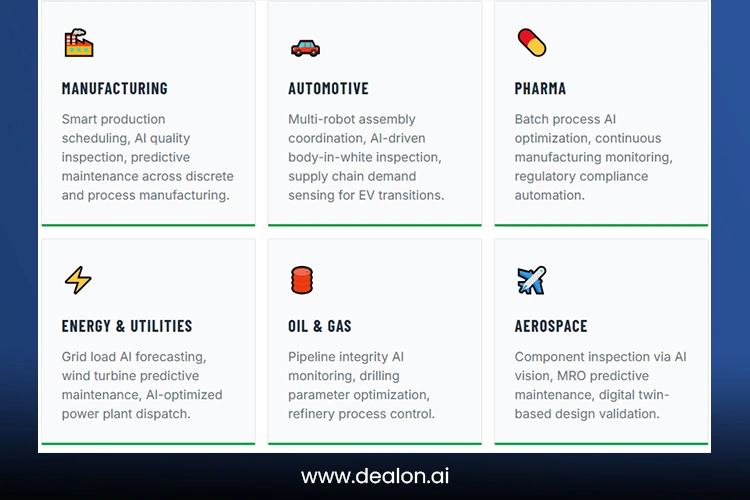
AI in Industrial Automation Across Major Industries
Cost, ROI & Adoption: Is Industrial AI Worth the Investment?
It relies upon scale and also application. It can take as little as 6 months to break even with a targeted predictive maintenance deployment for a machine worth a lot of money. The transformation of a smart factory is a program that will take multiple years and cost millions of dollars for an enterprise-wide transformation.
| Typical Cost Ranges (2026) | ROI Timeline |
|
Point solution (single use case): $50,000–$500,000 Departmental AI platform: $500,000–$5 million Enterprise smart factory transformation: $10 million+ |
Predictive maintenance: 6–18 months payback Quality inspection AI: 12–24 months Supply chain AI: 18–36 months Full smart factory: 3–7 years |
The highest return to the investor is realized by high-volume manufacturers that have expensive equipment and a high cost of downtime. Faster implementation by companies with specific data infrastructure & technical teams. Even when it comes to reasons why people hesitate to implement digital, some need to start with one use case that is high impact and then move into other areas over time.
The Future of AI in Industrial Automation (2026-2035)
By 2030, lights-out manufacturing in certain product categories in high-volume, stable demand industries will be the norm.
AI-powered supply chains – from demand signals to delivery: End-to-end autonomy of supply chains, from demand signal to delivery, will be technically feasible at scale within the decade.
In the near future, research will translate to the commercial use of advanced robotics. These are general-purpose industrial robots that are able to do dozens of different jobs without having to be reprogrammed.
Self-learning industrial systems: AI systems that can self-train as their operational data comes in, and keep their accuracy as things change over time, will be commonplace in industrial systems.
Local AI supremacy: With more powerful and affordable edge chips, most industrial AI inference is going to take place on the edge, rather than in the cloud, where latency is an issue.
Human-AI teaming models: Human-AI decision-making structures will be formalized, the AI will process the data, and the human will make decisions on new scenarios.
Is AI the right automation solution for Your Business?
It is right for you if you have:
- Operating data of large quantities of existing equipment.
- High volume, repetitive manufacturing processes.
- The cost of upkeep or regular unexpected shutdowns.
- Consistency issues affecting the quality of the products are affecting customer satisfaction.
- There is a significant need to improve efficiency to be competitive.
- Leadership skills (or hiring ability) to lead the implementation
- Commitments for transformation over multiple years by the executive.
Frequently Asked Questions
What is AI in industrial automation?
AI in industrial automation involves the application of AI to automate, monitor, and optimize industrial processes using data analysis, machine learning, and smart decision-making.
What are the applications of AI in manufacturing?
Predictive maintenance, quality inspection, production optimization, robotics, demand forecasting, real-time factory operation monitoring, etc., are all examples of how AI is applied in the manufacturing sector.
What is an example of industrial AI?
In the context of Industry 4.0, examples are the use of AI-powered robots, automated defect detection systems, smart factories, digital twins, and predictive equipment maintenance.
What are the benefits of AI in the factory?
By minimizing downtime, early error detection, resource optimization, enhanced safety, and quick decision-making, AI boosts efficiency.
In what ways does robotics fit into the industrial AI equation?
In the field of robotics, AI can be used to develop robots that have the capacity to learn and adapt to their environment, and to carry out complex tasks with high accuracy, flexibility, and efficiency.
How will AI automation help your business?
The benefits are reduced costs, improved productivity, better product quality, waste reduction, greater safety, and improved operational insights.
Is Artificial Intelligence taking the place of industrial workers?
The primary way AI is reshaping the world of industry is by taking over routine tasks and providing opportunities for employees to concentrate on more value-added tasks.
What is the price of industrial AI?
The costs are dependent on the size, technology, and industry. Small solutions can be based on minimal investments, and smart factory systems require large investments in infrastructure.
How is AI in industrial automation expected to evolve?
The future will see autonomous factories, the rise of advanced robotics, smart supply chains based on AI technology, digital twins, and a more human-machine collaboration.



