
Table of Contents
Grok vs Gemini: What to choose?
For those who don’t have much time to spare, here is the most unambiguous summary of winners for each workflow. The longer answer is included below, but this table reflects 80% of the cases.
| User Type | Better Choice | Why |
| Researchers | Gemini | 1M token context, Deep Research, Google Scholar integration |
| Content creators | Grok | Real-time trends from X, faster turnaround, conversational tone |
| Developers | Grok | Competitive SWE-bench score (~75%), low API cost, fast iteration |
| Students | Gemini | Free tier is more generous, Google Docs integration, multimodal |
| Business users | Gemini | Native Google Workspace, enterprise controls, audit trails |
| Real-time info seekers | Grok | Live X data — no other model gets this signal |
| Casual everyday use | Either | Both handle everyday questions well; choose by ecosystem |
The Key to Grok vs Gemini
Grok and Gemini are advanced AI chatbot systems capable of comprehending queries, producing human-like responses, and lending aid in areas such as writing, coding, research, and problem-solving.
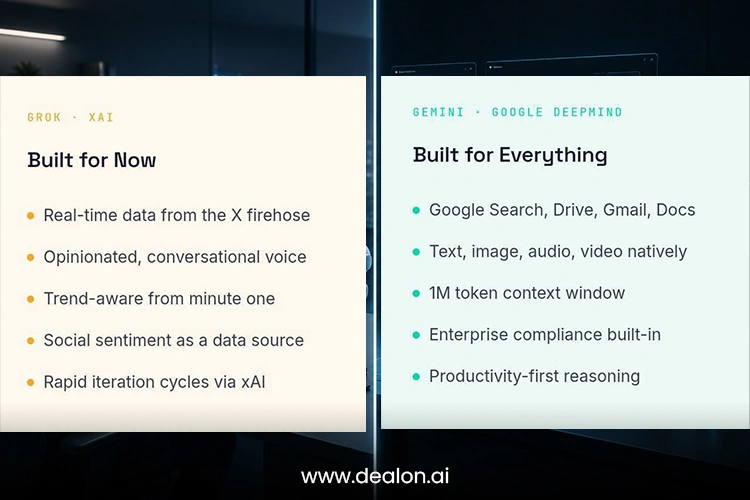
Grok is an AI assistant developed by xAI (Elon Musk’s AI company). Not only is it well integrated into X (formerly Twitter), but it’s also noted for its real-time information, trending insights, and a more natural tone, sometimes funny.
Google DeepMind has created its AI assistant, named Gemini. It functions on Google’s platform – the search, Gmail, Docs, Drive, Android, and more. A remarkable trait of Gemini is its ability to think well, process multimodal information (text, image, audio, video), and operate efficiently and productively.
To summarize, Grok is designed to handle social and trending data. At the same time, Gemini is engineered for the depth of its reasoning capabilities, productivity, and seamless integration with Google’s suite of tools.
Also Read: The Benefits of Chatbots: An Essential Tool for Companies in 2026
The Difference of Core Philosophy: Real-Time Intelligence vs Connected Intelligence
The key to Grok vs Gemini is the initial decision in both cases: What problem each company was solving. Knowing this will help you from asking the right tool the wrong question.
xAI vs Google DeepMind: Origins & Ecosystem
The Grok vs Gemini are two assistants who hail from very different backgrounds — and that’s what influences where they get their training data and how they run their businesses.
Grok: Born from X
Elon Musk launched xAI in 2023 with a certain thesis: The “best” AI model would be one that was trained on the raw and most up-to-date source of human thought. That sign is X (previously known as Twitter). The X firehose is hundreds of millions of posts a day — a set of data that Grok was trained on, making it feel like it has real trending discourse that you can’t get from a static set of data. All of Grok’s training runs are now powered by one of the world’s largest GPU clusters, the Colossus supercluster. By the start of 2026, xAI was already out with Grok 4.3, which featured video input and document generation, in their aggressive release schedule.
Gemini: the product of Google’s AI Decade
The result of Google DeepMind’s research is the birth of Gemini, an amalgamation of the research behind AlphaFold, PaLM, and Bard into one foundation model program. It has benefited from Google’s distinctive data advantages: the world’s largest search index, the video corpus of YouTube, the usage signals provided by the Android operating system, and decades of research in the area of understanding documents. In mid-2026, Google Workspace, Android assistants, and Google AI Studio for developers will be powered by the default engine of Gemini 3.1 Pro.
Ecosystem advantage
The advantage that Grok has is recency: being able to access live conversations. The strength of Gemini is the breadth – the integration with tools used billions of times a day by people. There is no one right answer — it’s a matter of what you’re looking to achieve.
Head-to-Head Performance: 7 Tasks That Reveal the Winner
Both models were benchmarked across seven real-world tasks. Here’s the scorecard — then the breakdown.
|
Task |
Grok |
Gemini |
| Reasoning & Logic
Multi-step, GPQA Diamond |
Strong |
Winner ✓ |
| Coding
SWE-bench Verified |
Winner ✓ | Close |
| Research & Fact-Finding
Current events, sourcing |
Winner ✓ | Strong |
| Writing & Creativity
Voice, marketing, stories |
Strong | Winner ✓ |
| Image & Multimodal
Vision, documents, diagrams |
Limited | Winner ✓ |
| Productivity
Email, docs, summaries |
Capable | Winner ✓ |
| Everyday Conversation
Natural dialogue, context |
Winner ✓ | Formal |
| Category wins | 3 | 4 |
They were evaluated on seven real-world tasks on both models. Let’s look at the scorecard and then the breakdown.
Reasoning & Complex Problem Solving
Gemini’s advanced thinking mode enhances its performance on tasks that require scientific reasoning, multi-step analysis, and complex reasoning. Grok can be useful, but it would be better at giving specific answers.
Coding Ability
Grok is quick to produce working code, and Gemini has a larger context window, resulting in more structured implementations when it comes to understanding giant codebases.
Research & Fact-Finding
Grok is useful for current events, leads for real-time information via X. Gemini is more effective in structured research, which involves more than just one source, and requires analysis.
Writing & Creativity
Grok is less formal and more creative and suited to social content. For reports, articles, and professional writing, Gemini delivers more polished, structured writing.
Image & Multimodal Understanding
It is currently stronger for multimodal tasks with its ability to analyze images, videos, audio, and documents in one workflow. Gemini has a clear edge.
Productivity Tasks
The ability to integrate with Gmail, Docs, Sheets, and other Google services is a significant edge for productivity in the workplace.
Everyday Conversations
Grok is more casual and funny in its conversation, and Gemini is more structured and assists in its conversation.
Multimodal Intelligence: Where Gemini Takes the Lead
From the ground up, Gemini was designed to reason across modalities all at once, rather than add image recognition to a language model, by training on text, image, audio, and video together. This yields real differences in the quality of their reasoning with mixed-mode tasks.
| Modality | Grok 4.3 | Gemini 3.1 Pro | Winner |
| Text understanding | Excellent | Excellent | Tie |
| Image analysis | Basic | Deep, native | Gemini |
| Video analysis | Added 2026 | Full support | Gemini |
| Audio/speech | Not supported | Native | Gemini |
| PDF/docs | Text extraction | Full layout understanding | Gemini |
| Code + image reasoning | Partial | Strong | Gemini |
Gemini’s ability to process various types of text, including lecture notes, scientific texts, and even invoices and contracts, is a real productivity boost for students uploading lecture notes, researchers reading scientific papers, and businesses dealing with invoices and contracts. Grok has been able to deal with pictures since 2026, but this is not a strong suit.
Coding & Developer Performance: Grok vs Gemini for Programmers
Code Generation
Strong code generation support for Python, JavaScript, TypeScript, Rust, and Java. Grok outputs more succinct and immediately runnable code, while Gemini outputs more commented, production-ready code with more meaningful variable names. For fast prototyping, Grok. Hand-offs to a team: Gemini.
Debugging Complex Errors
The long context window of Gemini (up to 1M tokens) allows you to copy and paste a full stack trace, files, and environment config all in one go. This alters the debugging assistance. Grok’s 64K tier (on Heavy expandable to 1M) is appropriate for most bugs, but is a constraint on large monorepos.
Understanding Large Codebases
Here, the context window size directly correlates with usefulness. The result is that Gemini can ingest an entire codebase in one pass and give you more coherent architecture suggestions. Grok is updated with the SuperGrok Heavy tier – and for a high price.
API and Software Development
Grok’s API via console.x.ai is extremely competitively priced — Grok 4 Fast costs about $0.20 per million input tokens, compared to the $2.00/M price for Gemini 3.1 Pro. This is a significant difference where the workload is an API at scale, and cost is a critical factor.
Programming Language Support
| Language | Grok | Gemini |
| Python | Excellent | Excellent |
| JavaScript / TypeScript | Excellent | Excellent |
| Rust | Good | Strong |
| Java | Good | Strong (Android native) |
| Go | Good | Good |
| SQL | Good | Strong (BigQuery integration) |
Gork vs Gemini in terms of Context Window, Memory & Long Conversations
Context length is a significant aspect to consider for power users, as it influences the quantity of information that an AI can handle simultaneously. The larger the context window, the longer the document, research paper, codebase, or meeting notes that the user can handle with a better understanding and consistency, throughout a conversation.
The main difference is that in the standard plan, Gemini offers a 1M-token context window, whereas Grok only has 64K tokens for regular users but sticks to 1M tokens on higher-tier plans. This is why Gemini is more appropriate for work that requires significant information, like book analysis, legal documents, or intricate software ventures. A bigger context window gives more flexibility to users for long and detailed workflows for most users.
Accuracy, Hallucinations & Trustworthiness
Both models have the same flaw — AI hallucinating the correct facts, but wrong ones. The question is, who is the one who doesn’t hallucinate as much in practice, and who provides more signals when it gets shaky?
When Gemini is uncertain about something, it’s more likely to hedge explicitly, and its Deep Research mode provides default sources, further clarifying errors. The confident and direct voice of Grok is appealing, but it can make for trickier outputs when there is some ambiguity. Its real-time X access also brings “noise” to responses concerning current events – in a way that’s comparable to what’s found on social media.
If accuracy is important (medical information, legal questions, financial data, scientific claims, etc.), always take both models with a grain of salt, rather than with a spoonful. While it’s slightly easier to check Gemini’s citation style, its real-time data makes it easier to find. Neither takes the place of primary source checking.
Pricing, Plans & Hidden Costs
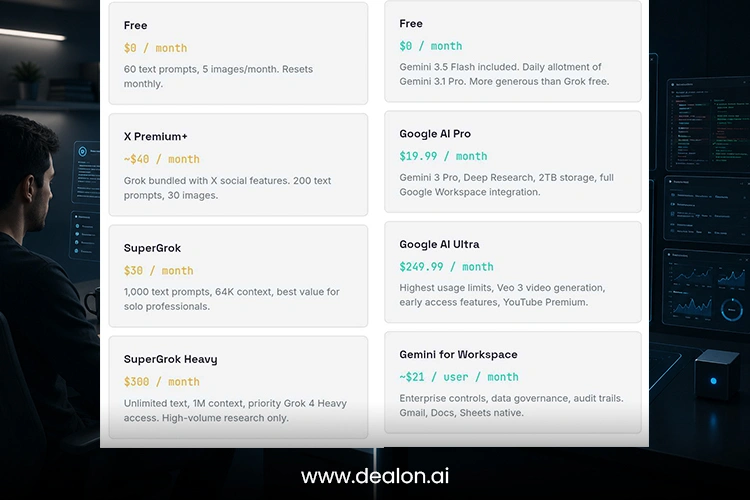
The pricing has been streamlined by mid-2026, though Grok’s pricing structure is quite more complicated and expensive at the top tier.
Privacy, Security & Enterprise Readiness
This is the size that most comparison articles fail to mention, but it’s a deciding factor for any organization working in a regulated industry.
The enterprise compliance infrastructure that Google Workspace has, including SOC 2, ISO 27001, HIPAA BAA support, GDPR data processing agreements, and organization data loss prevention policies, is all built into Gemini. By default, conversations are not used for training model updates on business tiers. Audit logs and admin controls are in place. But, for healthcare, finance, legal, and government – Gemini’s compliance posture is much more battle-tested.
In 2025–2026, Grok for Enterprise offers a data privacy guarantee: business data is not used for training by default, and xAI launched two tiers of the Grok—Grok Business and Grok Enterprise. xAI for Government began in early 2026 for the United States Department of Defense (DoD) use cases. Enterprise pricing needs to be negotiated for transactions. While Google has been rolling out enterprise deployments for 10 years, xAI’s enterprise history is much shorter, but still solid.
Gemini’s enterprise compliance stack is more tried and tested for healthcare, finance, law, and government. Grok is progressing well, but it’s not as deep as users of the system would like in terms of audit trails and certification history.
Ecosystem Lock-In: Google Advantage vs X Advantage
When selecting an AI assistant for 2026, it’s not just a matter of model performance; it’s the entire ecosystem. Existing tools, platforms, and services have a big impact on the extent to which they benefit different AI assistants.
In a connected approach like Google’s, it makes sense that people who are using Google services like Google Play, which is already integrated, would use Gemini. It’s compatible with Gmail, allows you to draft and summarize emails, is AI-powered for writing with Google Docs, lets you search and analyze files in Google Drive, and offers assistance on the device level with Android and Google Cloud for enterprise workflows. It also integrates with platforms like YouTube, which can offer additional functionalities like content summarization and information discovery.
The benefit of Grok is the X ecosystem and its ability to deliver real-time conversations, trending topics, and social sentiment. It is especially useful for those who want quick access to information regarding public conversations, market trends, and public discussions. With access to X Premium and xAI’s API offerings, Grok is a suitable choice for those who value real-time intelligence.
It’s really up to you where your workflow is digital and what you need to do. For users who are already well-versed in Google Workspace, the seamless integration of Gemini offers a big boost in productivity. For social media enthusiasts, chat forums, and cultural cues, Grok has a few things going for it that won’t be found in many other places. But in both cases, it may be more important than the individual AI features to consider ecosystem compatibility.
The Best Hybrid Workflow: When Professionals Use Both
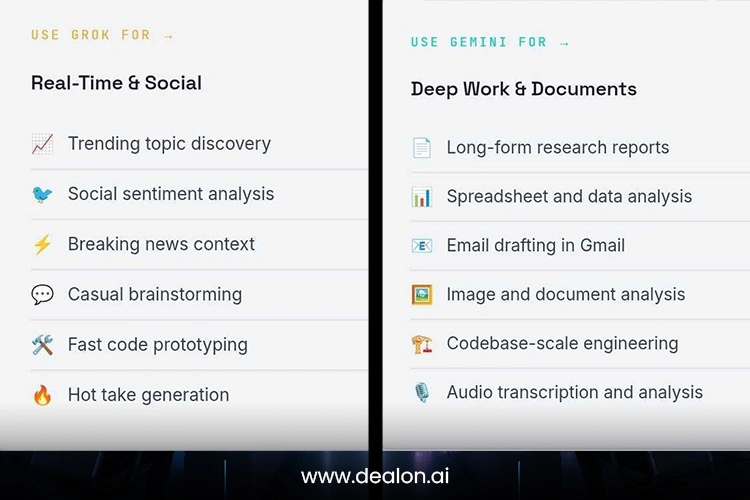
The most advanced users of AI in 2026 won’t have to ask “Grok or Gemini?”. They ask, “What tool do you use to do what task? A practical hybrid workflow:
Grok vs Gemini by User Type: Final Recommendations
Once all the analysis is done, it resolves like this:
| If you are a.. | Choose | Because |
| A journalist or news researcher | Grok | Real-time X data is irreplaceable for breaking news context |
| A student or academic | Gemini | Generous free tier, Deep Research, multimodal for papers and diagrams |
| A developer or engineer | Grok | Lowest API cost, fast codegen; use Gemini for large codebase work |
| A marketing professional | Grok | Trend awareness + conversational copy generation |
| A business executive or ops team | Gemini | Google Workspace integration, Docs/Sheets/Gmail, enterprise controls |
| A creative writer or author | Gemini | Longer context for book-length projects, stronger narrative structure |
| A data analyst | Gemini | BigQuery integration, spreadsheet analysis, and chart interpretation |
| A social media manager | Grok | Native X intelligence; knows what’s working in your niche right now |
The Future of AI Assistants: Where Grok vs Gemini Are Heading
Both firms are in a rush, and today’s comparison will seem old news in a matter of months. The following are vectors to follow:
Grok’s future: xAI is on the path to self-contained AI agents with roots in X’s social graph. Imagine an Artificial Intelligence that not only informs you about what is happening, but also acts on your behalf – scheduling posts, watching for mentions, creating market intelligence. DoD’s move to classified networks shows it has bigger plans than just the consumer market for Grok.
Google’s gambit: Google is putting its money where its mouth is and investing in the future of Gemini as the reason behind all of the Internet, from every Android device, every Workspace document, and every Google Cloud workload. The road to Gemini 4 will be longer context (2M tokens are already in testing), and agentic tool use and integration with Google’s advertising and search infrastructure.
Both companies are developing towards the same goal: An AI that acts on your behalf in the digital world, but with opposite lines of development. xAI is beginning at social intelligence, and extending outwards, while Google is beginning at productivity infrastructure, and bringing in intelligence.
FAQs
Q1. How will Gemini vs Grok fare in the year 2026?
Grok will have a stronger capacity for instant information and coding speed, while Gemini will be stronger in reasoning, multimodal tasks, and productivity.
Q2. What is the greatest difference between Grok and Gemini?
Grok is geared towards X spat-time data, and Gemini is about Google ecosystem connectivity and deep AI reasoning.
Q3. Is Grok better for coding than Gemini?
More benchmark than Gemini, but Gemini is more useful for large code bases and integrated development workflows.
Q4. Which one of these AI is better for research?
If you need to update things on the fly, you’ll want to use Grok, but if you want to do structured, academic-style research, you’ll want to use Gemini.
Q5. Is Grok up-to-date?
Yes, you can access live X posts and trends, but not all information is verified.
Q6. Is it possible to analyze images and videos with Gemini?
Yes, you can use images, videos, PDFs, and audio native to Gemini.
Q7. So, which AI is more suitable for businesses?
There is better enterprise security and Google Workspace integration with Gemini.
Q8. Which is better in Grok vs Gemini?
Grok will work better for very recent updates.
Q9. Do I need to use both Grok and Gemini?
Yes, they work well together: Grok – real-time insights, Gemini – deep work.



