
| At a Glance |
| $11B
Global chatbot market size in 2026, up from $2.6B in 2019 80% Of customer interactions now handled without a human agent 67% Of consumers choose self-service over speaking to a representative 30% Average reduction in customer support costs after chatbot deployment |
Table of Contents
What Is a Chatbot?
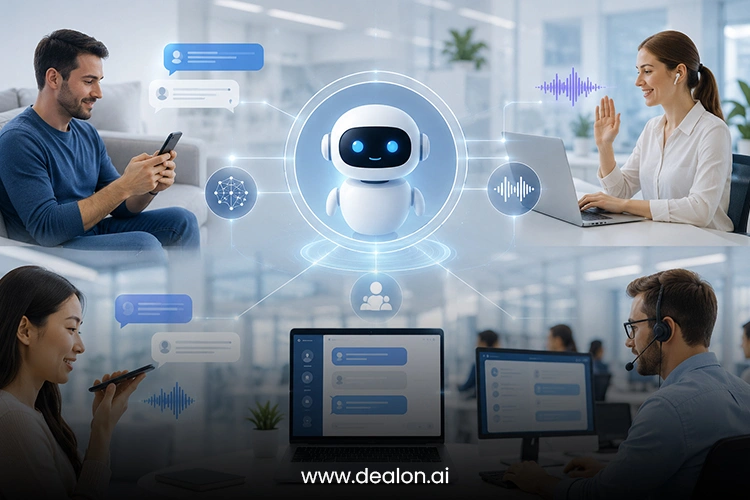
This is a piece of software that can communicate with people using natural language, via text or voice. It can answer questions, give information, solve customer problems, and perform operations automatically without requiring human intervention.
Advanced AI-driven chatbots leverage advanced technologies like NLP, machine learning, and generative AI to grasp user intent, preserve context, and provide more human and contextually relevant replies. Currently, AI-powered chatbots are more sophisticated, can engage in complex dialogues, respond in a personalized manner, and learn continuously. AI Chatbots are more advanced than rule-based chatbots, which follow a set of rigid scripts, and can handle more complex conversations, respond personally, and continuously learn.
Also Read: Mathematics of Deep Learning: What Laid the Foundations for the Breakthroughs in AI
Traditional Chatbots vs AI Chatbots
Both types of chatbots’ capabilities differ significantly.
| Traditional Chatbots | AI Chatbots |
| Follow predefined rules and scripts | Understand natural language and user intent |
| Limited to specific questions | Can handle complex and varied queries |
| Require manual updates | Learn and improve over time |
| Struggle with conversational context | Maintain context throughout interactions |
| Best for simple tasks | Suitable for advanced customer support and automation |
With the advent of generative AI, chatbots have transcended their role as simple customer support platforms, evolving into smart virtual assistants. Generative AI has revolutionized chatbots from being a mere customer service tool to a smart virtual agent that provides personalized, efficient, and scalable customer support. With the ever-evolving expectations of customers and the rise in the need for support, chatbots have become a crucial part of customer support strategies.
Once you understand how these systems operate, you will see just how many advantages chatbots offer, and why businesses in a variety of industries are spending a lot on them in 2026.
The Biggest Benefits of Chatbots at a Glance
At a glance, the following are the top benefits of Chatbots.
| Benefit | Business Impact |
Customer Impact |
Best For |
| 24/7 Availability | Reduce staffing costs | Support at any hour | All businesses |
| Instant Responses | Higher CSAT scores | Zero wait time | Ecommerce, SaaS |
| Cost Reduction | 30–50% OpEx savings | Faster resolution | Enterprise, SMBs |
| Lead Qualification | More pipeline, less effort | Relevant offers | B2B SaaS, ecommerce |
| Multilingual Support | Enter global markets | Native-language help | Global brands |
| Employee Productivity | Faster internal workflows | Quicker answers | HR, IT teams |
| Data & Insights | Voice-of-customer intelligence | More personalized CX | Analytics-led orgs |
| Sales & Revenue | Higher conversion rates | Better product discovery | Retail, SaaS |
Why Chatbots Matter More Than Ever in 2026
Customers’ expectations when they reach out to a support agent are now higher. They are impatient for answers; they’re looking for answers in seconds, not hours. They want to know that no matter where they visit your site or no matter what time of day, they will be met with a consistent experience, in London or in Lagos. They want their problem fixed the first time!
This is a particularly challenging issue for businesses as hiring is costly, training lasts months, and quality varies. New digital support channels, live chat, social messaging, in-app support, and voice have come into existence and put the already lean teams to the test.
AI Chatbots are turning out to be the solution. Not as a trick or a shortcut for businesses to save money, but as a change in the way that business services are provided at scale. They are no longer experimental technology, but rather have become mainstream infrastructure in 2026. 89% of customers expect a response within 24 hours from brands. Over 50% of them would expect a reply to their posts on social media within an hour. AI chatbots are always able to handle these standards.
From Scripted Bots to AI Agents: How Chatbots Have Evolved
To grasp the capabilities of modern chatbots, one must first understand their beginnings and how much they’ve evolved.
| Era 1 · 2000s | Rule-Based Chatbots
Decision-tree logic. If the user said X, do Y. Rigid, brittle, and frustrating for anything outside a narrow script. |
| Era 2 · 2015–2020 | NLP Chatbots
Natural Language Processing allowed bots to understand intent, not just keywords. Context improved dramatically, though multi-turn conversations remained difficult. |
| Era 3 · 2022–2024 | Generative AI Chatbots
Large language models enabled fluent, contextual, multi-turn dialogue. Chatbots could reason, summarise, and personalize at unprecedented quality. |
| Era 4 · 2025–Present | Autonomous AI Agents
Agents don’t just respond — they take action. They can process refunds, book appointments, update CRM records, and escalate intelligently, all without human intervention. |
24/7 Customer Support Without Expanding Headcount
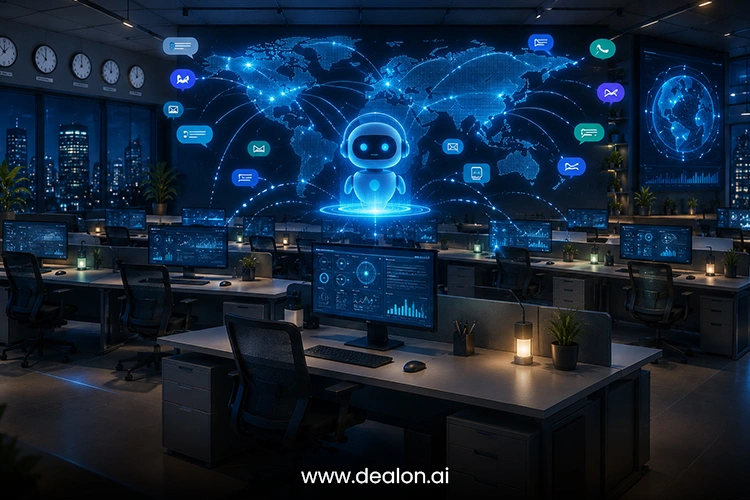
The first advantage of a chatbot is that it’s always available. Staff work on shifts. Chatbots don’t. They process inquiries at midnight on Saturday and Sunday, and at the same time in every time zone!
It’s a game-changer for businesses around the world. A Tokyo customer doesn’t need to wait until the London office is open. A shopper who leaves a cart at 11 PM will receive an immediate response to a shipping question and be able to complete the purchase.
Real-World Example: An ecommerce company with 4,000 monthly tickets in support deployed an AI chatbot, and found that 68% of all their tickets were resolved without humans — even order tracking, returns, and product questions were handled by the AI chatbot. Headcount did not change, but volume increased by 35%.
Instant Responses Improve Customer Satisfaction
Speed is one of the most convincing of all factors that make customers happy — and one of the most underutilized. Wait time is the number one reason that people are frustrated and unhappy with their interactions with customer service.
- First-Response Time Reduction: AI Chatbots answer in mere milliseconds. Average Wait for Traditional email Support is 12 hours. The average time for live chat with a human agent is 2-3 minutes. Most of the queries don’t require any waiting time if the AI chatbot is properly configured.
- Lower Customer Frustration: Things get worse as wait time increases. If someone is waiting 5 minutes to be told that their order will be shipped in 3 days, they are angrier than someone who is told the same thing in 5 seconds. Speed is separating the message from the emotion.
- Faster Issue Resolution: Today’s AI chatbots are not only capable of responding, but they also solve problems. They can fetch order data, process the request, and close tickets within a single conversation. The average time that users wait for a chatbot to respond to their ticket is less than 2 minutes, whereas for a human agent, it takes 8–12 minutes to respond to a routine ticket.
- Improved CSAT Scores: Improvement in CSAT by +24% on average after introducing the AI Chatbot. Companies in the Forrester study that implemented AI-powered chats reported that their CSAT improved in the first 90 days, thanks to the speed and availability improvements.
The Cost Savings Most Companies Underestimate
The usual ROI presented for chatbots is based on “saving on headcount. That would indeed be, but it’s not the entire story. The complete picture of the cost is as follows:
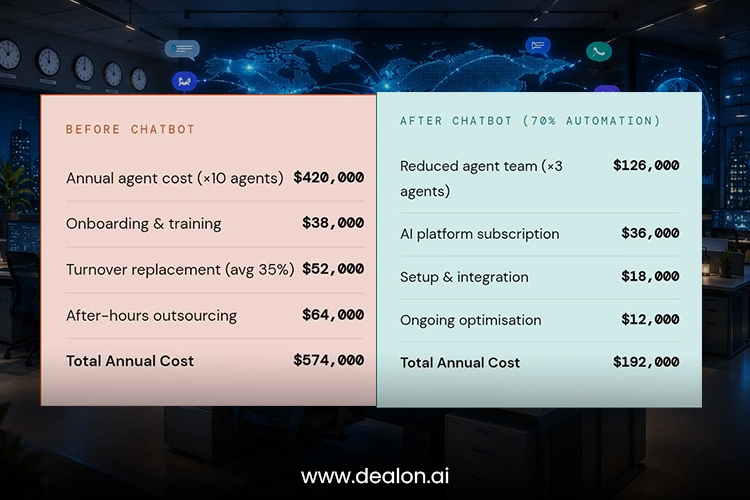
“The net benefit of AI chatbots is not limited to reduced staff numbers, but rather to accumulating savings as the volume of interactions increases, never having to hire, train, or replace an employee again.”
-Customer Service Cost Benchmark Report, 2026
Benefits of Chatbots for Customer Experience
Cost and time are important for business. However, the thing that customers remember is how the interaction was felt. When done right, AI chatbots can enhance the customer experience, more than just the metrics.
- Personalized interactions — Chatbots can pre-emptively engage customers by name, recall their purchase history, and offer suggestions based on it.
- Accurate answers — No matter the client’s question, the chatbot will provide the correct answer each time, which is beneficial for repeat customers.
- More efficient: Most users are more efficient at navigating through a conversation than using menus or reading FAQs, and they are also faster.
- Lower friction — AI can predict the next question, bring up relevant information, and lead users toward a solution without having to ask questions –
How Chatbots Increase Sales and Revenue
Today’s chatbots are not just about cutting support costs; they can directly contribute to businesses’ revenue by interacting with customers at every stage of the purchasing process.
- Lead Qualification: Chatbots can help qualify leads, gather contact details, and book demos automatically, freeing up salespeople to attend to leads with intent.
- Customer Behavior and Conversation Analysis: AI chatbots analyze customer behavior and conversations to recommend products, which can boost conversions.
- Cart Recovery: Chatbots can be used to communicate with shoppers before they leave, solve their doubts, and provide immediate offers to help recover abandoned carts.
- Upselling and Cross-Selling: Chatbots can recommend relevant upgrades, product bundles, or complementary products, helping to boost the average order value without compromising the customer experience.
Multilingual Support at Global Scale Opportunity Gap
Most companies have their expansion limited by the need for localized support that can be costly. It is very costly to have everyone speaking a foreign language in each market. AI chatbots break down all those barriers. The modern AI models are available in 90+ languages and can be used with near-native proficiency.
- Real-time translation is the ability to provide translation to customers across the world using a single AI.
- Leading models now handle tone, formality, and cultural nuance better and better.
- Businesses can gain access to fresh markets without having to hire a local support service.
- One of the most underestimated benefits of chatbots is for B2B SaaS businesses and ecommerce enterprises with a global reach. With no bilingual employees on the board, a mid-size brand can provide the same consistent and fluent service in French, German, Japanese, and Portuguese.
Employee Productivity Benefits of Chatbots Beyond Customer Support
Most of the articles are dedicated to external chatbots, that is, the ones that customers interact with. Internal chatbots offer the same ROI, but without all the hype and integration issues.
HR chatbots can process leave applications, benefits inquiries, onboarding procedures, and even policy searches. Those exchanges add up to thousands of hours of HR time spent at a 500-person organization each year.
Like Customer Support teams, IT help desk teams are dealing with the same high-volume, low-complexity ticket issues. IT help desk teams are struggling with the same high volume and low-complexity ticket challenge as Customer Support teams. Chatbots can solve these in seconds.
The average time employees spend looking for knowledge is 1.8 hrs/day. Dedicated to answering the question “What’s our returns policy on B2B orders?” or “How do I submit a reimbursement claim?”, an AI knowledge assistant can save hundreds of hours per year for a mid-sized team.
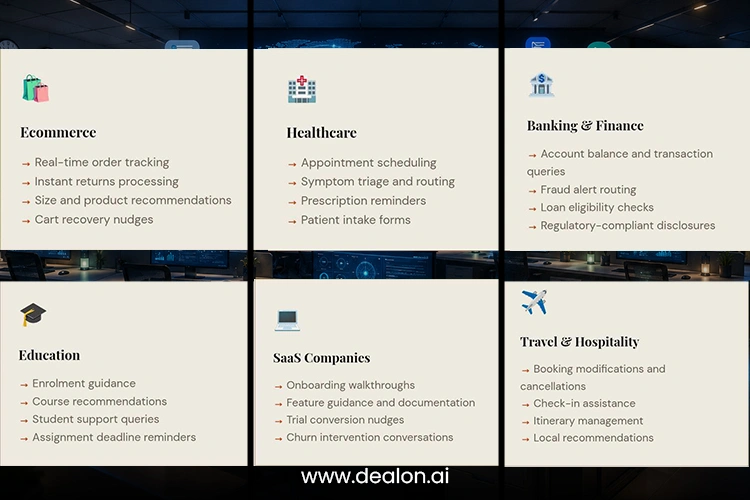
Industry-Specific Benefits of Chatbots
AI Chatbots vs Human Agents: What Each Does Best
The key framing for this is augmentation, NOT replacement. AI can deal with volume, humans can deal with complexity. Combined, they form a support operation that is quicker, more cost-effective, and more caring than either one or the other.
| Task | Chatbot | Human Agent |
| Order status/tracking | ✓ Ideal | Overkill |
| Complex complaints | Escalate | ✓ Ideal |
| FAQs & policy queries | ✓ Ideal | Inefficient |
| Emotional support situations | Limited | ✓ Essential |
| Lead qualification | ✓ Ideal | Expensive |
| Nuanced negotiation | Not suitable | ✓ Ideal |
| 24/7 availability | ✓ Native | Cost-prohibitive |
| High-stakes decisions | Escalate | ✓ Required |
| Consistent quality at scale | ✓ Ideal | Inconsistent |
The Hidden Benefits of Chatbots Most Businesses Miss
All the attention is paid to the operational advantages. These are data-driven benefits of chatbots which are of equal value — and most businesses are missing out on.
Customer Insights Collection
Each conversation in the chatbot is structured data. What questions customers ask, how they ask them, and what problems they encounter; all of this is a constantly updated voice of customer dataset that can be mined by the marketing, product, and operations teams for insights.
Trend Detection
If 200 customers come in a week asking the question “When is X going to be in stock?” that is a signal. Patterns like these can be detected by AI and brought to light from conversations, weeks before they are even mentioned in the surveys or reviews.
Knowledge Base Improvement
AI chatbot platforms are able to identify the queries that their bots are not able to answer. These gaps directly indicate gaps in the knowledge base that need to be improved, updated, and prioritized for product fixes. The AI-powered chatbot is evaluating your own support resources at all times.
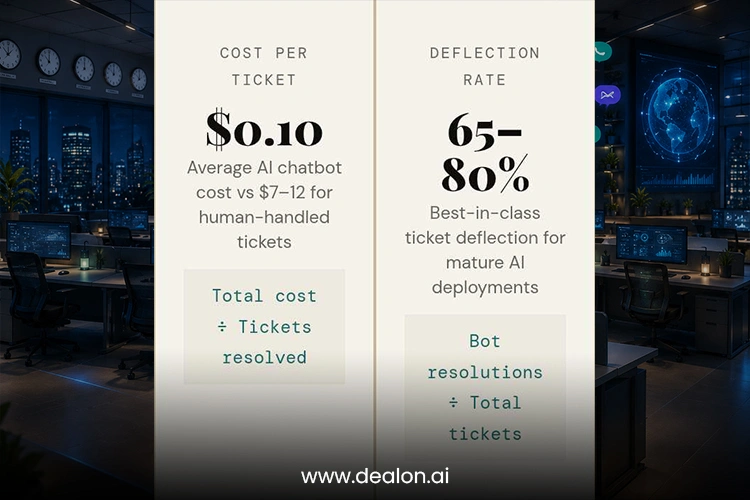
Measuring Chatbot ROI: Metrics That Actually Matter
Most of the chatbots are judged by general metrics such as “ticket volume. These are the KPIs you’re looking for to measure ROI:
Common Chatbot Challenges and How AI Solves Them
There are several common challenges associated with Chatbots that AI can overcome. There are a number of issues with Chatbots that AI can solve.
Challenge
Hallucinations: AI models sometimes give incorrect answers or answers that are wrong, particularly with niche or edge case questions.
Solution
Retrieval-Augmented Generation (RAG): Using AI to reference a trusted database of knowledge significantly decreases the occurrence of hallucinations. There are enterprise-grade platforms now available that deliver less than 0.5% error rate.
Challenge
Lack of Context: The early chatbots were unable to remember the context between turns, causing repetitive and frustrating interactions.
Solution
Extended Context Windows: Modern LLMs are able to preserve the full context of a conversation for extended interactions. Persistent memory: carries over from one session to another.
Challenge
Escalation Failures: When chatbots fail to escalate, it leaves the customer frustrated. Escalation is the undoing of chatbots that escalate too quickly to achieve the cost objective.
Solution
Sentiment-Triggered Escalation: AI can now identify signs of frustration, complexity, and high-value customer indicators and escalate with accuracy – the right time, every time.
Challenge
Privacy Issues: The customers are becoming more and more sensitive to releasing their personal information to an automated system.
Solution
Enterprise Security Standards: Top platforms include SOC 2 compliance, GDPR compliance, data minimization by design, and end-to-end encryption. It has become commonplace to be open about the use of AI.
Future Benefits of Chatbots: What Comes Next?
| 1 | Voice AI Agents
Voice chatbots with natural human speech have begun to be deployed in the mainstream. Phone support is in the process of being revolutionized at the same rate as text chat was five years ago. |
| 2 | Autonomous Customer Support
Completely independent agents who log in, perform actions, process transactions, and troubleshoot complex issues without any human intervention. |
| 3 | Omnichannel Orchestration
One AI to rule them all, handling the customer relationship in web, mobile, email, social, and voice, and keeping the customer context and memory consistent across all channels. |
| 4 | Predictive Customer Service
Customer identification—before they call for help — that then reaches out proactively to fix the issue by using AI. Reactive to preventive service. |
| 5 | Emotional Intelligence
Next-generation models have enhanced emotional response calibration and empathy modeling, helping to reduce the gap between the model and human agents on high-sensitivity interactions. |
Frequently Asked Questions
Q1. What are the key advantages of chatbots?
Benefits of chatbots include round-the-clock support, quick response times, cost-effectiveness, uniformity of customer service, multilingual support, and easy scalability.
Q2. What are the benefits of chatbots for customer service?
These can reduce wait times, answer frequently asked questions on the spot, deal with more than one conversation, and let people on the phone with them handle complex issues.
Q3. Do Chatbots play a part in replacing the human Customer Support Agent?
No. Chatbots are great for handling mundane tasks, but human agents are crucial in more complex, sensitive, and high-stakes situations with customers.
Q4. Is investing in AI Chatbots a worthwhile venture?
Yes, for the majority of businesses. With the proper use of Chatbots, they can help to increase efficiency, lower costs, and yield a significant return on investment.
Q5. What’s the value of money that chatbots can save for businesses?
Businesses can save between 30-50% of their customer support costs by automating and optimizing their processes.
Q6. Do chatbots stimulate sales?
Yes. Chatbots can qualify leads, suggest products, add back abandoned carts, and boost upselling and cross-selling opportunities.
Q7. Which industries do the Chatbots work best in?
High customer interaction volumes, such as ecommerce, healthcare, banking, SaaS, education, and travel, are the most rewarding sectors.
Q8. Are Chatbots safe for customer interactions?
The majority of enterprise chatbot solutions provide encryption, compliance elements, and security controls to safeguard customer information.
Q9. Where does the AI chatbot service fit in, compared to the traditional chatbot service?
Unlike traditional chatbots, AI chatbots comprehend the intent, context, and natural language to offer more personalized responses.
Q10. What are the drawbacks of Chatbots?
Chatbots can have difficulties with complex queries and may need to be properly set up and maintained for them to provide accurate and helpful responses.



