
Table of Contents
What Is Actionable Intelligence and Who Needs It?
Actionable intelligence is where data becomes a decision, not a report. Specifically, it is information that has been processed, contextualized, and delivered with enough accuracy and relevance to support a business decision or trigger an automated action.
If your analytics pipeline ends with a dashboard that people only check occasionally, then you have information — not actionable intelligence. It is more than that: It provides guidance on what action should be taken, when it should happen, and, in some cases, executes that action automatically. Business intelligence explains past performance, while actionable intelligence focuses on future decisions and recommended actions.
Once we define what this is, the next step is understanding how raw data actually transforms into decisions inside organizations.
| Role | Use Case | Value Level | Tool Dependency |
| Data Analyst | Reporting → insight generation | High | BI tools (Looker, Power BI) |
| Business Manager | Faster, better decision-making | Very High | Dashboards + alerts |
| Data / ML Engineer | Automated pipeline execution | High | APIs, Airflow, Spark |
| Executive | Strategic resource allocation | Critical | Predictive KPI systems |
| Startup Founder | Product-market signal detection | Very High | Low-code AI platforms |
| Enterprise AI Team | Autonomous business automation | Critical | LLM agents + orchestration |
The Core Concept — Data vs Information vs Actionable Intelligence
Most organizations possess large volumes of data but often lack the systems required to convert that data into meaningful decisions. To grasp why, a mental model of the transformation hierarchy is needed, which differentiates between numbers and results-generating intelligence.
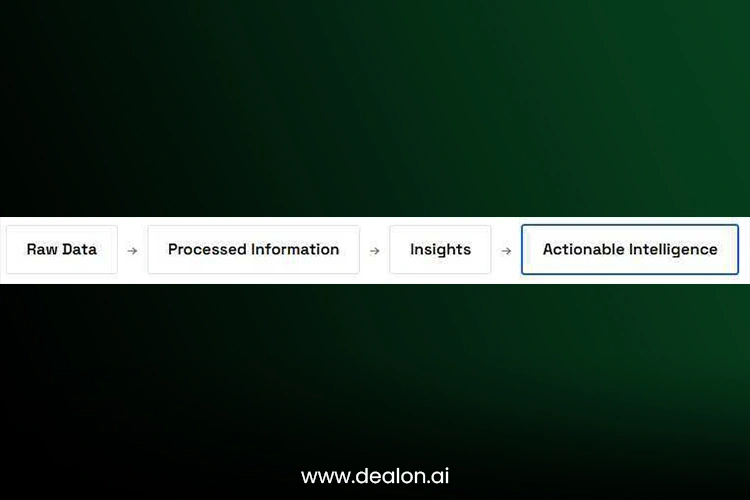
Raw data is the unprocessed information generated by systems, including logs, transactions, sensor readings, user interactions, and application events. By itself, it is of no significance. Processed information is structured – rows, aggregations, time stamps. Insights add interpretation: “conversion decreased 18% on mobile this week. That’s where most companies end.”
The execution gap occurs when organizations generate insights but fail to translate them into measurable actions. No one knows by default if the conversion drop is due to a developer hotfix, a pause in the campaign, or if there is in-depth UX research to be conducted. It addresses this by assigning a context to the insight, prioritizing it, providing recommended actions, and increasingly, in 2026, these systems are moving toward automated execution. Many organizations struggle to operationalize analytics investments, creating a significant gap between insight generation and execution. However, understanding the gap is not enough — organizations need a structured system to convert fragmented data into actionable intelligence consistently.
Also Read: Predictive Analytics in Supply Chain: Essential Trends Boosting Efficiency in 2026
The Actionable Intelligence Framework (AIF Model 2026)
The ACTION Framework is a six-step process that helps organizations transform fragmented data assets into a fully operational intelligence layer. Every stage takes care of its unique failure mode that stops organizations from progressing.
A — Analyze: clean, validate, and profile raw data. The idea of “garbage in, garbage out” remains relevant in 2026 because poor-quality data leads to unreliable intelligence.
C — Contextualize: Add external signals, historical baselines, business definitions to data. Without context, data often lacks the meaning required for accurate decision-making.
T — Transform: Use statistical and ML methods to uncover patterns, anomalies, and predictive signals.
I — Integrate: Link intelligence to platforms where decisions are taken – CRMs, ERPs, and ops platforms.
O — Operationalize: Implement insights into automated triggers, alerts, and workflows. If you can’t take action with it, then it’s simply a report.
N — Normalize: Create feedback mechanisms that continuously re-score the performance of the models and recalibrate thresholds as the business changes.
Once the framework is defined, the next challenge becomes how to implement it at scale through a real system architecture technically.
| Stage | Purpose | Output | Example Tools |
| Analyze | Clean and validate raw data | Verified dataset | Python (Pandas), SQL, dbt |
| Contextualize | Add business meaning and enrichment | Enriched data model | BI tools, metadata catalogs |
| Transform | Pattern and signal extraction | Insight objects | Scikit-learn, ML models |
| Integrate | Push intelligence into live systems | Connected data layer | APIs, reverse ETL (Census) |
| Operationalize | Trigger automated business actions | Automated workflows | Airflow, Zapier, AI agents |
| Normalize | Continuous learning and recalibration | Self-improving system | MLflow, model monitors |
Architecture of Actionable Intelligence Systems (Modern Stack)
In 2026, an actionable intelligence system is built as a layered architecture, with each layer having a specific and well-defined function. These layers must remain separated because unnecessary overlap between components can create latency, inefficiency, and system failures. The modern intelligence stack is made up of six layers: ingestion, storage, processing, intelligence, decision, and execution.
The ingestion layer is in charge of gathering real-time batch and streaming data from various sources such as business applications, databases, sensors, and external APIs. Tools like Apache Kafka, Fivetran, and APIs enable continuous data capture and movement through the intelligence pipeline.
The storage layer offers scalable and optimized storage solutions for storing large amounts of structured and unstructured data. Data lakes and data warehouses like Snowflake, BigQuery, and Delta Lake enable companies to store, organize, and access data efficiently needed for analysis and insights to drive decision-making.
The processing layer involves cleaning, transforming, and aggregating raw data into a format that can be consumed. In addition to the above, technologies such as Apache Spark, dbt, and Databricks enable organizations to process large amounts of data while maintaining quality, consistency, and accessibility.
At the heart of the system is the intelligence layer, comprising machine learning models, large language models (LLMs), anomaly detection systems, and predictive analytics to produce insights. With the help of frameworks and platforms like TensorFlow, PyTorch, and Claude API, companies can analyze intricate data patterns and make intelligent recommendations.
The decision layer brings together the rules-based systems and AI agents to help turn insights into actionable decisions. This layer determines the appropriate action based on business objectives, operational constraints, and AI recommendations. Organizations can use custom LLM agents and decision engines like Cortex to streamline and optimize decision-making processes.
The execution layer takes decisions and puts them into action by connecting to the business systems and automation platforms. Intelligence that can be generated by the system can be automated using tools like Zapier, Airflow, and custom APIs, which can lead to measurable operational outcomes.
One of the most important architectural factors in 2026 will be the distinction between intelligence and decision-making. These layers can be mixed to enable quicker automatic response. Still, they may lead to accountability problems if the decision is not transparent and has no explanation that is understandable by humans.
Leading organizations ensure that there is a clear separation between the production of intelligence and decision action, recording the reasoning, context, and justification for each action with structured decision objects before it is carried out. This not only enhances governance and auditability but also ensures the swiftness and efficiency of AI systems. With the architecture in place, it becomes important to understand how data actually flows through the system from ingestion to execution in practice.
From Data to Action — End-to-End Workflow
A step-by-step workflow reveals where delays occur and where automation can provide the greatest operational value.
| Step | Input | Output | Delay Risk |
| Collection | Source systems, sensors, APIs | Raw dataset | Medium — depends on source latency |
| Processing | Raw dataset | Clean, normalized data | Low — automatable with modern tooling |
| Modelling | Clean data | Scored insights | Medium — model training cycles |
| Decision | Insights + business rules | Prioritized action plan | High — human bottleneck without automation |
| Execution | Action plan | Business outcome | Critical — execution gap lives here |
| Feedback | Outcome signals | Model updates + recalibration | Chronic — often absent entirely |
Pay particular attention to the decision and execution steps, as these steps are most likely to have high delay risk, but lack the most value in analytics investment. Teams generate insights here, but fail to translate those insights into action at machine speed due to a lack of data-driven automation. Once the full workflow is understood, the real value becomes clearer when we see how actionable intelligence performs in real-world business environments.
Real-World Use Cases of Actionable Intelligence
The value becomes clearer when applied across different industries and operational scenarios. This doesn’t have to be industry-specific; it can be applied in healthcare environments as well as logistics and supply chain operations.
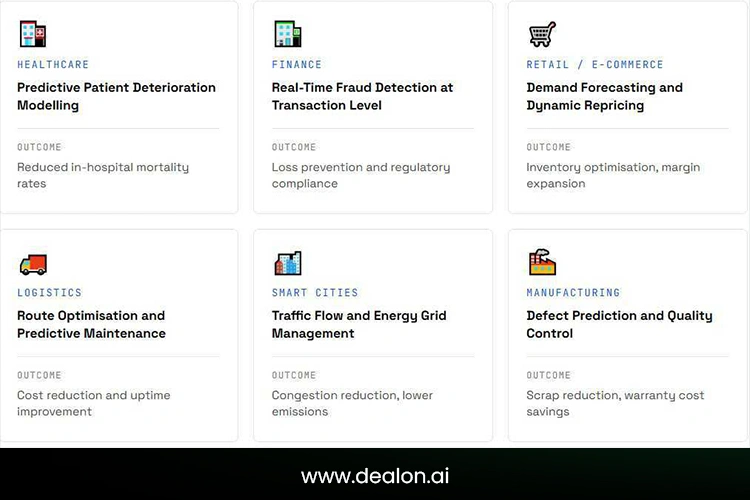
A bank can analyze transaction patterns in real time, block suspicious payments within milliseconds, notify customers through mobile alerts, and automatically create compliance records. These applications are only possible because of a modern technology stack that supports real-time data processing, intelligence generation, and automated execution.
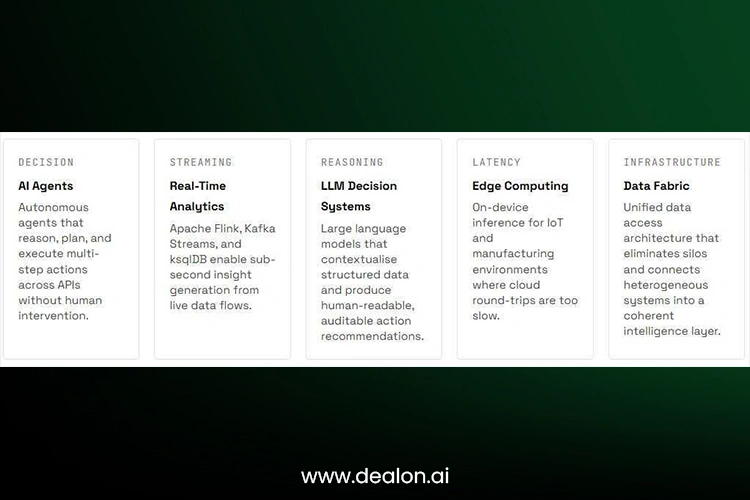
Key Technologies Powering Actionable Intelligence (2026 Stack)
Common Failure Points — Why Most Systems Fall Short
These failure patterns appear repeatedly across analytics initiatives and are often caused by similar organizational and technical challenges. All of them can be avoided.
| Problem | Root Cause | Fix |
| Data silos | Fragmented systems with no shared semantic layer | Unified data lakehouse with a centralized catalog |
| Poor data quality | No validation at ingestion; schema drift | dbt tests, Great Expectations, automated profiling |
| Slow insights | Batch-only processing — insights arrive 24h late | Migrate critical pipelines to real-time streaming |
| No feedback loop | Model outputs are never evaluated against outcomes | Build outcome tracking and automated model monitoring |
| No action taken | Insight delivery stops at a dashboard | Automation agents that convert insights into system events |
| No KPI alignment | Data team optimizes metrics the business doesn’t care about | Co-define KPIs with business owners before building |
Building an Actionable Intelligence Pipeline (Step-by-Step)
Implementation does not require enterprise-scale resources. You can get a working, usable pipeline for actionable intelligence up and running in weeks with a lean startup. This sequence can be adapted for organizations of different sizes and technical capabilities.
Identify KPIs first. Make decisions working from the back half. What numbers, in real-time, if any, would be so impactful that they would change your behavior?
Inventory data sources. Map all pertinent systems from CRM, ERP, product analytics, finances, and external APIs. Evaluate the quality and latency of each.
Develop ingestion and storage layer. Select tools that are suitable for your scale. Fivetran to BigQuery can be used to get a startup going. A custom Kafka + Delta Lake stack could be required by an enterprise.
Train & validate models. Begin with easy-to-interpret models (logistic regression, decision trees) and then proceed to more complex ones. Explainability is important for the trust of the stakeholders.
Deploy automation. Embed outputs in the context of actions. For example, when a churn prediction model automatically creates a customer success task in Salesforce, the prediction becomes an actionable score because it directly triggers a business response. An actionable score is a score that results in a task for a CSM in Salesforce.
Monitor and recalibrate. Configure drift alerts automatically. Create a feedback loop to close the loop on your training pipeline with feedback on the outcomes.
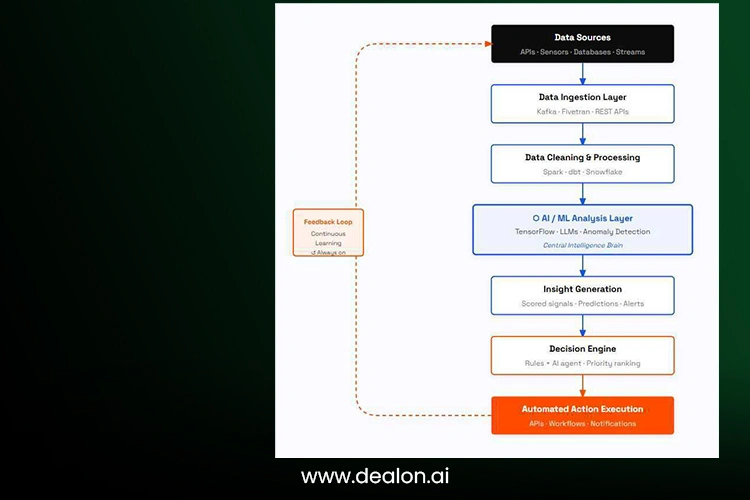
Actionable Intelligence Lifecycle Flowchart
The complete picture, from raw data sources to automatic execution, and back again through a continuous feedback loop, is shown below. The AI Agent Layer acts as the intelligence layer’s ‘reasoning brain,’ which will direct decisions to downstream systems.
KPI Mapping — Turning Intelligence Into Measurable Outcomes
Actionable intelligence lacks measurable value without a clear performance measurement system. The key distinction between leading and lagging indicators is essential to creating KPI structures that will actually detect the issue before it gets into a crisis.
| KPI Type | Example | Intelligence Application |
| Lagging | Monthly revenue, churn rate | Confirms outcomes; drives retrospective analysis |
| Leading | Customer intent signals, engagement score | Predicts future outcomes; triggers proactive action |
| Predictive | 30-day churn probability, demand forecast | Model output — the core |
| Operational | Pipeline latency, model accuracy | Health of the intelligence system itself |
An established practice should have a dashboard that displays the ROI for the business, but also the performance of the actionable intelligence system providing ROI. Even though the churn model has a 85% accuracy, if the system’s intervention rate is 12%, then the system is underperforming; the limitation is not necessarily the model itself but the effectiveness of the execution layer.
AI Agents and Real-Time Decision Systems (2026 Trend)
The biggest change in actionable intelligence in 2026 is the emergence of autonomous decision agents – These systems do more than generate insights; they evaluate options, recommend actions, and execute tasks across business systems.
Anomaly detection, correlation with historical context, optimal intervention, and logging of the reasoning are performed in seconds by autonomous decision agents.
The real-time triggers take the place of scheduled batch jobs. An at-risk customer who logs on today can get an intervention today (as opposed to tomorrow morning when the overnight batch is running).
Self-healing systems self-test their performance and reroute around failures or data quality issues, without the need for human intervention.
Instead of automating jobs, AI-driven business automation is going to automate business processes, like procurement, customer success, and risk management processes, and let the AI agents deal with exceptions that once humans dealt with.
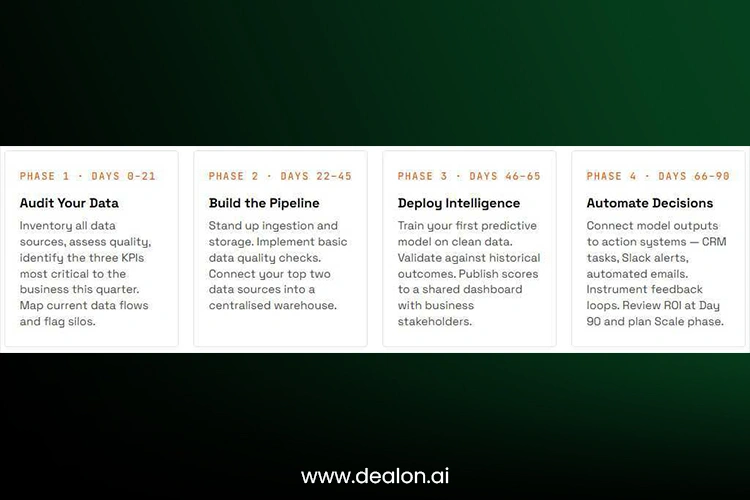
Implementation Roadmap for Businesses (0–90 Days)
The Future of Actionable Intelligence (2026–2030 Outlook)
What its path over the next four years highlights is that the way it is used for actioning decisions is being fundamentally changed in enterprises. Several technological developments will reshape how organizations use actionable intelligence:
- Increasingly autonomous organizations will use AI decision systems to manage functions such as procurement, customer success, and risk management, while humans focus on governance and oversight.
- AI decision operating systems will be the abstraction layer that will bring about a unified intelligence layer between previously siloed departments.
- Businesses will no longer experience a lag between an event and the response to it with zero-latency analytics. This is becoming a reality in manufacturing and logistics with edge computing and on-device inference.
- Predictive governance systems will also be used to anticipate compliance and risk and raise exposure flags before they happen, instead of only after they have happened.
- It is the organizations that can create the architectural framework that will enable them to transform data into action in real time at machine speed that will win this decade, not the ones with the most data.
To summarize the key ideas and address common confusion, the following FAQs clarify the most important concepts.
Frequently Asked Questions
What is Actionable Intelligence?
This is insight derived from data that provides clear guidance for decision-making or triggers specific actions.
What is the difference between Business Intelligence and Actionable Intelligence?
Business intelligence provides insight into the past and current performance, and this provides recommendations for actions to take in the future.
What are some intelligence tools for action?
Examples of commonly used tools are data platforms (Snowflake, BigQuery), processing tools (Spark), machine learning frameworks (PyTorch, Scikit-learn), or automation tools (Airflow, AI agents).
Do small businesses have the ability to employ actionable intelligence?
Yes. This can be made available to small businesses via cloud platforms, low-code tools, and AI solutions, such as forecasting, customer analysis, and automation.
Does AI need to be used to generate actionable intelligence?
No, although rule-based systems can make actionable insights, a rule-based system is not as scalable, as accurate in prediction, or as complex in data analysis.
Which industries have the best application of this?
Finance, healthcare, retail, logistics, and manufacturing benefit significantly because they generate large amounts of operational data and require fast decision-making.
What is the Actionable Intelligence Framework?
A formalized process that helps organizations to collect information, analyze it, make decisions, take action, and continuously improve.
How is its success measured?
Success is determined by various measurements such as accuracy, speed of answer, improvements to operations, business gains in terms of cost reduction or revenue generation, etc.
What is the execution gap in Data Analytics?
The execution gap is a lack of action on insights. The gap can be closed by linking analytics with automation and decision-making systems.



