
“Those supply chains that are able to predict disruption are more successful than those that can only react to it — and that’s a growing difference every year.”
Supply Chain Intelligence Report, 2026
Table of Contents
Where Predictive Analytics in Supply Chain Delivers ROI Fastest
The payback of investments in predictive analytics in the supply chain varies. It is important to understand the complexity/return nature of each use case before committing budget. Demand forecasting and logistics optimization generate the biggest returns – warehouse automation typically requires higher upfront infrastructure investment, resulting in slower ROI compared to software-driven use cases. ROI varies significantly depending on implementation complexity, data maturity, and integration depth across the supply chain stack.
| Use Case | Impact | Complexity | ROI Speed |
| Demand Forecasting | High-accuracy planning | Medium | Fast |
| Logistics Optimization | Faster deliveries | Medium | Fast |
| Inventory Control | Lower holding cost | High | Medium |
| Supplier Risk Prediction | Reduced disruptions | High | Medium |
| Warehouse Automation | Efficiency boost | High | Slow |
From Reactive Supply Chains to Predictive Systems

Traditional supply chains operate reactively, addressing problems only after they occur. Disruptions, like supplier delays, inventory shortages, transportation problems, and sudden changes in demand, are typically discovered after a disruption has already impacted operations. This approach has negative implications for supplier relations, customer satisfaction, and cost. This changes all this by anticipating the disruption and taking proactive measures. Using historical data, on-the-job signals, and external market forces, companies can make better decisions ahead of issues.
The transition to predictive systems is not just a technological change, but a change in the way that decisions are made in the supply chain. Traditional planning has a linear process, from forecasting demands to execution, identifying problems, and correcting them. At the same time, predictive systems work in a persistent cycle of data collection, analysis, and translation into predictions, optimizations, and anticipatory decisions.
The main distinction is that predictive systems are able to update themselves from every operational cycle. Organizations can create adaptive supply networks that evolve as more data is added. Rather than having to rely on static spreadsheets and manual adjustments, organizations can develop networks that adapt over time as they receive more data. This enables companies to react quickly to uncertainty, to make better use of resources, and to make use of disruptions in the supply chain as a chance for them to gain a competitive advantage.
Also Read: AI Tools for HR: How Smart Automation Is Transforming HR Teams
How Predictive Analytics in Supply Chain Works

Its strength lies in its capacity to integrate various data sources into a single intelligence platform, transforming raw data into actionable insights. A single data source is not enough to view the entire operation in the supply chain, because accurate forecasts require internal operational data, external market signals, and real-time information from connected devices. A data integration layer collects, cleans, normalizes, and structures the data from ERP systems, IoT sensors, sales records, supplier networks, and market trends to analyze.
Machine learning models can then detect patterns in this data to predict changes in demand, evaluate supplier risks, manage inventory levels, and enhance logistics efficiency. These insights are then passed on to decision engines that suggest what to do, like how to change inventory levels, delivery routes, or procurement plans. Final decisions are made in various operational areas such as logistics, warehouse management, procurement, and supplier management.
This architecture relies heavily on data quality, as the accuracy of the data in each layer is crucial for the others. Bad or incomplete data can make models less reliable and result in poor decision-making. As a result, data integration, governance, and management are critical best practices that need to be in place first before leveraging predictive models and automation.
Why Forecasting Accuracy Drives Profitability
The starting point of predictive analytics in the supply chain is forecasting – even a small mistake in prediction will result in large and cumulative cost distortions downstream. Even a 10% forecasting error can significantly distort downstream costs, leading to excess inventory in some regions and stockouts in others.
This is where the relevance of forecasting to supply chain management comes in, not only to make the planning more convenient, but also to make it more profitable. There is a huge gap between companies with forecast accuracy of 90-100% and those with an accuracy of 60-70%, and this difference can be seen in the financial profiles of companies in the same industry and competitive environment.
| Accuracy Level | Stockout Risk | Overstock Risk | Profit Impact |
| Low — 60% | High | High | Negative |
| Medium — 75% | Moderate | Moderate | Stable |
| High — 90%+ | Low | Low | Strongly positive |
Big Data Analytics in Supply Chain
Value comes not from individual data streams, but from the correlations discovered when multiple datasets are combined and analyzed together. All of these pieces of weather information were correlated with shipping lane performance, and were correlated with historical demand by SKU. Combined, they become a predictive signal that can push decisions for procurement weeks before the event.
| Data Source | Type | Primary Use Case |
| IoT Sensors | Real-time | Shipment tracking & condition monitoring |
| ERP Systems | Structured | Inventory planning & order history |
| Customer Behaviour | Behavioural | Demand signal & seasonal prediction |
| Weather APIs | External | Delay forecasting & route adjustment |
| Supplier Data | Operational | Risk scoring & performance tracking |
Big data analytics in the supply chain is the basis for predictive models to work on a large scale. The models are only as good as the data and its quality that is supplying them.
Predictive Analytics in the Logistics Industry

In the logistics sector, predictive analytics is primarily used to minimize delivery times, optimize routes, and enhance reliability in intricate supply chains. In industries like retail, e-commerce, and manufacturing, where logistics are a major part, the impact that even minor enhancements in delivery accuracy can make can lead to substantial savings in fuel usage, missed delivery windows, and operational inefficiencies. The insights gained from this can help logistics teams make decisions on rerouting, refining ETAs, tracking fuel consumption, and planning maintenance schedules for vehicles before they break down. While traditional logistics networks react to delays, predictive analytics allows for adaptive logistics networks that adjust in real time to changing conditions without impacting service quality and customer satisfaction.
Demand Forecasting Using Predictive Analytics
Demand forecasting is one of the most popular uses of predictive analytics in the supply chain, affecting almost every business decision, such as procurement, production planning, inventory management, and logistics capacity allocation. Modern forecasting models use multiple external signals beyond historical sales, improving accuracy at the SKU, regional, and channel levels. Ensemble models, XGBoost and LSTM networks, and other machine learning models are able to detect more complex demand patterns and provide more accurate predictions at the product, regional, and channel levels.
This enables businesses to plan, minimize overstock, avoid running out of stock, and allocate resources effectively. Predictive analytics in the supply chain is an ongoing process that can continuously learn from new data, making it more than just a reactive process and turning it into a dynamic system.
Supplier Risk Prediction
Predictive analytics is increasingly used to identify supplier risks before they disrupt production, such as delayed shipments or quality failures. The pandemic revealed the scarcity of organizations with a view into tier-2 suppliers, and it is the biggest structural risk in the majority of supply chains now. Dynamic risk score enables every supplier in the network to be assigned a risk score based on hundreds of signals from financial, news, logistics, geopolitical, and other sources.
| Risk Factor | Data Signal | Automated Response |
| Delivery delay pattern | Logistics performance data | Activate backup supplier protocol |
| Financial stress indicators | Credit & market data | Flag for procurement review |
| Political instability | Geopolitical event feeds | Diversify sourcing region |
| Quality issue signals | QA reports & returns data | Schedule supplier audit |
Inventory Optimization & Smart Warehousing
Predictive inventory systems solve a core supply chain challenge: balancing excess stock with stockout risk. The traditional rule-based systems draw reorder lines from a set of rules, whereas the predictive systems adapt to the variability in lead time, the signals for demand, and the data on suppliers’ reliability that are available in real time. Smart warehousing extends further, with every item able to send a signal to the predictive inventory system, picking systems, and robotics, and the ability to dynamically allocate slots, all of which involves a reduction in labor and order fulfillment time.
| System Type | Replenishment Behaviour | Operational Efficiency |
| Manual | Human-initiated, reactive | Low — error-prone & slow |
| Rule-based | Threshold alerts, fixed reorder points | Medium — consistent but rigid |
| Predictive AI | Dynamic, demand-signal-driven | Highly adaptive and self-correcting |
Transportation & Route Optimization
Predictive analytics in logistics is a key technology that has taken over the voyage from scheduling to optimizing a route in real-time. While traditional routing methods are based on fixed routes and historical assumptions, modern predictive routing systems continually monitor a variety of factors, including traffic patterns, weather conditions, fuel costs, driver schedules, vehicle capacity, and customer delivery schedules. AI-based routing systems can create optimal delivery plans by incorporating order data with real-time feeds, which helps in deciding the best sequence of stops, best routes, and correct estimated arrival times.
Predictive analytics in the supply chain not only optimizes the route but also enhances overall transportation decisions, such as choosing the right carrier, load consolidation, and planning transportation modes. These systems can determine the optimal mode of transport for a vehicle load – road, rail, or air – for a given set of operational conditions and provide recommendations. This can assist businesses to save on transportation costs, increase delivery reliability, and develop flexible supply chains that respond to unforeseen challenges without delay.
Where Predictive Analytics Is Being Deployed
Predictive analytics is not a feature unique to tech companies – it’s a phenomenon that has a lot of applications in the supply chain. It is now applied in each major industry vertical, and the use case has been fine-tuned to address the unique needs of each industry. Predictive analytics in supply chains is being widely adopted across industries, with tailored use cases depending on operational needs.
| Industry | Primary Use Case | Operational Benefit |
| Retail | Demand planning by SKU & region | Fewer stockouts, less markdown |
| Manufacturing | Predictive maintenance scheduling | Reduced unplanned downtime |
| Healthcare | Medical supply forecasting | Critical item availability |
| FMCG | Distribution network planning | Faster shelf replenishment |
| E-commerce | Last-mile delivery optimization | Customer experience improvement |
Tools & Platforms Powering Predictive Analytics
This is a system of interconnected technologies, not just one single solution, and includes enterprise software, cloud-based AI platforms, and logistics-specific solutions. Predictive technology stacks are usually designed to integrate several technologies with a core layer of operational data from an ERP system like SAP S/4HANA or Oracle SCM, which contains information about inventory, procurement, and forecasting.
Cloud-based AI solutions, like AWS Forecast, Azure Machine Learning, and Google Cloud Vertex AI, enable the development of forecasting models and processing large volumes of data, while IoT technologies, like sensors and RFID, offer real-time insights into shipments, equipment status, and operations.
However, their successful implementation will rely more on the quality of the data infrastructure than the technology itself. Quality of data is a key challenge for predictive analytics, stemming from fragmented systems, inconsistent data, and legacy ERP systems that weren’t built for AI analysis. If the data is incorrect or incomplete, the machine learning algorithms can produce wrong predictions, which can result in sub-optimal business decisions.
Thus, organizations should focus on data governance, advanced data management, and system integration before scaling advanced AI capabilities. A business that considers data infrastructure as a strategic asset, and not a technical nice-to-have, will be more likely to attain the correct, scalable, sustainable predictive supply chain operations.
Real Challenges in Predictive Analytics Adoption
While predictive analytics has great potential, there are several challenges in its implementation in the supply chain that can slow adoption down or even stall it in its tracks. Integration of legacy systems, data consistency, and the construction of accurate models that will be up to date in ever-changing real-world conditions are often underestimated by many organizations. Without being proactively managed, these challenges can drastically delay projects. Still, if they are addressed early in a project cycle, companies can implement projects 40–60% faster than those that have to deal with problems on deployment.
The challenges typically include the use of less accurate data due to data quality problems with legacy systems, and high initial setup costs of enterprise-grade tools. They also include a lack of in-house data science and analytics experts, model drift resulting from changing demand patterns, and insufficient training data. The ability to build a forecasting model is just the first step, however, and maintaining, retraining, and continually updating this model demands analytical capacity that may not yet have been developed or embedded in many supply chain teams. This means that during the adoption, there may be a need for a staged approach, vendor support, and building up of internal skills.
Predictive Analytics vs Traditional Supply Chain Planning
As the accuracy of the AI models increases, so does the gap between traditional and predictive supply chain planning. Companies relying on traditional planning are not static; they are increasingly falling behind as the gap widens with each planning cycle.
| Dimension | Traditional Planning | Predictive Analytics |
| Decision style | Reactive — responds to events | Proactive — anticipates events |
| Data usage | Historical only | Real-time + historical + external |
| Flexibility | Low — manual adjustment cycles | High — continuous model updates |
| Forecast accuracy | Moderate — 60–75% | High — 85–95% achievable |
| Disruption response | Days to weeks | Hours to minutes |
Predictive Analytics in Supply Chain in terms of ROI
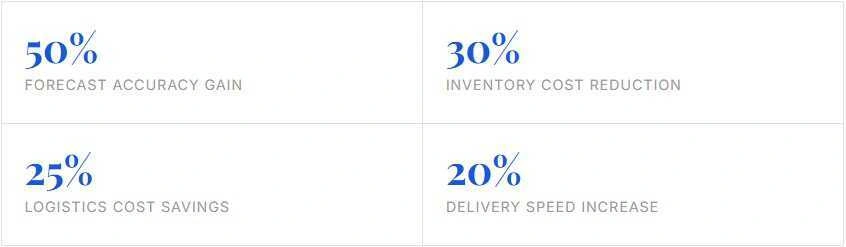
The business case for predictive analytics in the supply chain is often possible before the full-scale deployment, as it can have an impact on a variety of cost categories in the business.
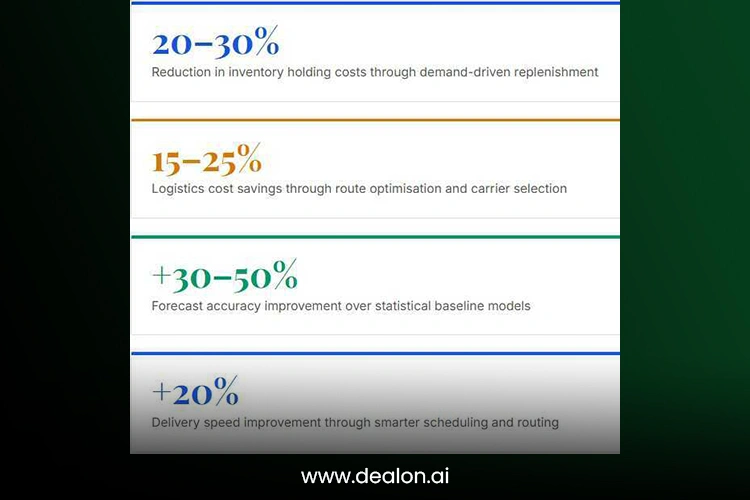
All the figures are based on case studies from the retail, manufacturing, and logistics industries. Results will be different for each person depending on initial maturity, data quality, and the extent of implementation.
The Future: Autonomous Supply Chain Systems
Predictive analytics in supply chains is taking a new direction in the future, one that will require them to not only predict disruptions but also take action on their own without the need for human interaction. The enabling technologies for this transformation are already available, such as sophisticated machine learning algorithms, live data pipelines, and AI-powered optimization engines. The evolution of governance, trust, and organizational structures, however, is still underway to provide for safe systems that can make operational decisions at scale on their own.
In this new paradigm, supply chains are considered as closed-loop smart systems, with AI forecasting directly influencing the autonomous procurement process, which has the capability of issuing an order automatically based on the forecast. These decisions are then cascaded through self-adjusting logistics networks that dynamically shift routes, modes of transportation, and delivery schedules in real-time, with self-healing systems that can switch suppliers or re-route supply sources when there are disruptions.
The big leap isn’t merely the accuracy of prediction but also the layer that seamlessly links prediction to action, bypassing the human bottlenecks and making predictive analytics in the supply chain a full-fledged operational intelligence.
Implementation Roadmap: From Data to Autonomous Operations
Successful uses of predictive analytics in supply chains are done on a project-by-project basis, gradually increasing the capability of the supply chain. These phases create a portable value per se, and prepare the groundwork for the next phase.
| PHASE 1 | Data Integration & Governance Bring data together from ERP, IoT, and external sources to a single data platform. Understand the data quality requirements and data quality governance in the very early stages of model training. |
| PHASE 2 | Pilot Demand Forecasting Roll out ML models for forecast on the highest-volume SKUs or product families. Set benchmarks for accuracy and an ROI framework for measuring ROI. |
| PHASE 3 | Logistics & Inventory Integration Make predictive models for route optimization and inventory replenishment. Make predictive models for route optimization and inventory replenishment. Connect decision outputs to ERP and WMS systems to execute semi-automatically. |
| PHASE 4 | Scale AI Models Across Network Implement supplier risk score, inter-facility inventory balancing, and multi-modal logistics optimization. Develop in-house skills to maintain and enhance models. |
| PHASE 5 | Autonomous Execution Layer Allow automated execution of all the following decisions, within predetermined parameters: replenishment decisions, carrier selection decisions, and supplier switching decisions. Keep humans in the loop for decisions with high stakes or outside of the range. |
Frequently Asked Questions
So what is predictive analytics in the Supply Chain?
Ans. Forecasting future events in the supply chain, including demand shifts, delays, and disruptions, using AI and data models.
It assists organizations in making proactive decisions rather than reactive decisions when the problem arises.
What are some of the benefits of predictive analytics in supply chain efficiency?
Ans. It helps to optimize operations, make quicker decisions, and forecast more accurately, and it cuts down on waste.
It aids in improving inventory management, logistics planning, and supplier efficiency proactively.
So, what is predictive analytics used for in the world of logistics?
Ans. It is used to increase the accuracy of delivery, minimize delays, and optimize transportation routes.
It also enables real-time fleet tracking, fuel management optimization, and predictive fleet maintenance.
What is the importance of forecasting in SCM?
Ans. Forecasting is crucial because all planning decisions in a supply chain rely on future demand forecasts.
Forecasting accurately minimizes stockout, decreases overstocking, and boosts profitability.
What are the benefits of predictive analytics in supply chains?
Ans. The primary advantages are reduced costs, enhanced demand accuracy, speedy deliveries, and resilience.
It also minimizes risks by identifying disruptions prior to their impact on operations.
What role does big data analytics play in the supply chain?
Ans. It brings together big data from various sources to discover patterns that enable better decision-making.
The insights gained assist in better forecasting, logistics optimization, and supplier risk management.
What are the tools that can be used in predictive analytics of supply chains?
Ans. Some of the most popular tools include ERP systems, cloud AI platforms, and IoT tracking systems.
Such as SAP, Oracle SCM, AWS Forecast, Azure ML, and Google Cloud Vertex AI.
What are the major hurdles in leveraging predictive analytics?
Ans. The primary challenges include high cost, low accuracy of the models, lack of skilled talent, and poor data quality.
It can’t be done without Data Governance and ongoing model refinement.
What are the benefits of predictive analytics in logistics?
Ans. It optimizes routes, decreases delays, and enhances delivery reliability, thus improving logistics.
It relies on real-time information, such as traffic, weather, and shipment conditions, to optimize operations in real time.
So what will the future of predictive analytics in supply chains be?
Ans. The future is fully autonomous supply chains that make decisions without humans.
These will automatically forecast, purchase, route, and adjust suppliers.



