
Table of Contents
Key Takeaways
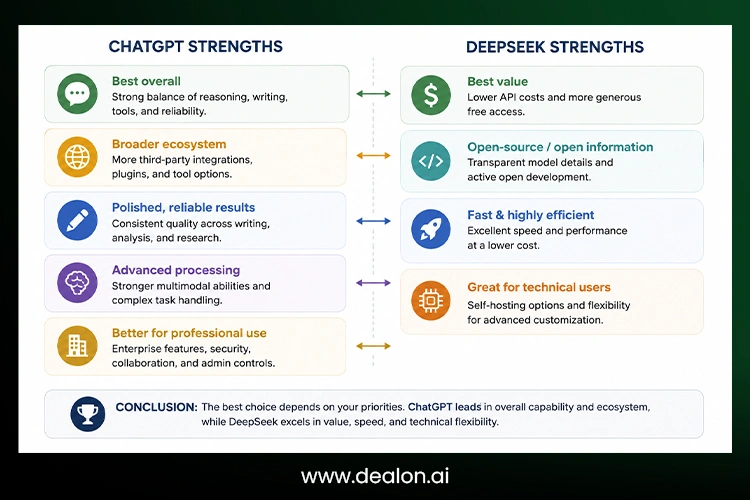
- ChatGPT shines in: research, multi-modal work, business workflow, and day-to-day productivity.
- DeepSeek’s advantages are: API affordability, open-weight deployment, and cost-sensitive development.
- ChatGPT can serve as a tool for developers when it comes to workflow, and DeepSeek can be used for experimentation and scaling.
- The best assistant is the one who is able to accomplish what needs to be done; hence, there is no permanent winner.
ChatGPT and DeepSeek are not competing in the same race. The better choice depends more on what you actually need Artificial Intelligence to do. In reality, the comparison goes far beyond which model reasons better.
It also depends on how each assistant performs in everyday tasks, research workflows, coding, multimodal capabilities, pricing, privacy, open-weight availability, business deployment, and overall reliability — areas where ChatGPT and DeepSeek are not always competing in the same way.
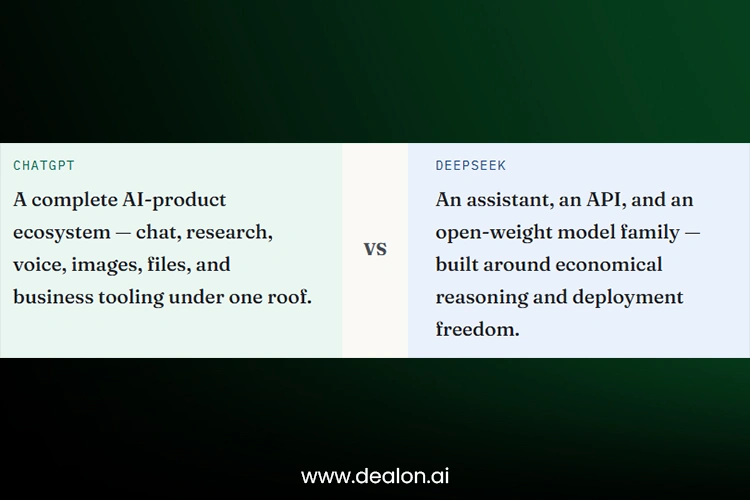
ChatGPT has grown into a complete AI-product ecosystem: a consumer app, a research tool, a voice and image workspace, and a business platform, all sharing one account and one memory layer.
DeepSeek is something different in structure — simultaneously a free chat assistant, a low-cost developer API, and a family of open-weight models that anyone can download and run on their own hardware.
This guide compares four layers of each product rather than treating “ChatGPT” and “DeepSeek” as single, interchangeable things:
- The consumer chat applications
- The paid assistant experiences
- The API and developer ecosystems
- Business and self-hosted deployment options
Every specific model name, price, or limit mentioned below can change without notice — both vendors ship updates frequently — so treat this as a framework for evaluating the two products yourself, verified against the live pricing and documentation pages linked throughout, rather than a permanent scoreboard.
Also Read: Autonomous Customer Service in 2026: How It Works and Why It Matters
Quick Answer: ChatGPT vs DeepSeek by User Type
There is no single universal winner. The better choice depends on what you’re actually trying to do, so here’s the decision above the fold.
| User type | Recommended assistant | Main reason | Important limitation |
| Casual user | ChatGPT | More complete, all-in-one assistant experience | Advanced features can require payment |
| Student | Depends on the task | ChatGPT for research and citations; DeepSeek for reasoning practice | Both answers still need verification |
| Researcher | ChatGPT | Deeper research workflow with files and citations | Usage limits vary sharply by plan |
| Programmer | Both | Different strengths in coding style and cost | Results depend heavily on language and repo |
| Mathematics user | DeepSeek (or blind test) | Strong reasoning model focus | Explanations still need checking |
| Content creator | ChatGPT | Writing, image, voice, and editing tools in one place | Can lean generic without a strong prompt |
| Budget-conscious user | DeepSeek | Free chat access plus a low-cost API | Smaller surrounding product ecosystem |
| Privacy-focused developer | Self-hosted DeepSeek model | Full infrastructure control | Requires real hardware and engineering time |
| Enterprise team | ChatGPT Business/Enterprise | Mature admin and governance tooling | Higher organizational cost |
| Multimodal user | ChatGPT | Broader voice, image, and file workflow | Availability still depends on the plan |
Table 1 · Quick decision matrix
Starting hypothesis: ChatGPT is the stronger all-around AI workspace, while DeepSeek is the more disruptive option for economical reasoning, development, and self-controlled deployment. Treat this as a hypothesis to test, not a conclusion — the sections below either support or complicate it.
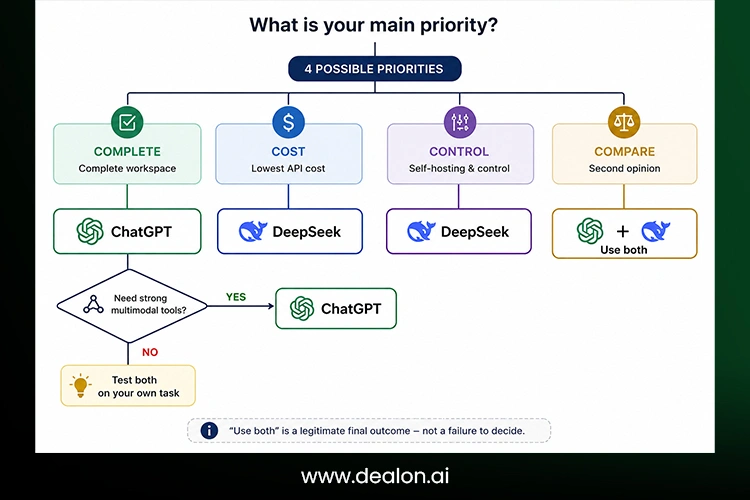
Flowchart 1 · Which AI assistant should you choose?
ChatGPT and DeepSeek aren’t the same type of product.
The most common mistake in this comparison is treating a model, a chatbot, an API, and a full software platform as identical things. They aren’t — and the gap explains a lot of the confusion in “which one is better” debates.
What ChatGPT includes:
- A consumer chatbot with multiple subscription tiers
- Web and mobile applications with synced history
- File analysis, voice interaction, and image tools
- Web search and multi-step deep research
- Projects and persistent memory across chats
- Business workspaces with admin controls
- Connected apps and data sources, plus custom assistants
ChatGPT Projects group related chats, uploaded reference files, and project-specific instructions in one place. At the same time, deep research runs a multi-step online investigation and returns a documented, source-linked report — a meaningfully deeper workflow than a single search query.
What DeepSeek includes:
- A free web assistant and a mobile app
- A developer API with an OpenAI-compatible request format
- Reasoning-focused models alongside general-purpose models
- Open-weight model releases that can be downloaded directly
- Support for deployment through third-party or local infrastructure
DeepSeek is delivered via web, app, and API, and its API documentation is designed to be as close to the OpenAI style as possible, reducing the switching cost for developers who are already developing on that style.
ChatGPT is primarily an integrated assistant platform. DeepSeek is simultaneously a chatbot, an API provider, and an open-weight model ecosystem — three different products wearing one name.
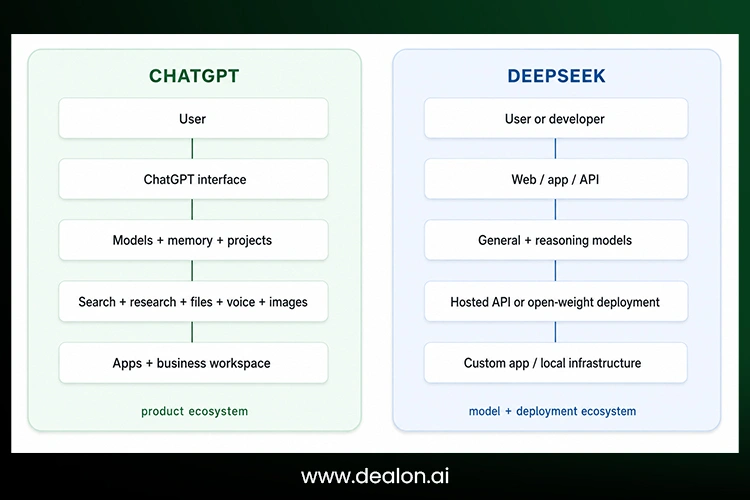
Flowchart 2 · ChatGPT vs DeepSeek ecosystem diagram
The core philosophy difference: AI workspace vs efficient intelligence
ChatGPT’s workspace-first philosophy
ChatGPT is built around the idea that the user completes an entire task inside one product:
ask → research → analyze → create → edit → connect → act
The focus is on a polished interface, multiple input types, persistent context, and connected tools that reduce how often you have to leave the chat window.
DeepSeek’s model-first philosophy
DeepSeek’s appeal runs through a shorter loop:
prompt → reason → generate → integrate or deploy
Its main appeal comes from efficient reasoning performance, low API costs, and deployment flexibility.
A more useful framing than “American AI vs Chinese AI”: geography genuinely matters for regulation and data governance, covered in the privacy section below, but it does not explain the full product difference. The sharper distinction is this —
ChatGPT is like a convenience and workflow completeness machine. DeepSeek offers the three values of capability, efficiency, and deployment flexibility.
| Feature | ChatGPT | DeepSeek |
| Primary identity | AI workspace | Model ecosystem |
| Main strength | Workflow completion | Cost-efficient intelligence |
| Best users | Researchers, creators, businesses | Developers, researchers, AI builders |
| Deployment | Mostly hosted | Hosted + self-hosted |
| Custom infrastructure | Limited | Strong |
Table 2. Comparison between ChatGPT and DeepSeek
Interface, setup, and user experience day-to-day.
Both platforms offer browser access, mobile applications, and synchronized conversation history across devices. The differences can be seen in the details: the limitations and restrictions of the free tiers, geographic availability, and the degree to which each product clearly outlines the sign-in and usage requirements. The specifics change frequently, and it would be best to keep an eye on the current help pages of each vendor, not relying on last year’s limits.
Conversation management
Searchable chat history, ability to fold conversations by projects or conversations, rename, chat history that persists between chats, temporary or private chats, and export or deletion controls. DeepSeek’s interface appears to be quite simple, with some viewing it as underdeveloped compared to ChatGPT’s Projects, while others see it as clean.
Learning curve
Worth evaluating straight up: which product will be easiest to use for a first-time AI user? Which one shows more technical toggles in front of its users (reasoning mode, model selection)? Is the interface transparent about how much you can do before you reach the limits? And how easy is it to carry on a session from one device to another without losing context?
If you’re building this comparison yourself, take screenshots of both interfaces on the same day — comparing an outdated DeepSeek screenshot against a freshly redesigned ChatGPT interface (or vice versa) is one of the most common ways these articles go stale within months.
Quality of reasoning: Which assistant has better reasoning?
It is not a quantifiable statement to describe one as “more intelligent” than the other. The breakdown into specific testable behaviors gives a much more honest comparison.
Mathematical reasoning
Mathematical reasoning should be evaluated through multi-step questions, probability, logical conditions, and word problems. Separately note the accuracy of the final answer, whether the model makes mistakes in calculations, if it is able to detect an impossible or contradictory question, and the clarity of its description of the calculations.
Instruction following
Use prompts with eight to ten explicit requirements stacked together, then check whether every condition is actually met — not just whether the final answer looks impressive. This is where many otherwise-strong answers quietly fail.
Nuanced judgement
Questions with no single right answer that present ethical choices, business strategy decisions, risk considerations, conflicting instances of evidence, and policy interpretation. It’s here that flexible, context-aware language handling tends to differentiate from a structured problem-solving approach.
Self-correction
Feed each assistant an incorrect assumption and watch what happens: does it challenge the assumption, accept it uncritically, correct itself once you push back, or worse, change a previously correct answer to agree with you?
Hallucination behaviour
Embed deliberately unanswerable questions and references to non-existent sources. Score when there’s uncertainty in the system or when the system makes up a confident, invented answer.
It’s widely noted that the strengths of ChatGPT and DeepSeek seem to vary from task to task, with independent comparative studies on NLP tasks revealing these differences. But there are some assessments that indicate that DeepSeek can outperform ChatGPT in structured reasoning and classification tasks, whereas ChatGPT can excel at tasks that involve nuanced and flexible language.
That pattern is used to support a verdict on a category, not on one overall intelligence score, and it’s a good prior to test against your own use case.
Benchmark scores vs real-world helpfulness
Being a leader in a benchmark leaderboard doesn’t always mean that you are a better assistant. Things to consider: benchmark contamination, self-reported vendor results, different versions of models/rationale budgets, tool-enabled results vs model-only results, differences between API and consumer chat product, accuracy vs latency trade-offs, English-language biases in test sets, and benchmarks that subtly go stale as models evolve under them.
A recent cross-platform user study comparing ChatGPT, Claude, and DeepSeek found that user satisfaction was statistically similar across the three despite real differences in funding and benchmark performance, and reported that a large majority of surveyed users regularly used more than one platform — evidence that benchmark leadership and day-to-day usefulness are related but distinct things.
| Benchmark category | What it measures | What it measures poorly | Matching real-world test |
| Mathematics | Structured problem solving | Everyday usefulness | Multi-step calculation |
| Coding | Issue resolution/code generation | Team workflow quality | Debugging a real repository |
| Long context | Information retrieval | Persistent memory | Analyzing a long document |
| General knowledge | Stored or retrieved facts | Citation reliability | Researching a current topic |
| Instruction following | Constraint compliance | Creativity and tone | Multi-condition writing task |
| Human preference | Which answer do users prefer | Objective correctness | Blind side-by-side evaluation |
Table 3 · How to interpret AI benchmarks
Pricing: free access, subscriptions, and the true cost of use
Comparing one monthly subscription price against another tells you almost nothing. Consumer subscriptions, developer API costs, and self-hosting costs are three separate budgets.
Free access
Track or compare daily/rolling usage limits, modes of reasoning permitted, access to Web search, limits on file uploads, access to images and voice tools, limits during peak times, queuing or response time when the load.
Individual paid plans
ChatGPT sells several consumer tiers; its entry paid tier has historically sat around $20/month, though features and limits shift often enough that the live pricing page is the only reliable source at the time you’re reading this.
API pricing
On the developer side, compare input-token price, output-token price, cached-input price, how reasoning tokens are billed, batch discounts, context-caching behavior, rate limits, and any minimum spend requirements. DeepSeek’s API pricing is set per model, and context caching is reportedly enabled by default in its documentation — worth confirming against the live docs, since caching defaults materially change effective cost at scale.
The cost of self-hosting
The infrastructure costs that come with self-hosting an open-weight model are: GPU rental/purchase, electrical power, engineering time, monitoring, security hardening, continuous model updates, scaling, and risk of downtime. A casual user will not find it worth it, while if a team is handling high-volume workload and has predictable expectations for data residency, it could be the whole point.
The simple pricing answer:
- Free users: Both are free to use.
- Individual users: ChatGPT is more expensive and offers a more comprehensive product ecosystem.
- Developers: DeepSeek is much more cost-effective per token.
- Governance and operations are important, as the cheapest model isn’t necessarily the cheapest solution for companies.
| Scenario | ChatGPT | DeepSeek hosted | Self-hosted DeepSeek | Most economical |
| Casual monthly use | $0/month on Free, with limited access to advanced models, files, analysis, voice, and image features. | $0/month through the official web or mobile app; DeepThink, web search, and file uploads are available, subject to service capacity and limits. | Not practical. Even a small local deployment requires suitable hardware, setup, and maintenance. | Tie on price: both offer free access. DeepSeek may provide more reasoning usage at no charge, while ChatGPT offers a broader integrated tool ecosystem. |
| Heavy individual use | Plus: $20/month. Pro options are currently $100 or $200/month, depending on usage allowance. API usage is separate. | $0/month for the consumer app, or pay-as-you-go API usage. DeepSeek V4 Pro costs $0.435/M uncached input tokens and $0.87/M output tokens. | Not economical for one person; an always-on GPU alone can cost more than a premium subscription. | DeepSeek is priced purely. ChatGPT Plus may offer better value when files, voice, images, research, memory, and workspace tools are used regularly. |
| 10-person content team | ChatGPT Business: $200/month when billed annually, or $250/month when billed monthly. This includes a managed workspace, admin controls, connectors, and business data protection. | No equivalent managed seat plan is listed. Under an illustrative API workload of 10M input + 5M output tokens/month, DeepSeek V4 Pro would cost approximately $8.70/month. | Roughly $5,800+/month for a minimally sized, always-on V4 Flash cloud deployment, before storage, networking, monitoring, and engineering costs. This is a lower-bound estimate, not a production quotation. | DeepSeek API for raw generation cost. ChatGPT Business for the lowest-cost, ready-made team workspace with administration and collaboration tools. |
| 10-person development team | For an API-only workload of 30M input + 10M output tokens/month, GPT-5.6 Sol would cost approximately $450/month: $150 input plus $300 output. | Using the same token volumes, DeepSeek V4 Pro would cost approximately $21.75/month: $13.05 input plus $8.70 output. | Approximately $5,800+/month for V4 Flash or potentially $29,000+/month for a full-size V4 Pro FP8 deployment using rented H100-class GPUs, before operational costs. These are rough compute-only lower bounds inferred from model size and GPU memory. | DeepSeek hosted API at this usage level. Self-hosting only becomes financially plausible at much higher, steady utilization or where control is worth the premium. |
| 10M API input tokens | GPT-5.6 Sol: $50 uncached or $5 when served entirely from cached input. Output, web-search, and other tool charges are not included. | DeepSeek V4 Pro: $4.35 on cache misses or approximately $0.036 on full cache hits. Output tokens are not included. | No meaningful fixed per-token figure. Cost depends on hardware utilization, throughput, concurrency, quantization, and operational overhead. | DeepSeek hosted API, by a substantial margin for input token cost. |
| Sensitive internal deployment | ChatGPT Enterprise: custom pricing. It adds enterprise controls, custom retention, regional data residency, stronger administration, and contractual support. (OpenAI) | API costs remain low, but it is still an externally hosted service. DeepSeek states that personal data may be processed and stored on servers in the People’s Republic of China, which may affect organizational data-residency decisions. (DeepSeek) | Approximately $5,800–$29,000+ per month in cloud GPU compute, depending on whether V4 Flash or full V4 Pro is deployed, plus security, monitoring, maintenance, and engineering. (Hugging Face) | Self-hosting when strict infrastructure control or data residency is non-negotiable. ChatGPT Enterprise may be more economical when managed security and compliance are acceptable. |
Table 3 · Total cost comparison
Pricing changes frequently. Chat subscriptions, API billing, and self-hosted infrastructure are different purchasing models and should not be treated as interchangeable. Subscription prices cover access to a finished product, API prices measure model consumption, and self-hosting costs include infrastructure and operational responsibility. The cheapest token price is therefore not necessarily the lowest total cost for a working business deployment.
Context window, memory, and long-document work
Three concepts that comparison articles routinely blur together:
- Context window — the maximum amount of text, data, or previous conversation history a model can consider when generating a response.
- Persistent memory — information retained or referenced across separate conversations.
- Retrieval — searching uploaded documents, project files, connected apps, or the web when needed, rather than holding everything in the active context.
One-to-one comparison: maximum supported context vs. effective context support in real use, retrieval accuracy at start, middle, and end of a long document, cross-chat memory, project instructions, quality of summarisation of long document, “lost in the middle” errors, and cost of context-caching. Useful stress test – 100-page document containing hidden facts at 5 different locations, and then the same questions were asked to both assistants, with the results scored as a percentage of facts retrieved.
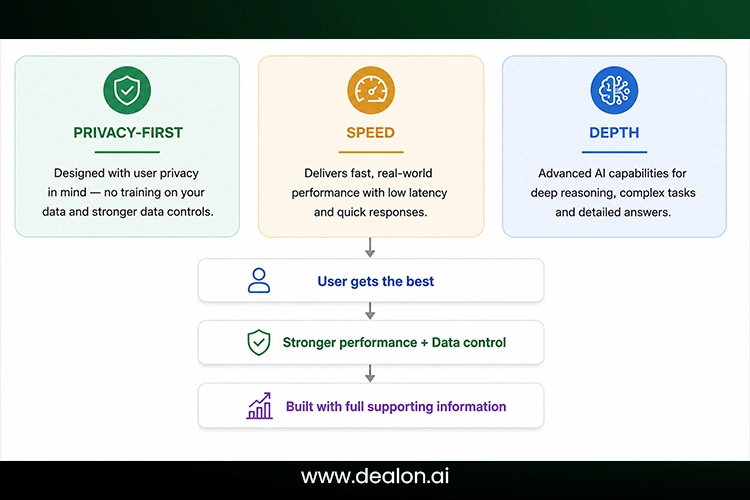
Flowchart 3 · Context window vs memory vs retrieval
Research, web search, and citation quality
Whether web search exists is the least interesting question here — the quality of the research process is what matters. Worth evaluating: search breadth (how many distinct, relevant sources get used), citation correctness (open every citation and confirm it actually supports the attached sentence), source-quality bias (official documentation and peer-reviewed papers vs. low-quality aggregator sites), and research depth on a complex, multi-source task with a written conclusion versus a quick factual lookup.
Today, ChatGPT’s web search and deep research capabilities, along with external connectors to shared drives, code hosts, etc., enable it to support a research workflow designed to yield a documented answer—not just a fact retrieved.
A basic accuracy test that you can perform: citation failure rate = (unsupported or broken citations/total of citations checked) × 100. It is a test that only takes five minutes and shows more about the quality of research than any leaderboard.
Coding, data analysis, and technical work
Structure this by actual development activity rather than a generic “which one codes better” claim.
Code generation
Test across Python, JavaScript/TypeScript, Java, Rust, and SQL — strengths rarely transfer evenly across languages.
Debugging
Use code containing syntax errors, logic errors, race conditions, dependency conflicts, and security vulnerabilities — a much more realistic test than asking for fresh code from scratch.
Repository-level understanding
Run tests to see if the assistant can follow a function across files, understand an architecture you never used before, suggest a safe refactor, write tests, maintain documentation, and not affect unrelated code — the difference between “writes code” and “understands a codebase.
Data analysis
Compare the workflow for working with spreadsheets, CSV, and statistical analysis, and how each handles bad or flawed data.
Developer integration
Examine API format, SDKs, IDE extensions, command-line workflows, tool calling, agent support, local deployment, and community libraries. DeepSeek’s API, which supports OpenAI, can help decrease migration effort. It’s not the same to say that it’s compatible or that it’s identical: “compatible” can mean it’s not completely compatible, so it’s better to test function calling, structured outputs, streaming, and error handling.
Multimodal capability: beyond text chat
Compare image understanding, image generation, voice conversation (including live spoken interaction), document reading, chart and spreadsheet interpretation, screenshot analysis, audio transcription, video understanding, and camera-based interaction.
A fair test set has the same picture, scientific diagram, error display from a screen, misleading graph, scanned document, and voice question for both assistants and is scored on whether the details described are accurate, not simply whether the description sounds confident.
ChatGPT’s product line includes file uploads, image creation, and voice features that continue to receive updates. Because DeepSeek’s multimodal offering can change quickly and unevenly across its app versions, label each tested feature with the exact app version and test date rather than assuming every DeepSeek model supports the same inputs.
Privacy, data storage, censorship, and trust
This is one of the most important — and most often oversimplified — parts of the comparison. Don’t collapse it into a single vague score; the underlying questions are genuinely distinct.
What data is collected?
Compare what each product logs: prompts, uploaded files, chat history, device information, IP address, voice or image inputs, usage analytics, and payment data.
Where is the data processed?
DeepSeek’s privacy policy states that it collects, processes, and stores personal data in the People’s Republic of China, and advises users against submitting sensitive personal data to its services. That’s a material, checkable fact rather than an inference — read the current policy directly before writing anything stronger.
Is user content used for model improvement?
The answer differs by account type: consumer accounts, opt-out settings, API usage, business accounts, enterprise contracts, and self-hosted models can all follow different rules under the same brand. OpenAI provides consumer controls for model-improvement preferences, and states that customer data from its business products and API is not used for model training by default — worth re-verifying against the current enterprise privacy page, since these commitments are exactly the kind of detail that changes with new product tiers.
Sensitive-topic filtering
Examine politically charged, controversial, and culturally sensitive questions on both, and record the pattern of direct refusal, partial response, neutral explanation, one-sided response, unsupported claims, or alternate answers based on the language. Transcribe the exact prompt and response, instead of describing it abstractly.
Hosted DeepSeek vs. Self-Hosted DeepSeek
Privacy conclusions about DeepSeek’s hosted consumer app do not automatically transfer to an independently self-hosted open-weight model — running the weights on your own infrastructure changes the data-processing answer entirely.
Privacy isn’t just a vendor issue. A poorly configured system that is self-hosted can endanger data by way of weak infrastructure, but a well-governed system that is hosted can satisfy many organizational needs. Which one to use depends on threat model, compliance requirements, and internal security procedures.
Flowchart 4 · What happens to your prompt? A simplified privacy data-flow diagram
Open-weight models, self-hosting, and vendor lock-in
Use “open-weight” deliberately rather than calling every releasable model “fully open source” — the two claims are not interchangeable, and license terms matter more than the label.
Worth comparing: Ease of access to the model weights, conditions for its use, conditions for commercial use, support for fine-tuning, quantized versions, local-inference capabilities, hardware requirements, and community support, among other things; ease of changing providers, and becoming dependent on any proprietary feature.
DeepSeek has publicly released several model families with accompanying technical reports, which is the basis of its reputation for openness relative to ChatGPT’s fully proprietary model weights.
DeepSeek may reduce model lock-in, but self-hosting can quietly introduce infrastructure lock-in instead — through GPUs, deployment tooling, and specialist engineering time. ChatGPT is more proprietary at the model level, but its surrounding productivity ecosystem can reduce how much custom infrastructure a team needs to build in the first place.
Teams, enterprise governance, and reliability
Team administration
Compare user provisioning, SSO, MFA, role-based permissions, usage reporting, shared projects and prompts, internal assistants, audit logs, retention controls, data residency options, and support channels. ChatGPT’s business tier includes a dedicated workspace with SAML SSO, MFA, admin controls, and business-data protections — the kind of governance layer that matters far more to a 200-person company than raw model quality.
Reliability and operational risk
Compare published status history, peak-time slowdowns, rate limits, API concurrency, regional availability, support responsiveness, service-level agreements, model deprecations, and unannounced changes in model behavior after silent updates. DeepSeek publishes model-specific API concurrency limits and offers a capacity-expansion process — but any serious evaluation should also test practical latency during normal and peak periods rather than relying on published limits alone.
Fallback planning
The production teams developing both are wise to use a backup model provider, store critical outputs as cache data, implement retry logic, have human approval for production tasks with high risk of failure, prompt using the provider that is independent of the model provider, and have standardized evaluation tests as an insurance policy against outage, outlandish pricing, or policy changes at a single vendor.
The “use both” strategy — a smarter answer than choosing one
Rather than staying loyal to one brand, route tasks according to demonstrated strengths.
Suggested hybrid workflow
Use ChatGPT for: multimodal work, deep research, voice interaction, presentation development, connected applications, collaborative projects, and final editing and formatting.
Use DeepSeek for: economical API workloads, independent second opinions, reasoning comparisons, high-volume text processing, coding experiments, local or self-hosted deployment, and reducing dependence on a single provider.
Cross-checking method
- Generate a first answer in one assistant.
- Ask the second assistant to critique it.
- Return the critique to the first assistant.
- Require evidence for any disputed claim.
- Apply human judgment for the final decision.
This dovetails into the previous user-satisfaction study: Many of the users who are using AI assistants are already using multiple platforms and adopting them as interchangeable tools rather than being loyal to any single platform as a permanent favorite.
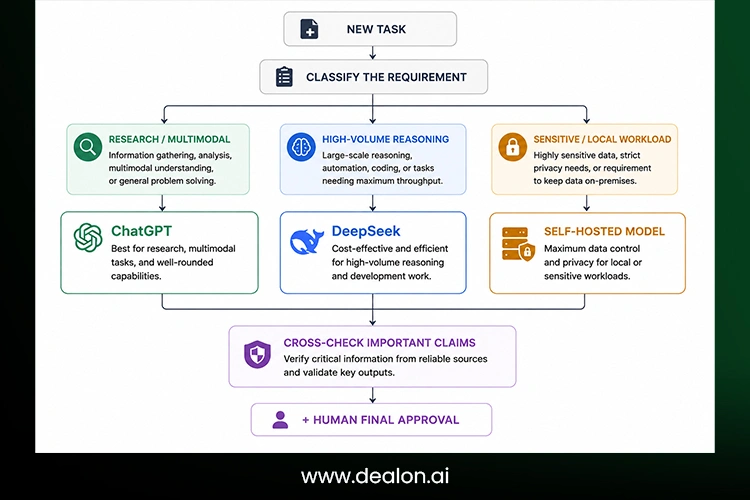
Flowchart 5 · The “use both” AI workflow — route by requirement, not brand loyalty
Final verdict: who wins ChatGPT vs DeepSeek?
A single arbitrary total score, without stated weights, hides more than it reveals. The scorecard below shows the weighting so you can adjust it to your own priorities — swap the weights and the “winner” can legitimately change.
The scores below are editorial product-level scores, and they evaluate each platform’s current product ecosystem, documented capabilities, pricing, deployment options, and governance features. Replace the reasoning and coding scores with your blinded test results once those experiments are completed.
| Category | Weight | ChatGPT | DeepSeek | Category winner |
| Everyday usability | 10% | 9.5/10 | 8.0/10 | ChatGPT |
| Reasoning accuracy | 15% | 9.1/10 | 9.1/10 | Tie—provisional |
| Research and citations | 10% | 9.5/10 | 7.8/10 | ChatGPT |
| Coding | 10% | 9.2/10 | 9.2/10 | Tie—depends on workflow |
| Multimodal tools | 10% | 9.7/10 | 7.2/10 | ChatGPT |
| Pricing and efficiency | 10% | 7.5/10 | 9.8/10 | DeepSeek |
| Privacy controls | 10% | 9.0/10 | 7.0/10 | ChatGPT for hosted use |
| Self-hosting and openness | 10% | 3.0/10 | 9.8/10 | DeepSeek |
| Enterprise governance | 10% | 9.8/10 | 5.5/10 | ChatGPT |
| Reliability | 5% | 9.2/10 | 8.5/10 | ChatGPT |
| Weighted total | 100% | 8.55/10 | 8.22/10 | ChatGPT overall |
Table 4 · Final weighted scorecard
How was the total calculated?
| Weighted total = Σ(category score × category weight) ÷ 100
For example, ChatGPT’s everyday usability contribution is: 9.5 × 10% = 0.95 weighted points |
However, the outcome doesn’t mean that ChatGPT is necessarily best for everyone. It implies that ChatGPT shows better performance based on a set of criteria heavily weighted toward usability, research, multimodal abilities, privacy settings, and enterprise governance.
For general users and enterprises, ChatGPT currently offers a more comprehensive AI assistant due to its functionality of research, multimodal tools, collaboration, and governance within a single ecosystem. DeepSeek is the better option if cost effectiveness, API scale, and deployment control are all of greater importance than full consumer experience.
Frequently asked questions
But is DeepSeek superior to ChatGPT?
It will vary from task to task. DeepSeek is better at cost considerations and problem structuring, whereas ChatGPT is more inclined toward thorough research, multimodal tasks, and routine style. Neither is a no-lose situation.
Is DeepSeek completely free?
The hosted chat service has a generous free tier. Still, the developer API is billed per token, and running an open-weight model yourself carries real hardware, engineering, and electricity costs — “free” only applies to one of the three access paths.
Is ChatGPT more accurate than DeepSeek?
Accuracy varies by model version, task type, prompt quality, and whether external tools like search are enabled — neither product holds a consistent accuracy advantage across every category.
Is DeepSeek safe to use?
For ordinary, non-sensitive use, it’s broadly comparable to other hosted assistants. Its privacy policy states data is processed in China and advises against submitting sensitive personal data — a materially different consideration from self-hosting the open-weight model on your own infrastructure.
Which is better for coding, ChatGPT or DeepSeek?
It depends on the language, repository size, debugging requirements, tool access, and budget — many developers use both and compare outputs on tasks that matter.
Which assistant is more suitable for students?
ChatGPT’s research and citation capabilities are for school research on a source basis, whereas DeepSeek’s reasoning capabilities are for mathematics practice. It is the student’s job to fact-check the work of either assistant.
Can DeepSeek generate images?
Image capabilities vary by app version and have expanded over time — check the exact tested product version and date rather than assuming a fixed answer.
Can DeepSeek replace ChatGPT?
For chat and API use, largely yes. For ChatGPT’s wider ecosystem — deep research, connected business apps, and mature admin tooling — DeepSeek doesn’t currently have direct equivalents.
Can DeepSeek run locally?
The official hosted app cannot; the separately released open-weight models can, through local or third-party deployment tools, given sufficient hardware.
Does DeepSeek store user data in China?
Its privacy policy states that personal data is collected, processed, and stored in the People’s Republic of China for the hosted service. Locally self-hosting an open-weight model is a separate scenario with a different data-processing answer.



