
There are now two systems in every HR department: the one that’s in the employee handbook and the one that’s developing around the AI tools for HR that are performing the screening, scheduling, and reporting under it. That second system won’t be an option in 2026. This guide charts the space where AI plays, its strengths, its gaps, and what still needs a human hand, and its ability to be used by a team, regardless of its size, without taking away the HR component that wasn’t built for automation.
Table of Contents
Which AI Tools Should HR Teams Use in 2026?
The table below outlines the need for each core HR function and the type of AI tool that can address that need, and who is likely to benefit the most from it.
| HR Need | Best AI Solution Type | Ideal Users |
| Resume screening | AI recruitment platforms | Hiring teams |
| Employee support | HR chatbots | Large organizations |
| Performance reviews | AI analytics tools | Managers |
| Learning & development | AI coaching platforms | Enterprises |
| HR analytics | Predictive workforce tools | HR leaders |
| Small business automation | AI HR assistants | Startups |
From Administrative HR to Intelligent Workforce Management
HR has gone through three generations in the past few years, and this third one is still in progress.
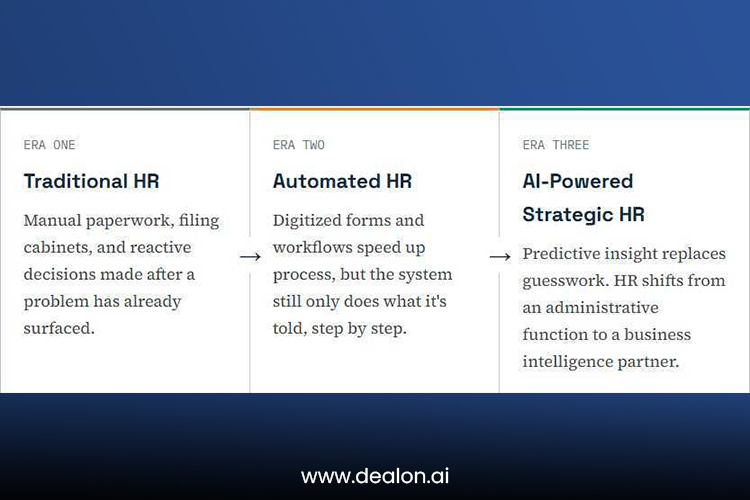
It is not because software is doing more, it is because HR is no longer being asked a lot of “did this get done” questions, and more “what should we do next” questions. AI is not taking the place of HR professionals; it is eliminating the mundane and repetitive work that lies beneath them, thereby giving HR professionals more time to be effective at their people strategy job.
Also Read: Scientific Machine Learning: Intelligent Modeling for the Real World in 2026
How AI Tools for HR Are Changing Every Stage of the Employee Lifecycle
Now, AI is involved in almost every employee step they take from initial use to the exit interview.
| 01 / RECRUIT | The funnel is enhanced with resume screening, candidate matching, auto-scheduling interviews, sourcing talent, and bias detection. |
| 02 / ONBOARD | Automated documentation and personalized journeys, with AI assistants on hand to answer day-one questions instantly. |
| 03 / PERFORM | The ability to have cycles with continuous feedback loops, AI-generated review summaries, goal tracking, and real productivity insight in between cycles. |
| 04 / DEVELOP | Customized training pathways, intelligent career counselors, skill gaps identification, and future job market insights. |
| 05 / ENGAGE | Sentiment, smarter surveys, predicting employee burnout, and early warning signs of employee attrition before it happens. |
Types of AI Tools For HR Teams
The AI-in-HR conversations are all about six interrelated categories of tooling.
| AI HR Tool Category | What It Does | Business Impact |
| AI Recruiting Tools | Automates hiring workflows | Faster recruitment |
| HR Chatbots | Handles employee support | Reduced HR workload |
| AI Analytics Platforms | Surfaces workforce insights | Better decisions |
| AI Payroll Assistants | Automates payroll tasks | Fewer errors |
| AI Learning Platforms | Personalizes development | Skill growth |
| AI Writing Assistants | Drafts HR communication | Saves time |
Best AI Tools for HR Teams in 2026: Real-World Comparison
In 2026, the AI HR landscape is more than just about basic automation tools – it’s about a transformation. AI platforms are now available in various forms to solve particular challenges throughout the employee journey – from recruitment and hiring to understanding trends in the workforce and enhancing employee experience. Based on the goals and objectives, size, and existing HR infrastructure, the best solution will vary. Here’s a practical perspective on the performance of the big categories of AI HR tools in business.
AI Recruitment Platforms
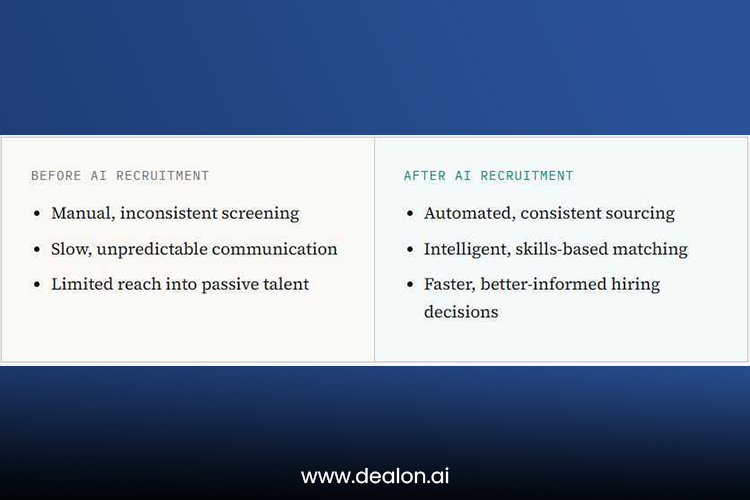
One of the most prevalent uses of AI in HR is in recruitment, with AI recruitment platforms emerging as one of the most popular applications. These tools can leave organizations with the ability to speed up hiring, better match candidates, and streamline the hiring process. Modern AI systems can now prioritize capabilities and experience trends alongside keywords to make better matches, not just based on keywords. Rather than just screening resumes for keywords, modern AI systems can now prioritize skills, trends in experience, and requirements for the jobs.
The enterprise answer to AI-powered recruitment, Workday integrates hiring, employee management, skills intelligence, and workforce planning into a single platform through the power of human capital management. Its AI-driven features enable companies to pinpoint talent shortfalls, suggest candidates, and make workforce choices based on data throughout the employee lifecycle. Companies with a large-scale requirement for a single system of record for HR see benefits in systems such as Workday, as they are able to link the recruitment decision to workforce strategies.
Artificial Intelligence (AI) powered matching and search functionality enables LinkedIn Talent Solutions to help recruiters tap into a global professional network of talent. AI’s strength is in its ability to provide relevant candidates at scale. AI can analyze profiles, skills, career history, and job requirements to provide candidates with the relevant skill sets. This is especially useful for companies looking to hire a niche talent or those hiring in bulk.
Greenhouse Software emphasizes enhancing the construction and uniformity of the hiring procedure. The AI-powered functionality helps candidates and schedules interviews, and ensures consistency in assessment procedures among hiring teams. These are tools that do not completely replace recruiters, but instead help to limit administrative time and inconsistent decision-making when recruiting.
AI HR Assistants and Chatbots.
HR Assistant powered by AI is revolutionizing the relationship between employees and HR. Employees can get answers to common questions instantly without having to wait for human support, such as company policy, benefits, leave, onboarding processes, and guidelines.
But an HR chatbot’s usefulness can’t just be based on how natural it is to communicate. Three main criteria for the most valuable systems are their ability to manage complex employee inquiries, to be accurate when it comes to the application of internal HR policy, and to know when to step in and provide human intervention.
A bot with a wrong salary policy, benefits, or compliance information can cause more issues than it resolves. Advanced HR assistants, therefore, value reliability and transparency as key values, knowing when they have no idea and easily passing on complicated cases to HR professionals. It’s not just about getting response times quicker; it’s about providing your employees with better and more reliable support.
AI Workforce Analytics Tools
AI workflow analytics platforms are a transformation from HR reporting to HR predicting. These tools look at workforce patterns and not just historical data, which allows organizations to predict future issues better.
Strongest platforms are more likely to be predictive in nature, provide workforce planning simulations, and identify risks early on, such as employee attrition or skill gaps. For instance, artificial intelligence can assist managers in identifying teams that might have retention issues, teams where more personnel might be needed, or what changes in the organization could bring about productivity issues.
These systems have the greatest benefit in that they are able to represent potential scenarios prior to decision-making. Instead of asking the question “What happened last quarter?” HR leaders can ask themselves some questions, like, “How does a hiring freeze impact project deliverables?” or “What are the skills we’ll need in our workforce in the next 2 years?” It enables businesses to shift their HR management focus to proactive workforce planning.
Generative AI in HR: Beyond Chatbots and Automation
While 2024 and 2025 have been the years of automating existing HR processes, 2026 is the year that HR teams are able to use AI directly within the working process — writing, editing, and customizing written content that HR teams have traditionally created by hand.
The reality of the change is that HR teams aren’t now writing from a blank page, but they’re making edits and approvals to a strong first draft, freeing up time to make the decisions that still need a human in the room. However, the quality of generative output is only as good as the policy and tone guidance it’s provided—at the end of the day, the teams that are making the most of AI are working hard to establish a clear style guide and approved source material, then using AI to start a draft and taking it from there.
AI Agents Are Entering HR: The Next Evolution of Smart Automation
The next wave is not one that you run as you do — it’s self-service of a goal across scheduling, analysis, and reporting. When a chatbot is waiting for a question, an agent recognizes a pattern and initiates the next step without anyone having to remember to do so – flagging a candidate, drafting a report, or opening a request.
| In Recruiting | Autonomous Recruiting Agents Source candidates, schedule interviews end-to-end, and adjust outreach based on response patterns — with minimal manual input. |
| In Employee Experience
|
AI Employee Experience Agents Handle routine employee requests independently, from policy lookups to leave requests, escalating only the genuine exceptions. |
| In Operations
|
AI HR Operations Agents Analyze workforce data continuously, prepare reports, and recommend hiring or staffing strategies before a leader has to ask. |
AI-Powered HR Analytics: Turning Employee Data Into Decisions
Conventional HR reporting only provides you with what has occurred. Predictive analytics attempts to identify what may happen next.
- What is causing the employees to drop out?
- What skills are needed in the business in the future?
- What are the sources of productivity divides?
- Who needs assistance if their performance begins to wane?
The important difference to remember is that traditional HR reporting is a rear-view mirror – it’s factual and always about something that has happened. Predictive analytics attempts to peer through the windshield instead, and if it’s found that staff is beginning to show signs of disengagement, such as a drop in engagement scores, a quitting manager, or an overloaded workload, for example, it takes a significant amount of weight in order to do something before the resignation letter is received, not after.
AI Bias, Privacy & Ethical Challenges in HR Automation
Never leave an AI HR tool to make decisions that impact a person’s livelihood without supervision. All the risks below are well documented in the industry, and all are design problems, not simply a compliance box to check off when you launch.
Is there any scope for bias in AI Hiring Tools?
Yes, training data problems and algorithmic discrimination do exist — and that’s why it’s important for human oversight of hiring decisions to remain.
Employee Privacy Concerns
Monitoring tools pose real questions regarding the data that is being collected, the use of the data, and whether any employees were ever informed.
Development of HR systems that promote Responsible AI
Resist the temptation to let AI make decisions that have significant consequences, conduct frequent audits, and avoid relying on “black-box” scoring.
AI HR Adoption: How Companies Should Implement AI Successfully
A four-step journey to implementing AI in practice without disrupting the team that it’s designed to support.
| 1 | Identify Repetitive HR Tasks
Use the high-volume, low-judgment tasks as the first place to use AI — it pays for itself the quickest. |
| 2 | Choose the Right AI Tools for HR
Don’t purchase a platform; find the right tool for the job. |
| 3 | Train HR Teams
Adoption is unsuccessful when the tool is tossed on a team with no time allocated for learning the tool. |
| 4 | Measure AI Impact
Establish a baseline prior to launch if you are not going to be able to prove the tool did anything at all. |
AI Tools for HR: Small Business vs Enterprise Use Cases
An AI strategy may vary based on the number of employees and available resources.
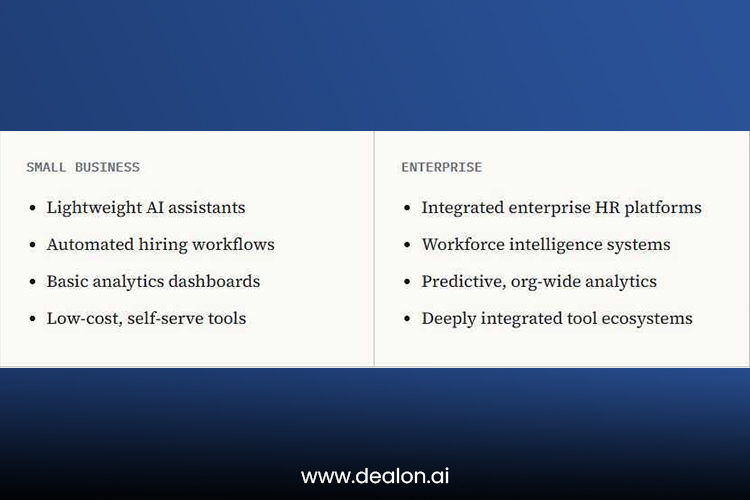
It’s not necessarily a matter of ambition: small teams are just as interested in predictive insight as enterprises are. So, considering whether it’s a 5-person HR function or a 500-person one, it’s about what you can reasonably sustain today or what you can afford to sustain in the market.
The Human Side of AI in HR: Why People Skills Still Matter
The desk can be cleared with the help of AI. It cannot be the opposite of a person who has the worst week of his career.
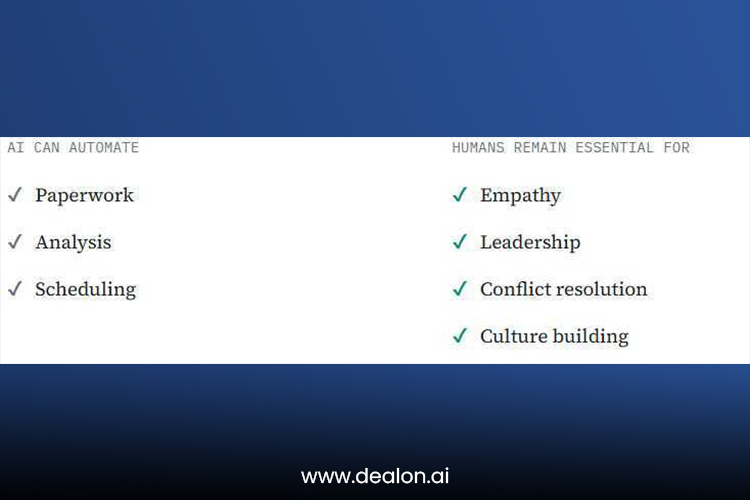
The teams that are doing AI adoption right view this as a division of labor and not a competition. Have the software clear the queue, and hold on to the person for the conversation afterward.
Cost, ROI & Hidden Expenses of AI HR Tools
Most vendors charge a subscription or per-user fee for their services, and enterprise contracts add in implementation and integration costs, which are rarely included in the sticker price. Some of the costs that teams typically miss out on — and that are clearly worth budgeting for — before signing on the dotted line are training time, data migration, and the amount of internal resources needed to customize workflows.
- Measuring AI HR ROI
- Cost-per-hire reduction
- Time saved
- Retention improvement
- HR productivity
What will be Different in HR by 2030?
The path ahead is specific in the coming several years.
- It isn’t just a bonus any longer, but a standard employee benefit.
- Isolation of pockets of HR operations as near-autonomous departments
- Real-time workforce intelligence is a replacement for quarterly reporting.
- Employees’ experiences are tailored to the individual level.
- Rather than relying on a CV, more employers are looking at skills to determine who to employ.
None of these needs a leap in technology; all are currently on the market in some form. The vast majority of the things that change by 2030 are that they get increasingly mature – the tools get quieter, the predictions get sharper, and the boundary between “HR software” and “HR judgment” continues to shift, further year by year, further toward AI.
AI Tools for HR Implementation Checklist (2026)
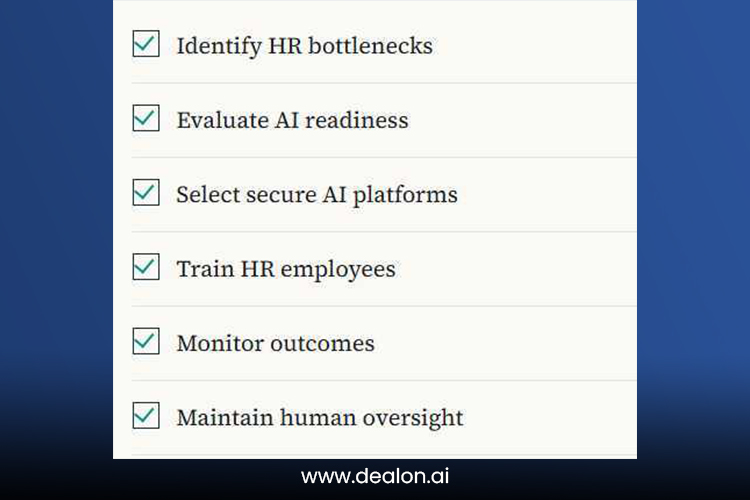
To prevent any AI tool from interacting with a real customer process, there are six checks that you should run.
Frequently Asked Questions
So far, what are the top AI tools to use in HR in 2026?
It depends on the need – teams tend to gravitate toward AI recruitment tools for hiring, HR chatbots to support employees, and predictive analytics tools to aid in workforce forecasting.
What impact are AI tools having on HR?
Eliminates repetitive, administrative tasks such as screening, scheduling, documentation, and shifts from a reactive reporting system to a predictive reporting system, thereby freeing up HR to focus on people strategy.
Can AI replace HR professionals?
The answer is that no AI is going to be as effective as a human in empathy, leadership, conflict resolution, and culture building – and to be clear, that’s a good thing.
What are the AI tools for HR that are used for recruitment?
The most prevalent are AI-driven applicant tracking systems and chatbots for recruitment, which generally screen resumes, match candidates, and even schedule interviews.
How can AI help enhance employee experience?
By enabling quicker induction, HR assistants can answer routine questions instantly and create custom learning and development plans for each employee.
Is there any risk to employee data from AI HR tools?
Safety will depend on the vendor, how the vendor does it, and the implementation — be sure that the vendor has clear policies of how it will use the data, conduct regular audits, and have clear human oversight on any consequential decision.
Can HR teams harness the power of ChatGPT?
While purpose-built HR platforms are likely to be more sensitive to compliance and data, general-purpose generative AI could be used for creating job descriptions, policies, and communications.
What is the cost of AI HR Tools?
The price tag varies from low pricing, per user subscription for small teams, to full enterprise contracts with implementation fees and integration fees added on.
The drawbacks of AI in HR.
The primary concerns are algorithmic bias, difficulties in the transparency of decision-making, and privacy concerns among employees when implementing monitoring tools without adequate communication.
What are some HR tasks that can be automated using AI?
The most frequent tasks today that can be automated in HR are resume screening, scheduling interviews, onboarding documentation, recurring employee inquiries, onboarding paperwork, payroll verification, and first draft HR writing.



