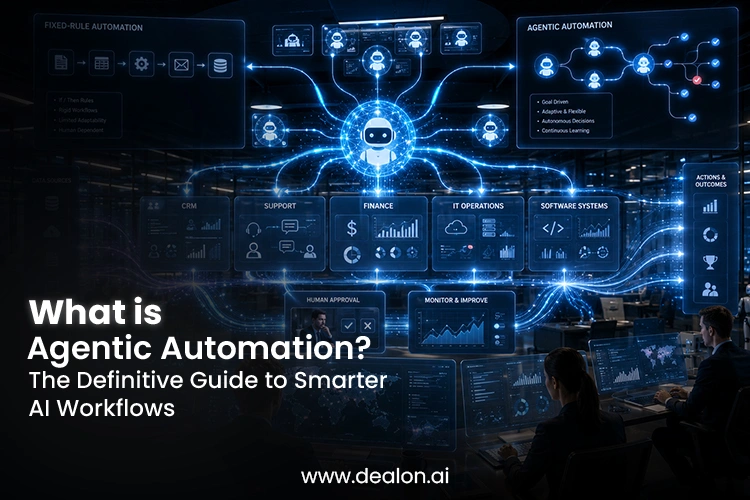

| What is Agentic Automation?
Agentic automation is the utilization of AI agents that can independently plan, decide, and execute multi-step tasks using tools, data, and APIs. Unlike traditional automation, it follows goals instead of fixed rules and can adapt its workflow dynamically based on context. |
Table of Contents
What is Agentic Automation?
This article explains ‘what is agentic automation’, how it works, and why it is becoming a core part of AI systems in 2026. Agentic automation is the employment of AI agents — software powered by large language models — to independently plan, decide, and execute multi-step tasks using tools, data, and APIs, rather than simply following a fixed script.
Where traditional automation executes instructions, agentic automation pursues a goal: it gathers context, chooses its own steps, adapts when something changes, and improves over time.
Anyone running repetitive, multi-step, decision-heavy work — operations leaders, IT teams, customer support, finance, and software teams — should care, because the biggest benefit is compounding: less manual coordination, faster execution, and systems that get better the longer they run.
In 2026, agentic automation is becoming a core layer of enterprise AI infrastructure, not just an experimental technology.
| Topic | Summary |
| Definition | AI agents that plan, decide, and execute tasks autonomously using tools and context, not just fixed rules. |
| Best For | Multi-step, decision-heavy, cross-system workflows with variable inputs. |
| Key Benefits | Speed, adaptability, lower operational load, continuous optimization. |
| Typical Use Cases | Support triage, code review, claims processing, lead qualification, and IT remediation. |
| Human Involvement | Set goals, approve high-risk actions, review outcomes — not micromanage steps. |
| Difficulty in Implementing | Moderate to high — depends on tool integration, governance, and data readiness. |
Agentic Automation vs Traditional Automation
This is the comparison most people search for first, and it’s worth being precise about, because “automation” now spans four genuinely different approaches. Each one adds a layer of judgment that the last one didn’t have.
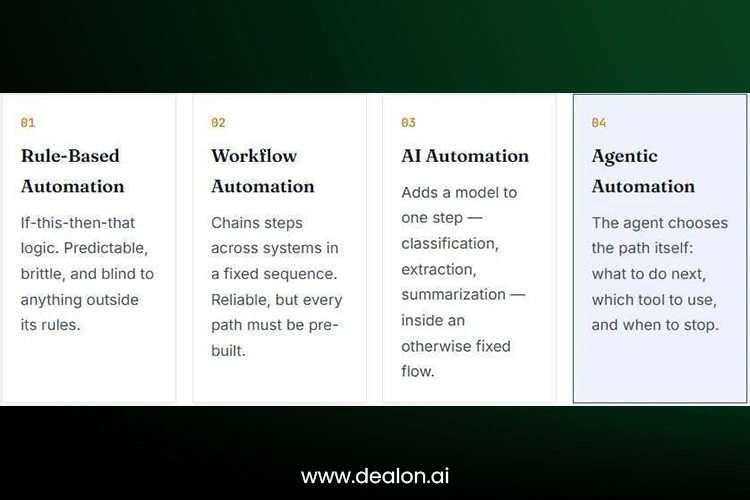
| Feature | Traditional Automation | AI Automation | Agentic Automation |
| Decision Making | Fixed rules | Single-step inference | Multi-step goal reasoning |
| Learning Ability | None | Limited retraining | Memory + feedback loops |
| Adaptability | Breaks on change | Partial flexibility | Self-replanning |
| Human Role | Constant setup | Periodic tuning | Oversight + approval |
| Complexity Handling | Simple tasks | Medium tasks | End-to-end workflows |
How Agentic Automation Works (Step-by-Step AI Agent Workflow)
Every agentic system, regardless of vendor or industry, runs through the same underlying loop. The names vary, but the shape doesn’t: a goal comes in, and the agent works it the way a competent employee would — understand, plan, act, check, improve.
| 01 | Goal Assignment
A person or upstream system defines the outcome — “resolve this ticket,” “reconcile this invoice” — not the exact steps. |
| 02 | Context Gathering
The agent pulls relevant data: records, past interactions, documents, and permissions it has access to. |
| 03 | Planning
It breaks the goal into an ordered sequence of sub-tasks, weighing more than one possible path. |
| 04 | Tool Selection
It chooses which API, database, or application to call for each sub-task. |
| 05 | Execution
It carries out the plan, calling tools and handling errors as they come up. |
| 06 | Self-Evaluation
It checks its own output against the original goal before calling the task done. |
| 07 | Continuous Improvement
Outcomes and corrections feed back into memory, sharpening the next attempt. |
A mid-size SaaS company pointed an agent at renewal risk. Given the goal “flag at-risk accounts before renewal,” it pulled usage data and support history, planned a sequence of checks, called the CRM and billing APIs, scored each account, and drafted outreach for the ones it flagged — all before a human reviewed the list each morning.
Also Read: Artificial Intelligence in Management: The Definitive 2026 Playbook
Core Components of Agentic Automation Systems (AI Agents, Memory, Tools)
Strip away the branding, and every agentic system is built from the same six parts, all wired into a central agent that coordinates them.
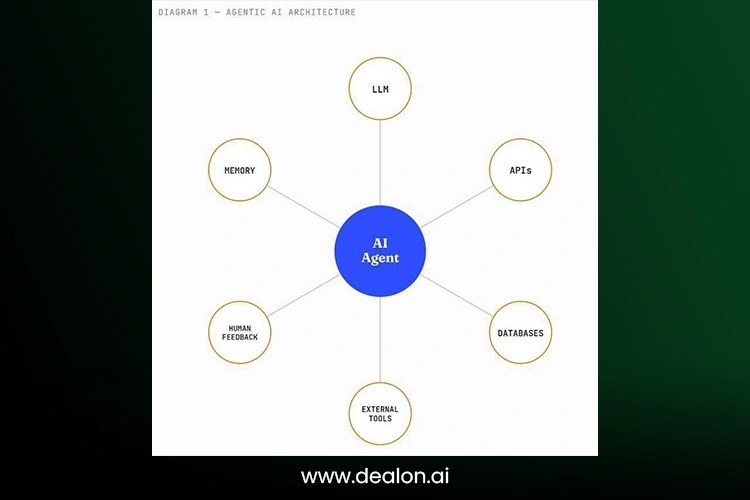
AI Agents are the orchestrators — the layer that decides what happens next. Large language models supply reasoning and language understanding. Memory stores past interactions, so the agent doesn’t start from zero each time. Tool integration and APIs let it act in the real world — sending emails, updating records, running queries. Feedback loops capture whether an action worked, and the planning engine uses all of it to decide the next best step.
Types of Agentic Automation Systems (Single-Agent vs Multi-Agent)
Not every agentic system looks the same. The right shape depends on how much autonomy the task can safely tolerate.
Single-Agent Systems
One agent owns an entire task end-to-end — drafting a report, triaging a support ticket, reconciling a spreadsheet. Simplest to build, easiest to audit, and the right starting point for most teams.
Multi-Agent Systems
Several specialized agents split a larger job — one researches, one drafts, one checks facts — coordinated by an orchestrator agent. Better suited to work too broad for one agent’s context or tools.
Autonomous Workflows
Fully self-directed sequences that run without a human in the loop for routine, low-risk decisions — think inventory reordering within pre-approved limits.
Human-in-the-Loop Systems
The agent plans and drafts, but a person approves before anything irreversible happens — the standard pattern for finance, legal, and healthcare workflows.
Collaborative Agent Networks
Agents from different teams or vendors interact across a shared protocol, each responsible for its own domain — an early version of what many are calling the “autonomous enterprise.”
Agentic Automation Use Cases in Business and Industry
Agentic automation earns its keep wherever work involves judgment across multiple systems — not just data entry.
| Industry | Agentic Task | Business Benefit | Autonomy Level |
| Customer Support | End-to-end ticket resolution | Faster response, lower headcount strain | High |
| Software Development | Code review, bug triage, PR drafting | Shorter release cycles | Medium |
| Healthcare | Prior authorization, scheduling | Reduced administrative burden | Low–Medium |
| Finance | Invoice matching, fraud flagging | Faster close, fewer errors | Medium |
| Marketing | Campaign optimization, reporting | Real-time budget reallocation | Medium |
| Manufacturing | Predictive maintenance routing | Less downtime | Medium |
| HR | Candidate screening, onboarding | Faster time-to-hire | Low–Medium |
| Cybersecurity | Threat triage and containment | Faster incident response | High, with approval gates |
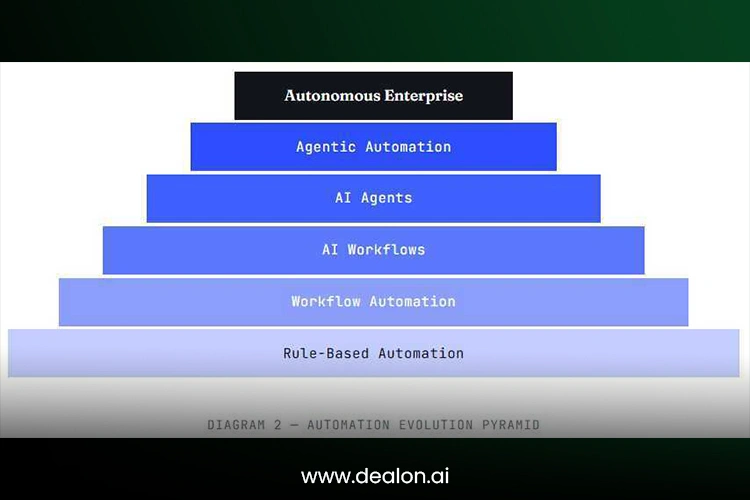
Agentic Automation vs AI Agents vs AI Workflows
This is where most articles blur three distinct terms together. It’s worth separating them clearly, because the words are not interchangeable. These terms are often confused but represent different levels of system design. An AI agent is a single autonomous unit that performs tasks using tools and reasoning. An AI workflow is a predefined sequence of steps where AI is used at specific points, but the structure remains fixed. Agentic automation refers to the broader system where one or more AI agents operate across workflows, making decisions dynamically with minimal human intervention.
Benefits of Agentic Automation
| Benefit | Business Impact | Example |
| Faster execution | Multi-step tasks finish without manual handoffs | Ticket resolved in minutes, not days |
| Better decisions | Decisions grounded in full context, not partial data | Fraud flags weighted by full account history |
| Lower costs | Fewer people are needed for repetitive coordination | Invoice reconciliation at scale |
| Continuous optimization | Systems improve without a rebuild | Agent refines outreach timing over months |
| Scalability | Volume grows without proportional headcount | Support agent handles seasonal spikes |
| 24/7 operations | Work continues outside business hours | Overnight order processing |
| Personalization | Responses tailored to individual context | Custom onboarding paths per customer |
Example: A customer support system using agentic automation to resolve tickets end-to-end by retrieving order data, generating responses, issuing refunds, and updating CRM systems without human intervention unless exceptions occur.
Agentic Automation Examples in Real Life
In real-world applications that involve reasoning, planning, and using tools, agentic automation is already in use. In customer support, for instance, AI agents can read through customer tickets, access order information, formulate responses, and only redirect complex calls to human agents. In finance, agents may match invoices throughout a number of systems and mark down any discrepancies without having to go through the process manually. They can check out pull requests, find bugs, and propose solutions to them even before human eyes check them out in software development.
Challenges, Risks, and Limitations of Agentic Automation
While the use of agentic automation has many advantages, it also presents new risks that need to be carefully managed. Just like with human agents, AI agents have the ability to perform intricate tasks with low supervision, which can also lead to faster spread of errors if not properly safeguarded. The most prevalent risk is AI Hallucination, where an agent is confident about presenting incorrect or misleading information. If these outputs are used without verification, they can result in flawed decisions or costly mistakes.
Another major concern is security, as AI agents may need to access various applications, databases, and external tools to execute their tasks. If there are no effective access controls and good authentication systems, these integrations can become weaknesses that might result in unauthorized access to the data or data breaches.
Furthermore, companies need to establish governance mechanisms to specify what AI agents can do on their own and what necessitates human permission. In different industries, which are subject to strict regulations, adherence to compliance, accountability, and risk management is paramount.
AI drift, in which an agent’s actions over time gradually change as the models, data, or business conditions change, is another challenge. An AI system that has been performing well at first will not remain so without continuous monitoring and periodic review. Moreover, when AI agents place too many API calls or run unnecessary workflows, it can result in unexpected operational expenses.
An agentic Automation framework that is mature has been structured to ensure that AI systems are reliable and accountable through a process of risk management. The AI agent suggests an action based on the objective it has been assigned. The proposed action is then subject to risk detection, which involves a review of the action and organizational policies, and taking into account such factors as costs, data sensitivity, security risks, and the possibility of undoing the action if it proves to be wrong.
When the action exceeds the pre-defined risk thresholds, it is automatically routed to human review, where an authorized person is able to review the recommendation. The proposed action can be approved, altered, or rejected prior to going forward by the reviewer. Once approved, the AI agent carries out the task, and every decision, approval, and outcome is captured in an extensive audit log for traceability. This permanent record helps with compliance and transparency, and allows organizations to audit AI-driven decisions at any time.
Agentic automation is not suitable for highly ambiguous creative work, emotionally sensitive decisions, or situations requiring strict legal accountability without human oversight.
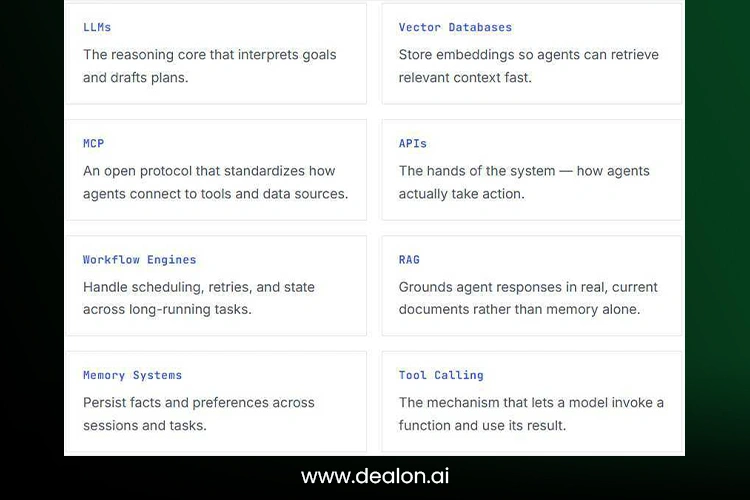
Technology Stack Behind Agentic Automation
How to Build an Agentic Automation System
Building an effective agentic automation system is best approached through a phased implementation strategy rather than a large-scale deployment. Most successful organizations begin with a single, well-defined workflow and gradually expand AI capabilities as reliability and performance improve.
The initial step is to determine repetitive multi-step operations that can be automated, such as handling customer support, document processing, or report generation. Then, organizations choose the best AI model based on its performance, accuracy, and capacity to perform the desired tasks. The third step after the selection of the model is to integrate the model with the necessary tools, databases, and business applications through APIs or protocols like the Model Context Protocol (MCP) to facilitate access to the resources the AI agent requires.
Once integrated, it is then deployed in a controlled environment (or pilot project) to test it before widespread adoption. Organizations then track such important parameters as accuracy, operational cost, response time, and exceptions to ensure system reliability. Lastly, they fine-tune the agent to make the most of prompts, enhance workflows, bolster guardrails, and integrate user feedback. Over time, this continuous enhancement process makes agentic automation more accurate, efficient, and valuable.
Best Tools for Agentic Automation in 2026
Instead of focusing on individual products that may quickly change, it is more useful to understand the main categories of tools that make agentic automation possible. Most organizations combine several of these technologies to build intelligent, end-to-end AI workflows.
AI agent platforms are the backbone of creating and deploying AI agents without human intervention. They allow a developer to specify the objectives, planning algorithm, memory, and tools that an agent has to execute tasks that are more complicated than a human would be able to do.
Workflow automation platforms coordinate multi-step business processes by connecting different applications and managing the sequence of tasks. They ensure that AI agents can trigger actions, pass information between systems, and complete workflows efficiently.
Vector databases are able to store and retrieve data according to meaning, not key terms. This ensures that AI agents have quick access to relevant documents, knowledge bases, or past interactions to provide more accurate and contextually correct responses.
Memory systems permit AI agents to remember essential details between sessions, like user preferences, past interactions, etc. This long-term memory assists agents in performing in a more consistent and personalized way over time.
LLM providers supply the large language models that power an agent’s reasoning, language understanding, and decision-making capabilities. These models enable AI agents to interpret instructions, generate responses, analyze data, and plan actions.
AI agents are integrated into other business software like customer relationship management, enterprise resource planning, ticketing, and communication platforms. The integrations enable agents to engage with genuine business information and automate actions throughout several applications.
Future of Agentic Automation (2026-2030)
Agentic automation is projected to become an integral component of business in 2026-2030. Businesses are likely to use AI coworkers with human workers to perform repetitive tasks like customer service, reporting, scheduling, and data analysis. AI agents can also enable some enterprises to become autonomous, handling basic day-to-day back-office tasks with little human intervention.
A key trend is the rise of multi-agent systems, in which several specialized AI agents collaborate under a coordinating agent to complete complex workflows. These systems will become more adaptive through self-improving workflows that learn from previous outcomes and continuously optimize their performance. AI is also expected to assist with project management by coordinating tasks across both human teams and AI agents. As these capabilities mature, organizations may increasingly rely on digital employees—AI agents assigned to specific business roles with clearly defined responsibilities and measurable performance.
Best Practices for Successful Agentic Automation
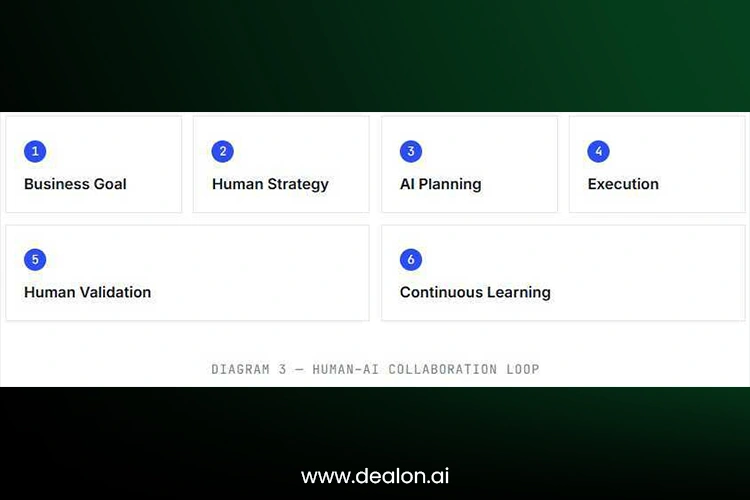
Successfully implementing agentic automation requires careful planning and continuous oversight. Organizations should keep humans in control by requiring approval for sensitive, high-cost, or irreversible actions. It is also advisable to start with a single, well-defined workflow before expanding AI to more complex business processes.
Ongoing monitoring is crucial for maintaining the accuracy and effectiveness of AI agents and ensuring they continue to align with business goals. Organizations should also ensure that they access all integrations with just enough level of access as needed to carry out their work. To assess the value of the automation to the business and measure return on investment (ROI), an approach can be taken through various measures, including time saved, cost savings, and error rates.
Finally, businesses should document workflows so that team members clearly understand how AI agents operate, and they should test and update systems regularly as AI models, business requirements, and external tools evolve. Following these best practices helps organizations build reliable, secure, and scalable agentic automation systems.
Is Agentic Automation the Future of Work?
Not in the way headlines suggest. AI won’t replace every worker — it will replace repetitive coordination: the chasing, checking, and re-entering that fills so much of a working day. What’s left is more supervisory: humans set direction and judge outcomes, while agents handle the execution in between. Organizations that adopt this pattern early aren’t just cutting costs — they’re building an operating muscle that’s hard for slower-moving competitors to catch up to.
Conclusion
So, what is agentic automation, in one line? It’s the shift from automation that follows instructions to automation that pursues outcomes — AI agents that plan, reason, and execute complex workflows across tools and systems, with people setting direction and reviewing what matters most.
The real shift is not from humans to AI — but from humans doing execution to humans directing intelligent systems that execute for them. In summary, ‘what is agentic automation’ answers to the fact that it is a shift from rule-based automation to goal-driven AI systems that can plan and execute tasks autonomously.
Frequently Asked Questions
What is agentic automation in simple terms?
Agentic automation is a form of an AI system that performs multi-step tasks, plans, decides, and acts with the help of tools, data, and APIs. It doesn’t perform fixed actions, but tries to achieve an objective and adapts its actions to context and outcome.
How does agentic automation work?
Agentic automation is a cycle that involves getting a goal, collecting the necessary context, generating a plan to accomplish it, identifying tools/APIs, executing actions, and assessing outcomes. Steps can be repeated and refined in the system until the desired results are reached, and often little or no human participation is needed.
What is the key difference between AI agents and agentic automation?
An AI agent is a single autonomous system that performs tasks using reasoning and tools. Agentic automation is a broader system that uses one or more AI agents to manage complete workflows or business processes. In short, AI agents are building blocks, while agentic automation is the full system.
How is agentic automation different from traditional automation?
Traditional automation operates on a set of predetermined rules and is not flexible enough to handle new scenarios. Agentic automation is goal-driven, which is able to take its next action, adapt to changing conditions, and make decisions in real-time as it sees them, depending on the situation and the tool it can use.
What are the main use cases of agentic automation?
Agentic automation is widely used in customer support, software development, finance, healthcare, marketing, HR, and cybersecurity. It is especially useful in tasks that require multiple steps, decision-making, and integration across different systems.
Is agentic automation safe to use in businesses?
Yes, but only when proper safeguards are in place. Safe implementations include human approval for high-risk actions, strict access controls, monitoring systems, and detailed audit logs to track every decision made by the AI agents.
What is an instance of agentic automation in the world?
They can help in various aspects such as customer support, finance, cybersecurity, and development. For instance, in customer service, AI can handle customer tickets end-to-end, in finance systems, AI can automatically reconcile invoices, in cybersecurity systems, AI can triage security threats, and in development, AI can review code and recommend fixes.
Will robotization take jobs from agents?
Agentic automation has a higher chance of replacing repetitive coordination activities as opposed to jobs. AI agents will still work on tasks that require less decision-making, supervisory, or strategic skills, while humans will take charge of more complex decision-making, supervisory, and strategic tasks.
What are the technologies in agentic automation?
Some of the most prevalent technologies are large language models (LLMs), AI agent frameworks, workflow automation tools, vector databases, memory systems, and APIs that bridge AI systems and real business applications.
What is the future of agentic automation?
The future of agentic automation involves multi-agent systems working together, more autonomous business processes, and AI systems acting as digital coworkers. However, human oversight will remain essential for critical and high-risk decisions.



