
Table of Contents
How AI Transforms Management Today
Artificial Intelligence in Management is moving beyond the data team and is now part of the strategy-setting, team composition, and risk pricing processes. Put simply, for executives who don’t have much time to spend on their jobs, the switch can be summarized in one sentence: AI has become the decision partner that distances data and action.
Who should use Artificial Intelligence in management, and how? Broadly, any leader responsible for allocating people, budget, or attention benefits from at least one AI-driven function — even if the rest of the organization has not yet adopted intelligent decision-making systems. The table below maps where the impact is highest today.
| Management Function | AI Use Case | Impact Level | Example Tool Type | Business Outcome |
| Strategic Planning | Market trend forecasting | High | Predictive analytics platform | Faster, evidence-based pivots |
| Performance Management | Automated performance tracking | Medium | People Analytics Dashboard | Shorter review cycles |
| Resource Allocation | Workload balancing algorithms | High | Workforce optimization engine | Higher team throughput |
| Team Communication | Meeting summarization & sentiment | Medium | AI meeting assistant | Fewer follow-up meetings |
| Risk Management | Scenario simulation | High | Decision intelligence platform | Earlier risk detection |
| Hiring & Talent | Skill-gap analysis | Medium | AI HR system | Faster upskilling cycles |
| Daily Operations | Report automation | Low–Medium | Generative reporting tool | Hours saved per week |
The New Definition of Leadership in the AI Era
For most of business history, leadership was defined by the ability of one person, or a small team, to synthesize incomplete information faster than their competitors. Artificial Intelligence in Management changes that premise. The synthesis step — pattern detection across large, messy datasets — is now something a system can do continuously, at a scale no individual can match.
This does not shrink the role of the leader; it relocates it. Leadership is shifting from human-only judgment toward AI-augmented leadership, where the manager’s core value is asking better questions, framing the right trade-offs, and owning the consequences of a decision. AI functions as a decision partner, not a replacement — it widens the field of view before a human commits to a course of action.
The outcome of this is a data-driven leadership approach – opinions are still needed, but are now accompanied by evidence. Successful leaders are the ones using AI as a tool to augment, not supplant, judgment in their leadership management in 2026.
Also Read: Mastering LLMs: A Complete Guide to Confident AI Learning in 2026
AI-Driven Management vs Traditional Management
| Area | Traditional Management | AI-Driven Management |
| Decision Making | Based mainly on experience and reports | Based on predictive insights |
| Planning | Periodic reviews | Continuous forecasting |
| Employee Management | Annual evaluations | Continuous feedback |
| Risk Assessment | Reactive | Predictive |
Core Pillars of Artificial Intelligence in Management
Artificial Intelligence in Management is built on four fundamental pillars that define how organizations use AI to improve leadership, operations, and decision-making. Rather than viewing AI adoption as a single technology upgrade, successful organizations evaluate these pillars individually to identify where AI can create the greatest impact. Each pillar addresses a different management challenge, from predicting future business trends to enhancing employee capabilities.
Predictive Intelligence focuses on using historical and real-time data to forecast future outcomes and help leaders make proactive decisions. By analyzing patterns, market trends, customer behavior, and operational data, AI systems can predict potential opportunities and risks before they occur. In management, predictive intelligence is commonly applied to areas such as demand forecasting, revenue prediction, inventory planning, and resource allocation. Technologies such as machine learning algorithms and time-series forecasting models enable organizations to identify trends with greater accuracy. For example, a retail organization can use AI to predict regional demand shifts and adjust inventory levels accordingly, allowing managers to respond faster to changing customer needs.
Operational Automation involves using AI to eliminate repetitive administrative tasks and streamline everyday managerial processes. Instead of spending hours on manual reporting, scheduling, data entry, or task coordination, managers can rely on AI-powered systems to automate routine workflows. Some technologies, like robotic process automation (RPA) and generative AI, help organizations improve efficiency while allowing leaders to focus on higher-value strategic activities. A practical example is an AI system that automatically generates weekly operational summaries for regional managers by collecting performance data, identifying key updates, and presenting actionable insights.
Cognitive Decision Support represents the ability of AI systems to assist leaders by analyzing complex information, evaluating different scenarios, and highlighting potential outcomes. Unlike traditional analytics that only describe what happened, cognitive decision-support systems help managers understand why events occurred and what actions may produce the best results. These systems use technologies such as decision intelligence platforms, advanced analytics, and AI-powered simulations to support strategic planning and investment decisions. For instance, before launching a new product, executives can use AI simulations to evaluate pricing strategies, forecast customer responses, and compare possible business outcomes.
Workforce Augmentation focuses on enhancing human capabilities rather than replacing employees. AI-powered assistants and copilots allow managers and teams to analyze information faster, generate reports, automate research, and improve productivity. By extending the analytical and creative abilities of employees, AI enables individuals to perform tasks that previously required significant time and expertise. Technologies such as AI copilots, virtual assistants, and generative AI tools are being integrated into workplaces. For example, business analysts can use AI systems to create initial report drafts within minutes, allowing them to spend more time refining insights and supporting strategic decisions.
These four pillars form a complete management system for AI-driven management. Adaptive leadership models, operational efficiency, and quicker, data-driven decisions in a highly competitive business landscape can all be developed by organizations that successfully leverage predictive intelligence, operational automation, cognitive decision support, and workforce augmentation.
AI-Powered Decision Making — The Leadership Engine
Every leadership decision sits somewhere on a spectrum between data-driven and intuition-driven judgment. Intuition remains valuable — it encodes years of pattern recognition a model has never seen. But intuition alone is vulnerable to blind spots, recency bias, and scale limits. Predictive analytics in strategy addresses exactly those gaps: it tests a leader’s instinct against evidence before resources move.
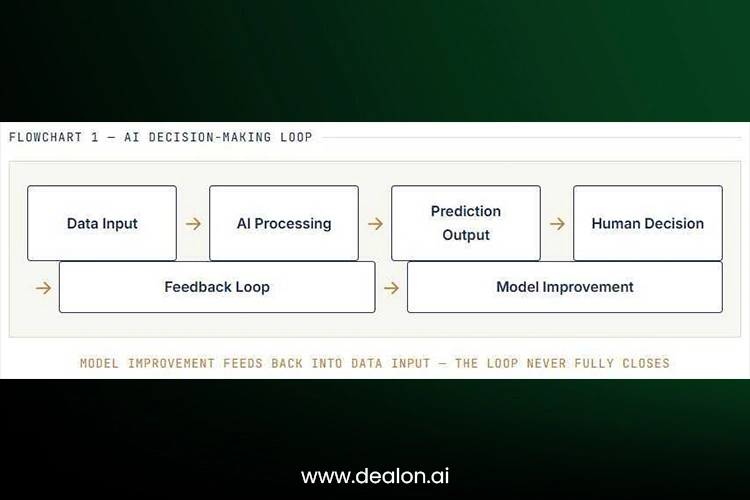
Scenario modeling is where this becomes concrete. Instead of debating a single forecast, AI-driven management lets a team simulate several futures — optimistic, conservative, and stressed — and see how a decision performs across all of them. The loop below shows how that process typically runs inside an organization already using intelligent decision-making systems.
For example, global retailers use AI forecasting systems to analyze seasonal demand, regional buying patterns, and supply chain constraints before making inventory decisions. Instead of reacting to shortages after they happen, managers can prepare multiple strategies in advance.
How AI Improves Team Management & Productivity
The idea of management AI is not to take the place of leaders, but to provide them with improved tools for making decisions faster, running operations more efficiently, and adapting to changes in the external environment. While AI can undoubtedly decipher data, anticipate trends, and perform tasks automatically, the human touch, creativity, and accountability are invaluable.
| HR Function | AI Tool Role | Benefit | Risk / Challenge | KPI Improvement |
| Performance Tracking | Continuous signal aggregation | Objective, ongoing feedback | Over-reliance on quantifiable metrics | Review cycle time ↓ |
| Workload Distribution | Capacity-aware task routing | Reduced burnout, balanced output | Requires accurate capacity data | Overtime hours ↓ |
| Skill Gap Analysis | Competency mapping against role needs | Targeted, faster upskilling | Bias if the training data is narrow | Internal mobility ↑ |
| Productivity Forecasting | Trend modeling from historical output | Earlier staffing decisions | Can undervalue qualitative work | Forecast accuracy ↑ |
AI in Strategic Planning & Forecasting
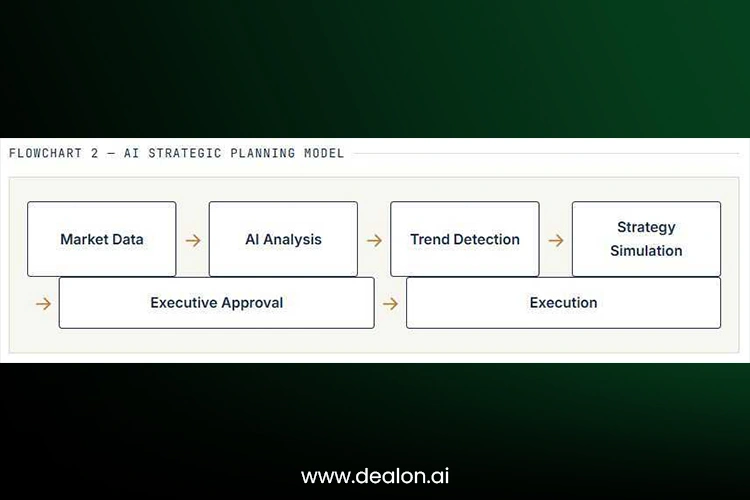
At the enterprise level, AI in leadership shows up as market trend prediction, risk forecasting, and competitive intelligence systems that monitor a moving landscape continuously rather than through quarterly reviews. This does not remove strategy sessions from the calendar — it changes what walks into the room: modeled options instead of raw opinion.
Automation of Managerial Operations — The Silent Revolution
The most visible AI stories are strategic. The most valuable ones, quarter over quarter, are often mundane: automated reporting, meeting summarization, workflow automation, and email or task prioritization. None of these make headlines, but together they return hours of a manager’s week that used to disappear into administrative overhead.
| Task Type | Traditional Method | AI Method | Time Saved | Accuracy Improvement |
| Status Reporting | Manual compilation from multiple sources | Auto-generated summary reports | ~60–70% | Fewer omissions |
| Meeting Notes | Manual note-taking | AI transcription & summarization | ~80% | More consistent action items |
| Task Prioritization | The manager makes a judgment call each morning | Priority-ranked task queues | ~30–40% | Fewer missed deadlines |
| Inbox Triage | Manual sorting | AI-suggested categorization | ~50% | Faster response times |
AI for Leadership Communication & Decision Support
Communication is where many leaders first encounter intelligent decision-making systems, often without naming it that way. AI meeting assistants now capture and summarize discussions in real time. Sentiment analysis in teams — applied carefully and transparently — can flag early signs of disengagement across a distributed workforce before a survey would catch it. Smart dashboards for executives compress dozens of reports into a single live view, so a leader walks into a room already briefed rather than being briefed inside it.
If properly used, these tools can help reduce the time gap between “something is happening” and “leadership knows about it. When misused, they make it look as though they know everything. The tension is the subject of the next section.
Ethical Leadership in Artificial Intelligence in Management
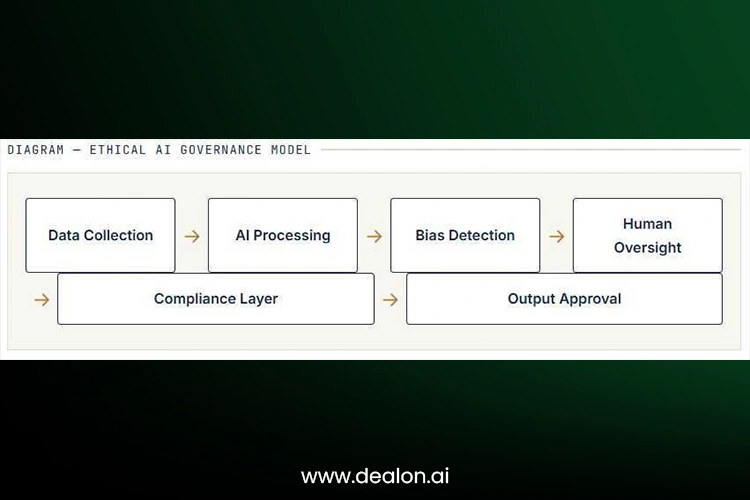
No credible playbook on Artificial Intelligence in management can skip its risks. Four issues deserve a leader’s direct attention rather than delegation to a technical team alone:
Bias in algorithms. Models trained on historical decisions can quietly repeat historical inequities in hiring, promotion, or performance scoring.
Transparency issues. If a manager cannot explain why a system produced a recommendation, that recommendation should not be treated as a final answer.
Data privacy concerns. Sentiment and performance monitoring must be scoped, disclosed, and limited — surveillance erodes the trust that AI-driven management depends on.
Responsible AI leadership frameworks. Organizations need a named governance owner, not just a policy document, for AI-assisted decisions. The most effective organizations will not allow AI systems to make high-impact decisions independently. Instead, they will create human-in-the-loop systems where managers review recommendations, challenge assumptions, and remain accountable for outcomes.
AI Tools Transforming Modern Management — 2026 Landscape
| Category | Main Purpose | Management Impact |
| Analytics AI | Finds patterns | Better forecasting |
| HR AI | Understands workforce | Better talent decisions |
| Workflow AI | Automates tasks | Higher productivity |
| Decision AI | Simulates outcomes | Better strategy |
Rather than focusing on specific AI products that may change over time, leaders should understand the major categories of AI tools that support management functions. These categories represent the core capabilities organizations need to improve decision-making, productivity, and workforce management.
AI analytics platforms can enable organizations to turn vast quantities of their operations and market data into valuable insights. They analyze the patterns, make forecasts, and build dashboards to enable managers to track performance, detect trends, and make data-driven decisions. Examples include enterprise analytics systems used by companies to monitor sales trends, operational efficiency, and customer behavior in real time.
AI HR solutions leverage AI to improve the management of workforces by assisting in areas like recruitment, employee skill evaluation, training and development, and workforce planning. These systems help managers in identifying the skill gaps and make better hiring and employee development decisions. Organizations increasingly use AI-powered workforce platforms to identify skill gaps, recommend training pathways, and improve internal mobility.
AI project management tools help with coordinating the team by automating repetitive management activities like scheduling, task assigning, monitoring project progress, and creating project status reports. These enable managers to pay more attention to strategic issues and less to administration.
AI decision intelligence platforms can aid complex leadership decisions by running simulations to consider possible outcomes and scenarios. They contribute to the executive’s risk analysis, comparison of strategies, informed investment, operation, and long-term planning decisions.
Implementation Roadmap for Organizations
Adopting Artificial Intelligence in Management works best as a phased rollout, not a single company-wide rollout announcement. The roadmap below reflects the sequence most organizations that succeed with AI-driven management actually follow.
| Phase | Objective | Tools Needed | Timeframe | Success Metrics |
| Phase 1 — Awareness & Audit | Map current decisions and data gaps | Data inventory, readiness assessment | 4–6 weeks | Clear inventory of decision points |
| Phase 2 — Pilot Projects | Test AI on one contained use case | Single analytics or automation tool | 1–3 months | Measurable time or cost saved |
| Phase 3 — Integration | Connect AI outputs into daily workflows | Dashboards, workflow integrations | 3–6 months | Adoption rate among managers |
| Phase 4 — Scaling | Extend across departments | Governance framework, training | 6–12 months | Org-wide decision-cycle reduction |
Industry-Specific Use Cases of Artificial Intelligence in Management
- Healthcare management — staffing forecasts and patient-flow prediction to reduce ward bottlenecks.
- Financial leadership — risk modeling and fraud pattern detection supporting executive decisions.
- Manufacturing operations — predictive maintenance and production scheduling led by AI-driven management.
- Retail management — demand forecasting and dynamic workforce scheduling by location.
- Education administration — enrollment forecasting and resource planning across departments.
Challenges & Limitations of AI in Leadership
While the use of AI in Management has its merits, organizations must be aware of its drawbacks before making too many decisions based on AI. There are several challenges, such as overreliance on AI, where the leaders start accepting AI suggestions without applying their experience, critical thinking, and judgment.
Poor data quality is also another important constraint. AI systems rely on accurate and complete information to generate insights and make informed management decisions, and any errors or omissions in data can result in inaccurate insights and flawed management decisions. Another obstacle is resistance to change, which can stem from employees and managers not embracing AI because it may lead to job insecurity, or they are not familiar with the new solution. Furthermore, many leadership teams lack the technical expertise to comprehend AI outputs and gauge assumptions, as well as to effectively leverage AI insights. It is therefore important that managers become AI literate to effect its successful implementation.
Future of Artificial Intelligence in Management — 2026–2030 Vision
Between 2026 and 2030, Artificial Intelligence in Management is expected to move from being a supportive technology to becoming a core part of organizational leadership. AI co-leaders will increasingly act as continuous decision assistants, helping executives analyze information, prepare strategies, and evaluate business scenarios during leadership discussions.
AI systems can also become more independent, making decisions on automatic or semi-automatic processes (e.g., inventory management, workflow optimization, resource allocation) without needing to be constantly monitored and approved. Meanwhile, other firms will turn into AI native companies, building processes to include AI from the ground up, instead of incorporating it.
But the future leadership model that is most likely to emerge is hybrid: Humans will guide, govern, create, and hold accountable, while AI will be fast, analyze, and predict. The best companies won’t be turning humans out of the job by using AI, but will be augmenting their human leadership with AI to make their management more intelligent and adaptive.
Human + AI Leadership Model — The Winning Formula
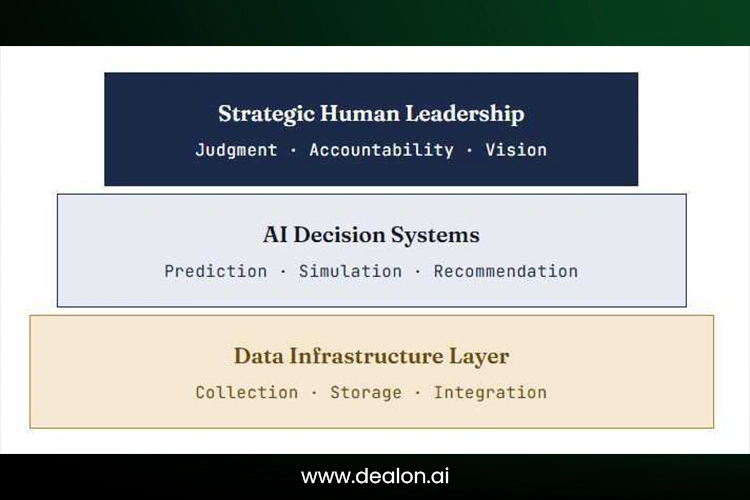
Every section of this playbook points to the same conclusion. AI handles data — at a volume and speed no team can match. Humans handle judgment — the accountability, negotiation, and emotional intelligence that a model cannot carry. The organizations pulling ahead in AI in leadership are not the ones automating the most decisions; they are the ones that have drawn a clear, deliberate line between the two and built genuine collaboration across it.
Conclusion
At the operational level, below the strategic layer, Artificial Intelligence in Management also works quietly but very effectively, on the management of people’s activities, and not only for the project.
The future of management belongs to those who can combine human expertise with AI capabilities. The organization that uses AI responsibly and keeps the balance between technology and human decision-making will be better poised to create an agile, intelligent, and future-ready workplace.
Frequently Asked Questions
What is Artificial Intelligence in Management?
It is the use of machine learning, predictive analytics, and automation to support planning, decision-making, and workforce oversight — working alongside human leaders rather than replacing them.
How is AI used in leadership decision-making?
AI processes a large amount of operational and market data, surfaces patterns and predictions, and presents modeled scenarios so decisions are grounded in evidence rather than intuition alone.
Is there a possibility of human managers being replaced by AI?
CIR-Judgment, accountability, negotiation, and emotional intelligence are uniquely human tasks for which no AI can take the place.
What are some of the current examples of AI in management?
Predictive workforce analytics, workload balancing algorithms, sentiment analysis in team communication, automated meeting summarization, and AI-assisted strategic forecasting.
Is AI in management ethical?
It can be, when organizations address algorithmic bias, maintain transparency, protect employee data, and keep human oversight in every consequential decision.
Which industries use AI for management?
Healthcare, financial services, manufacturing, retail, and education administration are among the sectors most actively applying AI to management and operations.
What skills do managers need in the AI era?
Data literacy, comfort interpreting model outputs, ethical judgment, and strong human skills like coaching and communication to translate AI insight into action.
How does AI improve business efficiency?
By automating repetitive reporting and coordination tasks, shortening decision cycles, and surfacing workflow inefficiencies that are difficult to detect manually.



