

Predictive analytics in digital marketing is the utilization of historical customer data and machine learning to forecast what someone will do next — click, buy, churn, or ignore a campaign entirely — before it happens. Instead of waiting for a monthly report to explain what already went wrong, marketing teams in 2026 route budget, timing, and messaging toward the outcomes a model says are most likely. This guide covers how the technology actually works, which models power it, where it already shows up across channels, and where — despite the hype — it still falls short.
Table of Contents
Should You Use Predictive Analytics?
Short answer: almost certainly yes, in some form. The only real questions are which use case to start with and how much data and engineering investment you can afford. Here’s the decision table before you read another word.
| If you are… | Should you use it? | Biggest benefit | Difficulty |
| Small business | Yes | Better targeting | Low |
| Ecommerce | Absolutely | Higher conversions | Medium |
| SaaS | Essential | Lower churn | Medium |
| Enterprise | Critical | Revenue forecasting | High |
| Agency | Yes | Better campaign optimization | Medium |
What Is Predictive Analytics in Digital Marketing?
Predictive analytics in digital marketing combines historical behavioral data — purchases, page visits, email opens, ad clicks — with statistical models to predict the probability of an event, such as a purchase, a cancellation, or a click. It is a form of predictive modeling applied specifically to customer behavior prediction, and it sits on top of the marketing analytics stack most teams already have.
In the ’90s, direct-mail marketers created a scoring card that would assign points to customers based on their purchase frequency over the previous year, and then send catalogs to those who scored high enough. That logic was automated in early CRM systems in the 2000s, using simple statistics. The difference is in size and availability. Over the last decade, teams that never would have had access to a data scientist can now forecast marketing opportunities with model-based marketing platforms, lower-cost compute, and now, large language models that can auto-generate features from raw text and event logs.
It helps to separate three layers of analytics maturity:
Descriptive — what happened (dashboards, reports).
Predictive — what will likely happen (churn risk, purchase probability).
Prescriptive — what to do about it (next-best offer, optimal bid, retention discount).
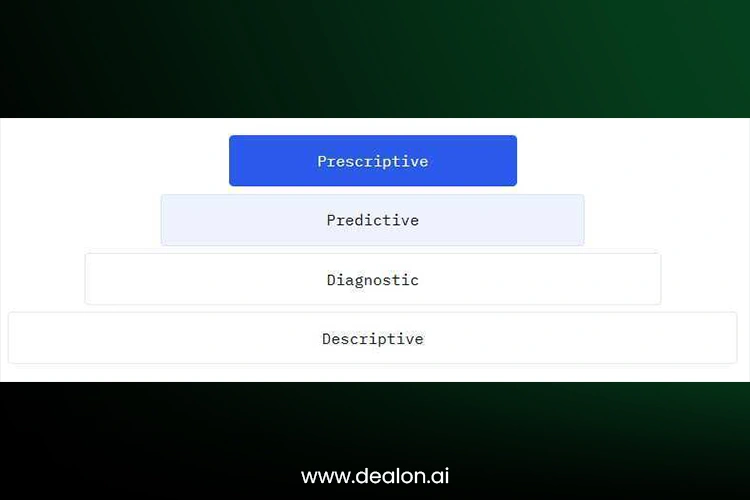
Most teams live at the bottom of that pyramid. Predictive analytics is the layer that turns a dashboard from a mirror into a forecast:
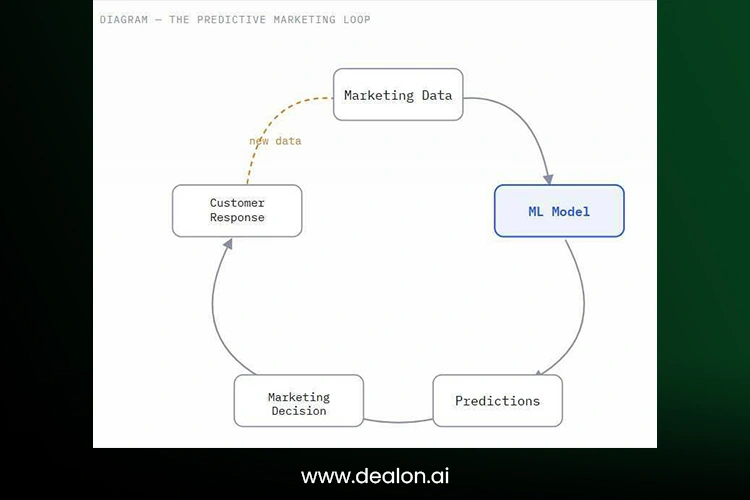
Customer response becomes new data, which trains the model — the loop, not any single prediction, is the point.
How Predictive Analytics Works Behind the Scenes
If you’re wondering what predictive analytics is in practice, every predictive marketing system, no matter how polished the dashboard looks, runs the same seven-step pipeline underneath.
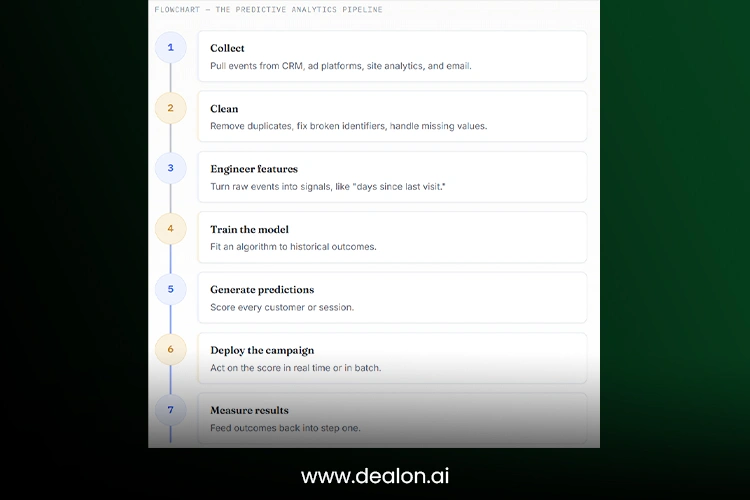
A concrete example: an ecommerce brand collects browsing and purchase history, engineers a feature for “days since last order,” trains a gradient boosting model on customers who churned in the past, then scores its full list weekly. Anyone who crosses a churn-risk threshold is routed automatically into a win-back email flow — a working predictive customer analytics loop, not a one-off report.
Types of Predictive Analytics Every Marketer Should Know
“Predictive analytics” is an umbrella term. In practice, marketers use a handful of distinct prediction types, each answering a different question.
| Type | Predicts | Used by | Typical outcome |
| Churn prediction | Who leaves | SaaS | Retention |
| Customer lifetime value (CLV) | Future revenue | Ecommerce | Budget allocation |
| Lead scoring | Purchase likelihood | B2B | Better sales handoff |
| Recommendations | Next purchase | Retail | Upselling |
| Demand forecasting | Future demand | Brands | Inventory planning |
Two more belong on this list even though they didn’t fit the table: next-best-action prediction, which recommends the single best message or channel for a given customer at a given moment, and lead scoring’s sibling, purchase propensity, which ranks entire audiences by likelihood to convert before a campaign even launches.
Also Read: What is Agentic Automation? The Definitive Guide to Smarter AI Workflows
The AI Models That Power Predictive Marketing
You don’t need the math to use predictive analytics, but knowing what each model is good at helps you ask vendors better questions.
| Regression
Best for simple, interpretable forecasts like predicting revenue from ad spend. |
| Decision trees
Easy to explain to stakeholders; good starting point for lead scoring. |
| Random forest
More accurate than a single tree; handles messy marketing data well. |
| Gradient boosting
The workhorse behind most churn and CLV models in production today. |
| Neural networks
Excels with large volumes of behavioral or image/text data. |
| LLM-assisted prediction
Turns unstructured text — reviews, support tickets — into usable features. |
| Time-series forecasting
Purpose-built for demand and seasonal traffic forecasting. |
Real-World Applications Across Marketing Channels
Email Marketing
Predictive send-time optimization estimates when an individual subscriber is most likely to open, rather than blasting a list at 9 a.m. for everyone.
SEO
Traffic-trend models forecast which topics will gain search volume, letting content teams publish ahead of demand instead of chasing it.
Google Ads
Conversion-probability scores feed automated bidding, so budget shifts toward the searches most likely to convert in real time.
Social Media
Engagement-propensity models help decide which audience segments see which creative variant first.
Content Marketing
Predictive customer analytics can flag which blog readers are likely to convert to leads, prioritizing gated content and follow-up.
CRM
Churn scores inside the CRM trigger retention offers automatically, before a sales rep would otherwise notice a cooling account.
| Channel | Prediction used | Example |
| Open probability | Send-time optimization | |
| SEO | Traffic trends | Topic forecasting |
| Paid ads | Conversion probability | Bid optimization |
| CRM | Churn | Retention offers |
| Ecommerce | Product affinity | Personalized recommendations |
Predictive Analytics vs Traditional Analytics
Traditional analytics and predictive analytics serve different purposes, even though both rely on data to support decision-making. The simplest way to distinguish them is that traditional analytics explains what has already happened, while predictive analytics predicts what is probable to happen next. Predictive analytics relies on AI, machine learning, and statistical models to look at patterns from the past and predict the future. It not only reports on the past results but can also forecast customer actions, future KPIs, and new trends, giving marketers a chance to make proactive decisions, optimize campaigns, and deal with opportunities and risks that may emerge.
Predictive Analytics vs Generative AI vs Marketing Automation
These three get lumped together as “AI marketing,” but they’re not competitors — they’re a relay team. Predictive analytics decides who to target and when. Generative AI writes the creative that gets sent. Marketing automation is the plumbing that actually delivers it.
A retention example: a churn model flags an at-risk customer (predictive), a generative model drafts a personalized win-back email based on that customer’s purchase history (generative AI), and an automation platform sends it at the exact hour the send-time model recommends (automation). Remove any one layer, and the campaign gets dumber.
Benefits That Actually Impact Revenue
Generic “improves marketing” claims aren’t useful. Here’s what predictive analytics actually moves, and why:
- Higher conversion rates because the budget and messaging go to people already showing purchase intent.
- Reduce customer acquisition cost (CAC) with propensity models, as they target less of the low probability audience.
- As a result of this, increased ROAS due to bidding models directing ad spend to expected conversions rather than clicks.
- Better customer retention because churn scores turn account loss from a surprise into a manageable pipeline.
- Sharper personalization because product affinity models recommend items that customers are statistically more likely to want.
- Smarter inventory planning because demand forecasting keeps marketing promotions aligned with actual stock availability.
- Less wasted ad spend because low-intent segments are excluded before the campaign launches, not after.
The pattern across all seven is the same: every dollar and every send is directed using probability-based predictions instead of guesswork, which is where predictive customer analytics earns its value.
Challenges and Limitations Most Articles Ignore
Predictive analytics is not a plug-and-play win. The failure modes rarely make it into vendor pitch decks.
- Poor data quality: a model trained on inconsistent or duplicated customer records will confidently produce wrong scores.
- The cold-start problem: new customers and new products have no history to predict from.
- Privacy laws: GDPR, state-level US privacy laws, and platform-level consent rules all constrain what data can feed a model.
- Bias: models trained on historical behavior can quietly reproduce historical inequities in who gets targeted.
- Overfitting: a model that memorizes past campaigns instead of generalizing, performs beautifully in testing and badly in production.
- Third-party signal loss is driving prediction to first-party data and contextual signals: Cookie deprecation.
- Model drift: You get people responding differently because they’ve been away for six months, and a model that functioned well during that time fails, with no one realizing.
- Human oversight: no model should make an irreversible customer-facing decision without a person able to review it.
Most predictive analytics failures aren’t modeling failures — they’re data pipeline failures. Fix data quality before buying a bigger model.
Best Predictive Analytics Tools in 2026
After understanding what predictive analytics is, choosing the right platform becomes the next important step. The right tool depends far more on your team’s data maturity than on feature checklists.
| Tool | Best for | AI features | Learning curve |
| Google Analytics | SMB | Predictive audiences | Low |
| Salesforce Einstein | Enterprise | Lead scoring | Medium |
| HubSpot | Marketing teams | Forecasting | Low |
| Adobe Experience Platform | Large brands | Customer journeys | High |
| BigQuery ML | Data teams | Custom models | High |
Two more worth knowing: Microsoft Dynamics layers predictive lead and opportunity scoring into a sales-and-marketing CRM already common in enterprise IT stacks, and Amazon SageMaker is the go-to when a team wants to build fully custom marketing forecasting models rather than use a vendor’s black box.
How to Implement Predictive Analytics Step-by-Step
Skip the vendor demo and start here instead — this is the sequence that actually ships a working model.
| 01 | Define the business goal Name the outcome you actually want to move, in revenue or retention terms. |
| 02 | Collect the relevant data Gather the behavioral and transactional history tied to that goal. |
| 03 | Choose one KPI to predict Pick a single, measurable target — resist predicting everything at once. |
| 04 | Clean the data This step quietly determines whether the model will work at all. |
| 05 | Select a model Match the model to the data volume and the need for explainability. |
| 06 | Train it Fit the model on historical outcomes tied to your chosen KPI. |
| 07 | Validate against held-out data Test on data the model has never seen before, trusting it. |
| 08 | Deploy into a live campaign Let real predictions drive a real, limited campaign first. |
| 09 | Monitor performance Watch for model drift as customer behavior shifts. |
| 10 | Retrain on a schedule Feed new outcomes back in on a fixed, recurring cadence. |
Most teams overinvest in step five — model selection — and underinvest in steps two and four, data collection and cleaning. A simple model on clean data will beat a sophisticated model on messy data almost every time.
Industry-Specific Use Cases
Industry-specific use cases of predictive analytics show how different sectors solve unique business problems using data-driven forecasting. In retail, it helps fix issues like overstocking or stock shortages by predicting demand by store and season, resulting in better inventory control and fewer discount losses. In healthcare, predictive models identify patients who are likely to miss appointments, enabling targeted reminders and reducing no-show rates.
In the financial sector, it enhances cross-selling capabilities. It minimizes risks by assigning a score to customer affinity and their credit behavior, thereby increasing the conversion rate of offers and decreasing defaults. In the education sector, it forecasts a student’s probability of enrolling in a school to help target outreach and minimize drop-outs during enrollment.
Predictive analytics in the travel sector aids in demand forecasting and price sensitivity analysis, enabling businesses to adapt their pricing strategies in real-time. In real estate, it rates the readiness of the buyer, so agents work with hot leads rather than cold leads. For SaaS, it foresees customer churn by analyzing usage patterns to enable proactive retention measures and boost renewals.
Finally, in manufacturing, it aligns production with distributor demand through forecasting models, ensuring smoother operations and better coordination between marketing and supply chains.
What Lies in the Future of Predictive Analytics
A handful of shifts are converging on the same idea: prediction is moving from a quarterly modeling exercise to something closer to a live, ambient layer of marketing infrastructure.
AI agents are starting to act on predictions autonomously — adjusting bids or triggering flows without a person clicking “approve” — while real-time prediction replaces batch scoring that updates once a day. The retreat of third-party cookies is pushing everything toward first-party data, and multimodal AI now folds in images, audio, and video alongside clickstream data. Autonomous campaign optimization and predictive customer journeys extend this further, mapping an entire path rather than a single next action.
Two quieter trends matter just as much: privacy-preserving AI, which trains models without centralizing raw personal data, and synthetic data, which helps solve the cold-start problem by simulating plausible customer behavior. Finally, causal AI is starting to answer a harder question than correlation-based models ever could — not just who is likely to buy, but which specific marketing action actually caused them to.
Common Mistakes Businesses Make
- Using too little data, since a model trained on only a few hundred conversions rarely generalizes well enough to be reliable.
- Ignoring feature engineering, because raw event logs alone are usually not enough, and meaningful predictive signals need to be carefully constructed.
- Blind trust in AI, as treating model outputs as certainty instead of probability, can lead to poor decision-making.
- Skipping A/B testing, which means deploying models without validating performance against existing processes.
- Not retraining models, which allows model drift to reduce accuracy over time gradually.
- Using the wrong KPIs, where optimizing for clicks instead of actual business outcomes like revenue or retention leads to misaligned results.
- No human oversight, since fully automating decisions that require judgment can introduce unnecessary risks.
- Over-personalization, where overly aggressive use of predictions can make customer experiences feel intrusive rather than helpful.
Frequently Asked Questions
What is predictive analytics in digital marketing?
The use of historical customer data and machine learning to forecast future behavior — such as purchases, churn, or clicks — so marketing decisions can be made ahead of time instead of in hindsight, is predictive analytics.
How does predictive analytics improve marketing ROI?
It optimizes the allocation of budget and messaging to customers and moments when you expect the highest conversion rates, which minimizes wasted spend and increases conversions.
What is the difference between predictive and prescriptive analytics?
Predictive analytics predicts what will happen; prescriptive analytics goes a step further and recommends the specific action to take in response.
Which industries benefit the most from predictive analytics?
Ecommerce, SaaS, retail, and finance see the fastest returns, largely because they generate high volumes of behavioral data to train models on.
Is predictive analytics the same as AI?
No. Predictive analytics is one application of AI and machine learning, specifically focused on forecasting outcomes from historical data.
What tools are used for predictive analytics?
Common options include Google Analytics, Salesforce Einstein, HubSpot, Adobe Experience Platform, Microsoft Dynamics, Amazon SageMaker, and BigQuery ML.
Can small businesses use predictive analytics?
Yes. Built-in predictive features in tools like Google Analytics and HubSpot let small teams use basic forecasting without hiring a data scientist.
How accurate is predictive analytics?
Accuracy varies widely by data quality and use case; well-maintained churn or CLV models are commonly reliable enough for production use, but no model is ever certain — it estimates probability, not fact.
What data is needed for predictive analytics?
At minimum, historical records of the outcome you want to predict — such as past churn or purchase events — plus behavioral signals like site visits, email engagement, and transaction history.
What is the future of predictive analytics in marketing?
Expect real-time, agent-driven prediction, heavier reliance on first-party data, and causal AI models that identify not just who will buy, but what specifically will cause them to.



