
Table of Contents
The Mathematics Every Deep Learning Practitioner Must Know
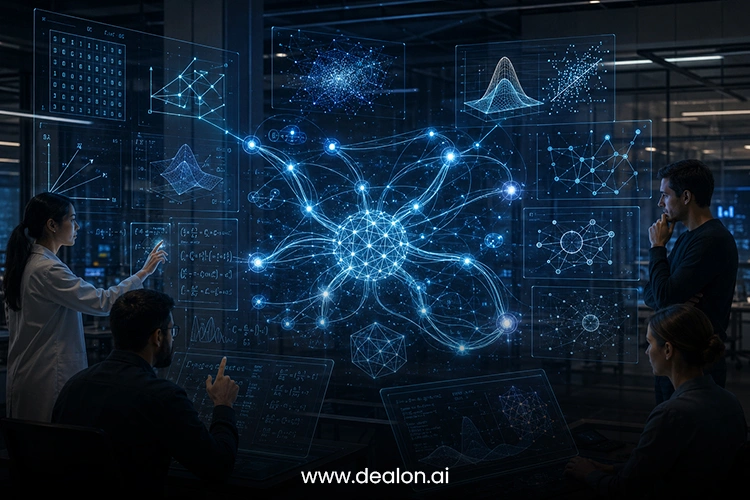
To start, here is a simple graph that maps all of the major mathematical fields that are used in today’s state-of-the-art in deep learning. Use this as a guide to follow through each section.
| Mathematical Concept | Why It Matters in Deep Learning | Used In | Mathematical Concept |
| Linear Algebra | Data representation and transformation through vectors, matrices, and tensors | Transformers, CNNs | Linear Algebra |
| Calculus | Learning from prediction errors via gradients and the chain rule | Backpropagation | Calculus |
| Probability Theory | Representing and reasoning under uncertainty | LLMs, Generative AI | Probability Theory |
| Optimization | Efficiently minimizing errors to train model parameters | Gradient Descent, Adam | Optimization |
| Statistics | Evaluating performance and ensuring generalization | Model Validation | Statistics |
What Is Deep Learning?
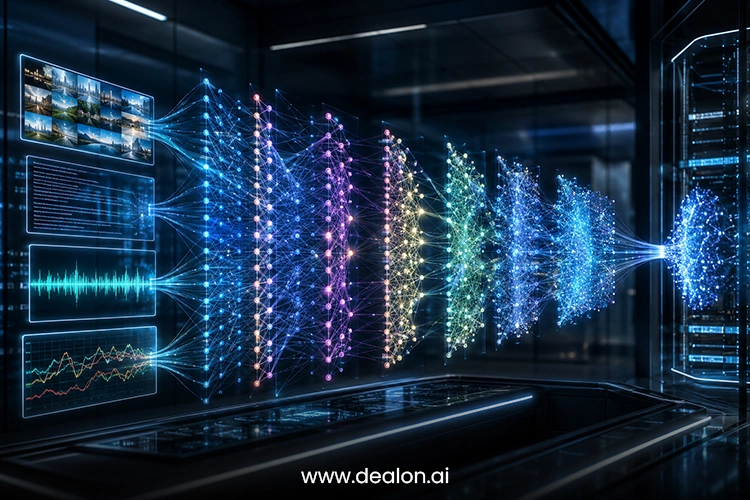
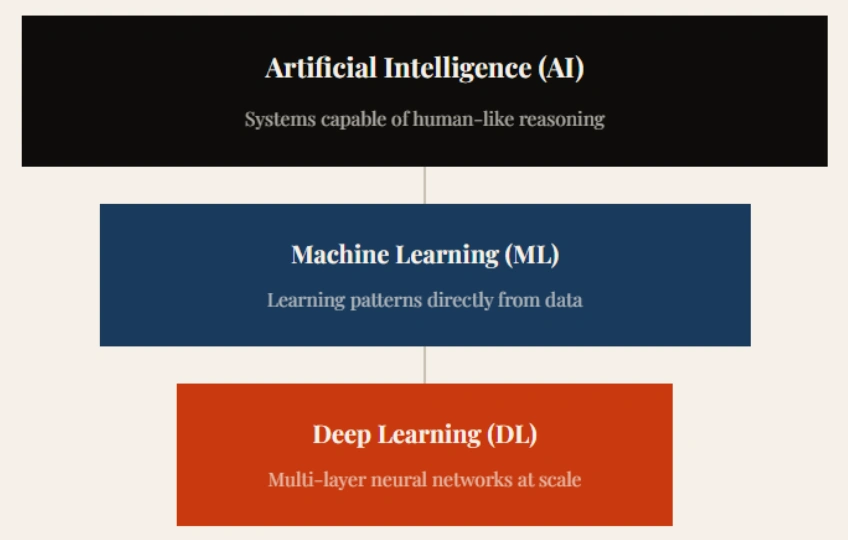
This is a subset of ML that is based on artificial neural networks with layers of learning patterns, relationships, and representations from massive sets of data. Deep learning systems can automatically detect important features and learn and adapt over time, without the need for manual feature engineering, as can traditional machine learning models.
The language models, image recognition systems, recommendation engines, autonomous vehicles, and speech assistants are just a few examples. It achieves success by its capability to process complex, high-dimensional data and discover patterns that can be hard for individuals or traditional algorithms to discover.
At the very heart of deep learning is not a programmatic approach to making a computer think, but a way to mathematically approximate the structure of reality.
Also Read: AI and Problem-Solving: The Definitive Guide to Solving Complex Business Challenges
What Is the Mathematics of Deep Learning?
Mathematics of Deep Learning is the set of mathematical concepts, theories, and methods used to help neural networks learn from data and make predictions. These foundations shape the nature of the information represented, the process of learning, the criteria used to measure errors, and the process of models evolving.
| 1 | Linear Algebra
Representing and transforming data at every layer |
| 2 | Calculus
Optimizing model parameters through gradient-based learning |
| 3 | Probability
Managing uncertainty in predictions and distributions |
| 4 | Statistics
Evaluating performance and ensuring models generalize |
| 5 | Optimization
Efficiently finding the best model parameters at scale |
Deep learning is not possible without mathematics. All the predictions, weight updates, and learning process are in turn controlled by a series of mathematical operations performed billions of times a second.
Why Mathematics of Deep Learning Is Fundamentally a Mathematical Discipline
A common misconception among many entering the AI field is that they think that coding is the most significant part of all of AI. Actually, the purpose of code is only to execute mathematical concepts. All the advances in the last decade in AI research can be traced to a mathematical insight: the attention mechanism, residual connections, dropout regularization, variational inference – all of them mathematical first, engineering second.
At the most basic level, neural networks are mathematical functions. A neural network receives a set of numbers as input, performs some sequence of matrix multiplication and non-linear transformations, and returns some numbers as output. The optimization problem for training is to find the parameters of the function that performs the best with respect to a set of data that minimizes the prediction error.
Mathematical innovation and AI capability go hand in hand. As part of the transformer architecture, researchers added novel mathematical structures that gave rise to models like GPT, Claude, and Gemini. These novel mathematical structures, such as scaled dot-product attention, positional encodings, and layer normalization, are key to the success of models like GPT, Claude, and Gemini. Better maths leads to better models.
It is important to become familiar with the priority of these terms first before we delve into the mathematics involved in them.
The Hidden Language of AI: Linear Algebra
All neural networks rely on linear algebra as their basis. All of the data that flows through any neural network—whether it’s an image, a sentence, a pattern of user behavior—has to be broken down into numbers, and those numbers are encoded into the structures of linear algebra.
A vector is a list of numbers in a particular order. The word “mathematics” is not used as an object of a language model, such as Claude or ChatGPT. It uses one of these lists, a vector, which represents a word’s meaning, as a result of patterns learned in the training process.
We have seen that neural networks are constructed from matrix elements. A matrix is a table of numbers that is arranged in rows and columns. A neural network consists of layers of units, where each layer has a weight matrix that is a structured set of parameters used to convert the input vector to a new representation. The task of learning in a neural network is to determine these values for all of these weight matrices.
In today’s era of AI, the most demanding computation is matrix multiplication. GPT-4 performs a series of 96 transformer layers, each doing billions of matrix multiplications when given a prompt. The purpose-built technology used in AI training – GPUs and TPUs – has been designed with a sole focus on completing these multiplications as quickly as physically feasible.
Large language models, such as ChatGPT, Claude, and Gemini, now have an embedding as a dense vector in a high-dimensional space to represent all their knowledge. What is special about these embeddings is that semantic operations on meaning are equivalent to mathematical operations on these embeddings. Similar words are grouped. Geometric distances are established between concepts.
Calculus: How Neural Networks Learn From Mistakes
Linear algebra is the language of representation; the language of learning is calculus. A neural network would be able to make predictions, but if there weren’t calculus, there wouldn’t be any way of improving those predictions through feedback.
Derivatives indicate the rate at which a function’s value varies in response to a small change in the value of the input. Derivatives are important in the mathematics of deep learning because they provide an answer to a very important question: Will increasing or decreasing this particular parameter by a little bit increase or decrease the error by how much?
This network is a “stack” of many functions; dozens, hundreds, or even thousands of layers of functions. A computational trick in calculus, called the chain rule, can be used to find the effect on the final output of the network if the intermediate output is affected by changing an early parameter in the network, even if the early parameter is not directly connected to the output.
Neural networks are trained using the algorithm: Backpropagation. It does this by taking the derivative of the loss function in the model using the chain rule, and then moving each parameter in the model towards a direction of decreasing error. If it weren’t for the chain rule from differential calculus, backpropagation, and hence modern mathematics of deep learning, they would not exist.
The rate of change of the loss function with respect to a parameter indicates exactly how to change and how much we must change the parameter in order to minimize the loss function. These small changes culminate in a very competent model over millions of training steps. All machine learning is run on the calculus of gradients.
Probability Theory: Teaching Machines to Handle Uncertainty
Prediction is impossible in the world; data is not perfect and is noisy. Probability theory is the mathematics of dealing with uncertainty, and it underlies all of the AI systems you are using today!
The generative model learning process to generate images is not just memorizing images — it is learning the probability distribution over all realistic images, and sampling from that to construct new images.
Most deep learning models work on the basis of maximum likelihood estimation. It says: Determine the model parameters that make the observed training data most likely under the model. This beautiful idea relates training to prediction in a mathematically logical manner.
Bayesian probability is a way of updating beliefs on the basis of new evidence. Bayesian reasoning is found in uncertainty quantification, reinforcement learning, and probabilistic programming in AI systems. It encapsulates the natural notion that we should take a starting point and adjust it with data.
A large language model such as GPT or Claude doesn’t “know” what the next word in a sentence is. It, on the other hand, generates a probability distribution for each word in its vocabulary. The model calculates the probability of certain continuations of a text, and gives them a high probability, while giving the unlikely continuations a low probability, after which they sample from that distribution and produce text. This is essential to comprehend: LLMs are not knowledge databases; they are probability machines.
Optimization: The Engine Behind AI Training
Optimization is a method that allows the neural network to learn by identifying the optimal set of parameters that will minimize the prediction error. The modern AI models have millions or even billions of parameters, which means efficient optimization algorithms are vital.
Deep learning optimization is based on gradient descent. This is achieved by determining the direction of the largest decrease in error and adjusting the model parameters in that direction. As the model is run, it approaches an optimal solution.
SGD does not use the whole dataset for each iteration; it uses small data batches. This is especially helpful in decreasing computational complexity and can also improve the model’s ability to generalize by incorporating some randomness when the model is being trained.
More modern optimizers like Adam adapt the learning rate automatically and add momentum to the learning rate for the SGD. The features enable large language models and transformer-based systems to train more quickly and reliably.
The optimizer you choose directly influences the training speed, the accuracy of your model, and the computational cost. Optimization is one of the most crucial research fields in deep learning, and as AI models increase in size, this area of study will continue to be crucial.
The Mathematics Behind Transformers
Transformers are the backbone of AI technologies such as ChatGPT, Claude, and Gemini. Their success is based mainly on their attention system.
Attention helps a model to pay attention to the most relevant parts of the input when it is making predictions. This allows the understanding of the context and relationships in data.
Each token is converted to Query, Key, and Value vectors. These vectors are used to decide what information to attend to when processing.
To allow transformers to learn the order of the tokens in a sentence, positional encodings are introduced in addition to the attention. Transformers work in parallel and are able to capture long-range relationships well, unlike previous models like RNNs and LSTMs. They were scalable, and thus the basis of the AI revolution today.
Statistics and Generalization: Why AI Learns Beyond Training Data
Any model that only memorizes training data is of no use. Generalization is the aim of deep learning. The mathematical theory behind statistics explains the conditions under which and the reason why this is possible.
Bias vs Variance
A key principle in statistical learning theory is the bias–variance tradeoff. Bias is a systematic error due to false assumptions, an overly simple model that does not reflect the true structure of the data. Variance is sensitivity to noise – a model that fits the training data very closely, but is unable to “see” the test data. The major issue in the model selection is establishing the proper relationship between these two forms of error.
Overfitting and Underfitting
Overfitting is when the model becomes memorized instead of modeled, learning the training examples. A model with high bias will have a poor performance on test data, but will have a great performance on training data. If the model and its associated algorithm are too simple to capture the structure of the data, it will perform poorly on the training examples as well (underfitting). Failure modes can be identified by using a statistical evaluation procedure.
Regularization Techniques
Modeling regularization is used to prevent overfitting. L2 regularization (weight decay) will regulate large parameter values and keep them ‘close to zero’. Randomly disconnecting neurons during training, Dropout is a method that makes the network learn redundant representations. These techniques are mathematical “hints” that represent prior knowledge about the smoothness and simplicity of the true underlying function.
Evaluating Model Performance
However, more than mere accuracy is required for the proper evaluation of the statistics. Some of the metrics used on classification tasks are:
| 1 | Accuracy
Fraction of correct predictions. Misleading on imbalanced datasets |
| 2 | Precision
Of all positive predictions, what fraction are truly positive? |
| 3 | Recall
Of all true positives, what fraction did the model correctly identify? |
| 4 | F1 Score
Harmonic mean of precision and recall. Balanced metric for uneven classes |
Numerical Stability: The Math Problem Most Beginners Never Notice
When it comes to mathematical problems, numerical stability is the one that most people never look into. Numerical instability is a class of problems that people who use the mathematics of deep learning often experience, but are not mentioned at the beginning of the tutorials. These are cases in which the calculations performed by the maths when training the network yield values that are too large, too small, or not precise enough to be processed by a computer.
| Numerical Stability Challenge | What Causes It? | Impact on Training | Common Solution |
| Vanishing Gradients | Gradients become increasingly smaller as they move backward through many layers. | Early layers learn very slowly or stop learning entirely. | ReLU activations, residual connections, normalization layers. |
| Exploding Gradients | Gradients grow exponentially during backpropagation. | Training becomes unstable, and model parameters diverge. | Gradient clipping and careful weight initialization. |
| Unstable Activations | Layer outputs vary dramatically across training steps. | Slower convergence and inconsistent learning. | Batch Normalization and Layer Normalization. |
| Large-Scale Training Challenges | Billions of parameters and massive datasets increase numerical complexity. | Loss spikes, training failures, and higher compute costs. | Mixed precision training, optimized learning rates, continuous monitoring. |
From Equations to Breakthroughs: How Mathematics Created Modern AI
All the past ten years of transformative AI applications have stemmed from a particular mathematical breakthrough. The last decade of transformative AI applications can be understood from a specific mathematical breakthrough. Grasping these connections gives insight into the key reason that many question AI’s progress.
Computer VisionCNNs detect the same feature anywhere in an image by using a mathematical operation called convolution. The concepts of translation invariance have enabled modern image recognition, face detection, and medical imaging. |
Generative AIDiffusion models rely on a stochastic process that learns to undo noise. They can get real images from pure noise by slowly removing the noise from the random input. |
Scientific DiscoveryAlphaFold, an example of this, uses evolutionary information, geometric deep learning, and attention mechanisms to forecast protein structures, addressing intricate biological challenges through advanced mathematical techniques. |
Drug DevelopmentGraph neural networks treat molecules as graphs of atoms and bonds, and can predict chemical properties and speed up drug discovery much faster than in a lab. |
Will Future AI Require New Mathematics of Deep Learning?
Although the mathematics of deep learning is a great success, it might not be the ultimate mathematical tool for artificial intelligence. Current models continue to have difficulty with real reasoning and causal understanding, as well as systematic generalization out of their training set.
To overcome these constraints, researchers are investigating a model for reasoning and a neuro-symbolic approach to AI that integrates neural networks with formal logic systems to enhance structured thinking and decision-making.
Meanwhile, emerging fields of mathematics like information geometry, category theory, and topological data analysis are becoming relevant to AI studies.
Therefore, the future of AI could rely on the development of new types of mathematical techniques to reason and abstract, as well as on larger models.
FAQs
Q1. What skills and concepts do you need in mathematics to be a deep learning expert?
The mathematics of deep learning are linear algebra, calculus, probability, statistics, and optimization.
Q2. Is calculus important for neural networks?
Yes, calculus is necessary in the sense that backpropagation and gradient descent are used to train models.
Q3. How much linear algebra do AI engineers need?
A good knowledge of vectors, matrices, and tensor operations, and some knowledge of advanced topics, is suitable for research and optimization purposes.
Q4. Why are transformers considered to be mathematical models?
The model is completely based on linear algebra and probability using the scaled dot-product attention mechanism.
Q5. Is probability more important than calculus in AI?
Both are important: calculus is used to motivate students to learn by optimization, and probability is used to predict and deal with uncertainty.
Q6. Which mathematical principle is the toughest to grasp in the mathematics of deep learning?
The hardest thing to grasp is that overparameterized models can still provide good generalization.
Q7. What are the basics of deep learning without advanced mathematics?
It is okay to begin with the basics, but further development would need more mathematical knowledge.
Q8. How is mathematics used in ChatGPT?
Implements linear algebra for embeddings, calculus for training, probability for prediction, and optimization for learning.
Q9. Which areas of math are most critical to AI?
The most useful is linear algebra, with calculus, probability, and optimization as supporting areas.
Q10. What are some of the first mathematical concepts for a novice to learn to master for use in machine learning?
Learn the basics of vectors, matrices, and simple derivatives, and apply them to understand the operation of neural networks.



