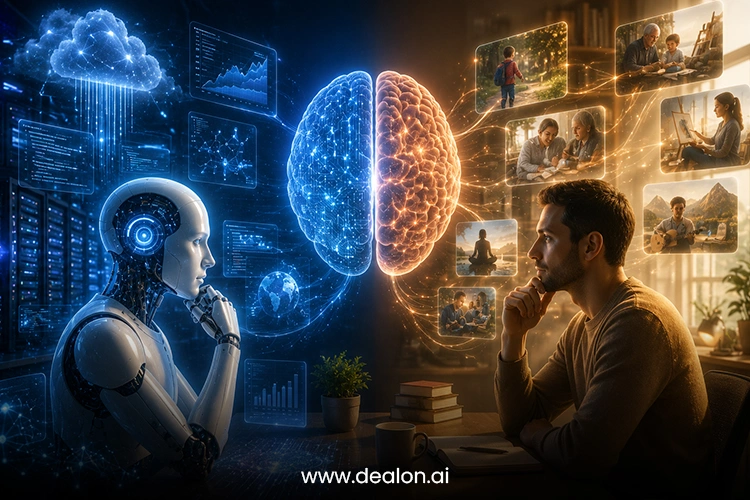

The comparison of artificial intelligence vs natural intelligence is often framed as a contest — a race to see which one thinks faster, works harder, or will eventually win. That framing misses the point. Artificial intelligence and natural intelligence are not competitors running the same course; they are two different kinds of systems, built through entirely different processes, optimized for entirely different jobs.
Artificial intelligence is engineered. It is assembled from algorithms, shaped by training data, run on computing infrastructure, and pointed at objectives that people define. Natural intelligence, by contrast, grows. It develops inside a biological brain and body, through years of sensory experience, social interaction, emotional consequence, and lived history. Neither of these facts makes one system “smarter” than the other in any simple sense — they make the two systems good at different things, in different circumstances, for different reasons.
This distinction matters more in 2026 than it did a few years ago, because artificial intelligence has moved out of research labs and into everyday decisions — hiring, diagnosis, tutoring, writing, driving, forecasting. The temptation is to assume that because a system responds quickly and fluently, it must be reasoning the way a person does, or that faster processing is the same thing as deeper understanding. It usually isn’t. This guide sets out, plainly and without hype in either direction, where artificial intelligence outperforms human cognition, where natural intelligence remains stronger, and — more usefully — how the two are increasingly designed to work side by side.
The short version, which the rest of this guide unpacks in detail: AI is powerful in computation and pattern recognition, while natural intelligence remains stronger in contextual understanding, lived experience, values, and flexible judgment. The strongest systems of the next decade will not ask humans to imitate machines, or machines to imitate humans. They will assign each form of intelligence the responsibilities it is genuinely suited to handle.
Also Read: What Are Agentic Workflows? The Definitive Guide To Autonomous Work
Table of Contents
The Difference at a Glance
Artificial intelligence is created through algorithms, data, computing infrastructure, and human-designed objectives. Natural intelligence develops biologically, through the brain, body, sensory experience, social interaction, and lived experience. Neither origin story is better — they produce very different kinds of capability.
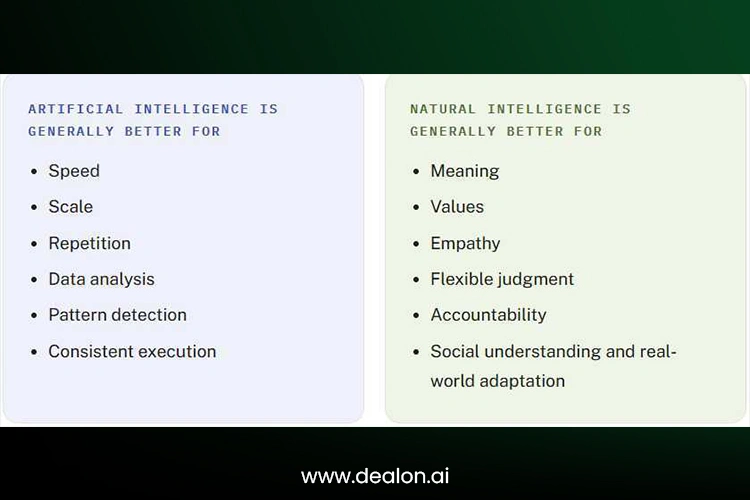
As a rule of thumb, AI is generally superior in speed, scale, repetition, pattern analysis, and data retrieval. Natural intelligence is generally stronger in emotional understanding, common sense, moral responsibility, contextual reasoning, and adaptation to unfamiliar situations. Neither advantage is absolute, and both systems fail in characteristic ways — AI when data or objectives are poorly specified, humans when bias, fatigue, or incomplete information cloud judgment.
The most useful conclusion is not “which one wins,” but “which one is doing the job it’s actually good at.” The future of most fields is less likely to involve full replacement of people, and more likely to involve deliberate collaboration between artificial and natural intelligence — each handling the part of the problem it was built, or born, for.
| Comparison Area | Artificial Intelligence | Natural Intelligence |
| Origin | Human-designed computational systems | Biological development |
| Learning source | Training data and feedback | Experience, senses, interaction and reflection |
| Processing speed | Extremely fast for defined tasks | Slower but contextually flexible |
| Memory | High-volume and reproducible | Selective, associative and reconstructive |
| Emotions | Can simulate emotional responses | Experiences emotions biologically |
| Creativity | Generates from learned patterns | Combines imagination, experience and intention |
| Adaptability | Strong within trained or supported environments | Strong in unfamiliar and changing environments |
| Energy use | Often computationally expensive | Highly energy-efficient biological processing |
| Accountability | Lies with designers, operators and institutions | Can be assigned to the individual |
| Best use | Scale, automation, prediction and analysis | Judgment, values, relationships and meaning |
Table 1 — Artificial Intelligence vs Natural Intelligence at a Glance
What Is Artificial Intelligence?
AI covers a wide range of capabilities: language processing, pattern recognition, prediction, planning, image interpretation, decision support, content generation, and robotics or automation. What ties these together is not a single piece of technology, but a shared design philosophy — take a task, define an objective, and build a system that gets measurably better at it through data and feedback.
It’s worth being precise here, because “AI” is often used as if it names one thing. It doesn’t. A spam filter, a language model that drafts an email, a robot arm on a factory floor, and a recommendation engine all fall under the same umbrella term. Yet, they work in very different ways and have very different limitations.
Narrow or task-specific AI is built to do one thing well — detect fraud, translate a sentence, sort images. It has no capability outside its trained domain. Generative AI produces new text, images, audio, or code by learning patterns from large volumes of examples. Multimodal AI combines several types of input and output, such as text and images. Autonomous or agentic AI can plan multi-step actions and use external tools with limited supervision. Artificial general intelligence — a system with flexible, human-level reasoning across arbitrary domains — remains a theoretical or developing concept rather than an established reality.
Modern AI systems typically learn through a pipeline: large-scale data collection, model training on that data, and the extraction of statistical patterns that allow the system to predict a likely next output. That base process is refined using human feedback, reinforcement signals that reward or penalize certain outputs, and further fine-tuning on narrower datasets. Increasingly, systems also use real-time retrieval and tool use — pulling in current information or calling external software — rather than relying solely on what was learned during training. None of this requires the system to understand why an answer is correct in the way a person would; it requires the system to have found a statistical structure that reliably produces useful outputs.
What Is Natural Intelligence?
Natural intelligence is the cognitive ability that develops in biological organisms. This guide focuses mainly on comparing artificial intelligence with human intelligence. Still, it should be acknowledged that intelligence shows up throughout the animal world — in the navigation of migratory birds, the communication systems of dolphins, the social coordination of primates, and the tool use of certain corvids. Natural intelligence, in other words, is not a uniquely human phenomenon; humans are simply the most extensively studied and most relevant case for this comparison.
Human cognition rests on the brain and nervous system, but it is never purely computational. It draws continuously on sensory perception, memory, emotion, and attention, and it develops through embodied experience — literally moving through and touching the world — as well as social learning, language, and culture. A child does not learn what “hot” means from a definition; they learn it by touching something warm, watching a caregiver react, and hearing the word paired with the sensation, repeatedly, across many contexts.
This is where the concept of embodied intelligence becomes useful. Physical sensations, fatigue, movement, pain, hormones, emotional states, social surroundings, and environmental experience shape human thinking. A decision made after a full night’s sleep is not the same cognitive event as the same decision made after eighteen sleepless hours, even though the “processor” — the brain — is identical in both cases. This is one of the clearest ways to distinguish natural intelligence from purely computational processing: an AI model’s output does not vary because it is tired, hungry, or emotionally affected by the previous conversation it had. A human does.
The Core Difference — Designed Intelligence vs Evolved Intelligence
This is the conceptual foundation the rest of the comparison builds on. Artificial intelligence is engineered to optimize objectives that people define in advance — reduce error on a benchmark, maximize engagement, and predict the next word accurately. Natural intelligence evolved for a much messier, open-ended set of pressures: survive, cooperate, communicate, reproduce, and adapt to environments that were never designed with the organism in mind.
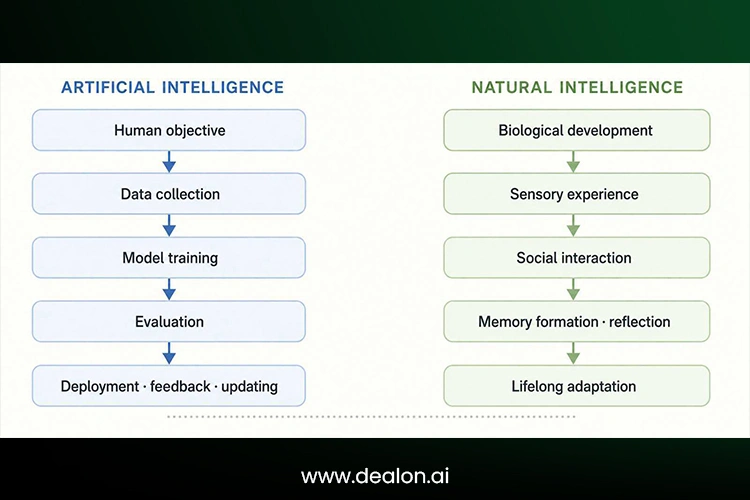
Diagram 1 — Development Pathways of Artificial Intelligence and Natural Intelligence
How AI and Natural Intelligence Process Information
Artificial intelligence commonly converts information into numerical representations, identifies statistical patterns across enormous datasets, predicts the most likely output for a given input, and does all of this while following the optimization objective it was trained on. It is, at its core, a very fast pattern-matching and prediction engine, and increasingly a tool-using one.
Human cognition works differently. People combine perception, memory, emotion, culture, and context all at once, often without noticing they’re doing it. Humans interpret implied meaning that was never stated outright, construct causal stories to explain why something happened, lean on intuition built from years of accumulated experience, and revise their beliefs in response to both personal experience and social feedback. A doctor reading a chart isn’t only processing numbers — they’re weighing the patient’s history, tone of voice, and what they didn’t say.
| Processing Dimension | Artificial Intelligence | Natural Intelligence | Practical Implication |
| Data volume | Can process very large datasets | Limited conscious processing capacity | AI is better for high-volume analysis |
| Context | Depends on available input and system design | Draws from lived and social experience | Humans often understand unstated meaning better |
| Consistency | Usually consistent under stable conditions | Can vary with mood, fatigue and bias | AI helps standardize repetitive decisions |
| Causal understanding | May infer patterns without genuine causal understanding | Often seeks causes and explanations | Human review remains important |
| Ambiguity | Can struggle when instructions conflict | Can negotiate unclear meaning | Humans are often better in uncertain situations |
| Speed | Extremely fast | Comparatively slower | AI supports rapid analysis |
| Interpretation | Statistical and representational | Experiential and meaning-oriented | Humans connect facts with values and purpose |
Table 2 — Information Processing Comparison
Learning — Data Training vs Lived Experience
Both humans and AI systems learn, in the sense that both get better at tasks over time. But the mechanisms underneath that word are fundamentally different.
These techniques for learning with AI all overlap, and are used in combination: supervised learning from labeled examples, unsupervised learning from unlabeled data, reinforcement learning from reward signals, and self-supervised learning from raw data itself. They are iterated over a series of fine-tuning steps on specialized datasets, feedback loops of fine-tuning from human reviewers, and periodic updates of the model as more information is available.
Humans can sometimes grasp an entirely new concept from a single explanation or a single striking experience — touch a hot stove once, and the lesson sticks for life. AI performance, by contrast, depends heavily on its training, architecture, and the context it’s given at the time; some modern systems can generalize impressively from very little in-context information, so it would be an oversimplification to claim that all AI systems require thousands of examples. The more accurate statement is that AI’s ability to learn quickly from limited information is inconsistent and highly dependent on how the system was built.
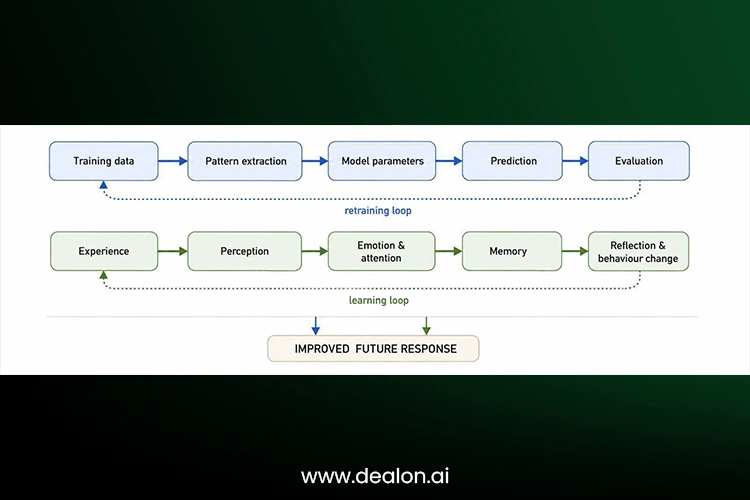
Flowchart 1 — AI learning vs Human learning
Memory — Perfect Storage Is Not the Same as Understanding
It’s a common assumption that AI has “better memory” than people. That claim needs unpacking, because several different things get bundled under the word “memory”: stored information sitting in a database, context-window information available to a model during a single conversation, information a system can pull through retrieval, and the patterns encoded in a model’s parameters after training. None of these is the same as human working memory, long-term memory, procedural memory (how to ride a bike), or emotional memory (why a certain song still makes you tear up).
Forgetting isn’t just a flaw in human cognition — it does real work. It helps people prioritize what matters, generalize from specific incidents to broader lessons, recover from information overload, and stay focused on the present rather than being paralyzed by every detail of the past. A system that remembers everything with equal weight has no built-in mechanism for deciding what’s important.
When an AI system “recalls” a fact, it is either retrieving a stored record or generating a statistically likely answer. That is a different act from a person remembering something they personally lived through, with all the sensory and emotional texture that implies. Retrieval can be accurate without being remembered in any meaningful sense.
Speed, Accuracy, and Consistency
| Task | Likely Stronger Performer | Why | Main Limitation |
| Large-scale calculation | AI | High processing speed | Incorrect inputs can produce misleading outputs |
| Emotional conflict resolution | Natural intelligence | Empathy and social context | Human bias and emotional involvement |
| Medical image screening | AI-assisted human team | Pattern detection plus clinical judgment | Neither should operate without proper safeguards |
| Creative brainstorming | Hybrid | AI generates volume; humans provide direction | Quality depends on prompts and judgment |
| Emergency response | Natural intelligence with AI support | Real-world adaptation and accountability | Humans may face stress and limited information |
| Fraud pattern detection | AI | Continuous high-volume monitoring | False positives and changing attack methods |
| Ethical decision-making | Humans and institutions | Values and accountability | Moral disagreement and bias |
| Routine customer support | AI | Fast and scalable | Struggles with complex emotional cases |
Table 3 — Performance by Task Type
Creativity — Can Artificial Intelligence Truly Create?
Creativity is more than producing something new. It’s useful to separate it into several components: novelty, usefulness, intention, emotional meaning, cultural relevance, personal expression, and evaluation and taste — the judgment of whether an idea is actually good.
AI is genuinely useful for rapid idea generation, exploring style variation, recombining existing patterns in unexpected ways, building fast prototypes, and supporting visual or textual experimentation that would take a person far longer to produce manually. As a creative assistant, it can dramatically widen the range of options on the table.
What AI cannot supply on its own is personal intention — a reason a particular piece of work needs to exist. Humans bring life experience, emotional stakes, cultural identity, moral judgment, and taste: the capacity to look at ten generated options and know, for reasons that are hard to articulate, which one should be kept fully. Ultimately, humans decide why something should exist in the first place.
The most useful framing treats AI as a creative instrument or collaborator, not as a genuine independent artist, and not as a meaningless copying machine either. A synthesizer didn’t replace musicians; it gave them new sounds to direct. AI functions similarly for many creative fields — expanding the palette, while leaving direction, judgment, and meaning to the person holding the brush.
Consciousness and Self-Awareness — What We Know and What We Do Not
This section calls for scientific caution. Intelligence, consciousness, and self-awareness are related concepts, but they are not identical, and conflating them leads to overconfident claims in both directions.
A system can perform intelligent tasks — translating a language, diagnosing a mechanical fault, writing coherent prose — without that proving anything about consciousness. Fluent language, in particular, does not automatically demonstrate subjective awareness; a system can be trained to produce sentences that sound self-reflective without there being any inner experience behind them. Researchers do not currently have a universally accepted test for machine consciousness, and it should be remembered that human consciousness itself is not fully understood by neuroscience or philosophy either. Claims of certainty in either direction — “AI is obviously conscious” or “AI could never possibly be conscious” — outrun the current evidence.
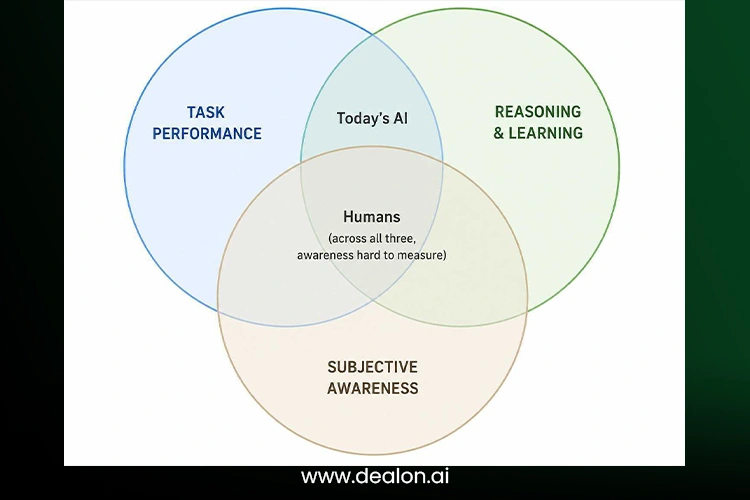
Diagram 2 — Relationship Between Task Performance, Reasoning, Learning, and Subjective Awareness
Energy Efficiency — The Overlooked Intelligence Comparison
| Resource Factor | Artificial Intelligence | Natural Intelligence |
| Primary infrastructure | Data centres, processors, storage and networks | Brain, nervous system and body |
| Energy source | Electricity and supporting infrastructure | Biological energy from food and oxygen |
| Scaling method | Additional hardware and computing capacity | Learning, collaboration and social organization |
| Maintenance | Software updates, hardware replacement and monitoring | Sleep, nutrition, health and recovery |
| Environmental impact | Depends on model size, energy source and usage | Lower direct computational footprint |
| Availability | Can operate continuously with infrastructure | Requires rest and recovery |
| Replication | Software can be copied or deployed widely | Human expertise takes time to develop |
Table 4 — Resource and Energy Comparison
Bias and Error — Machines Are Not Neutral, Humans Are Not Objective
Neither form of intelligence gets a pass on bias. AI bias can creep in through unrepresentative training data, historical discrimination baked into that data, poorly defined objectives, labeling errors made by human annotators, choices made in model design, the specific context a system is deployed into, feedback loops that reinforce existing patterns, and even the way users phrase their prompts.
Human bias is found in confirmation bias, focusing on the first information received, stereotyping, availability bias (the tendency to focus on the most readily available information), emotional reasoning, social pressure to conform, and personal incentives that unconsciously influence judgment.
Real-World Use Cases
Healthcare
AI can aid in identifying patterns in scans, clinical records, prioritizing patients, analyzing research, and providing decision support. There will always be clinical judgment and ethical considerations and informed consent and accountability and a whole lot of complicated things that a single scan and a single set of data can’t cover, and that’s where humans still play a vital role.
Education
AI supports personalized exercises, fast feedback, translation, accessibility features, and content generation. Teachers provide motivation, emotional support, classroom judgment, social development, safeguarding, and — critically — the ability to evaluate whether a student genuinely understands something, rather than merely producing the right answer.
Business and management
AI helps with forecasting, data analysis, automation, reporting, and scenario generation. Human managers handle leadership, negotiation, trust-building, organizational politics, values, and strategic accountability — the parts of management that resist quantification.
Art and media
Here, AI plays a role in ideation and production support, while questions of authorship, originality, cultural value, copyright, and creative direction remain firmly human territory — both practically and legally.
Defense, law, and government
These are the domains where the need for strict accountability, transparency, oversight, due process, and human control is most acute — the stakes of getting it wrong are too high to delegate fully to automated systems.
| Industry | Best Uses of AI | Essential Human Role | Recommended Model |
| Healthcare | Screening, analysis and documentation | Diagnosis, empathy, consent and accountability | AI-assisted professional |
| Education | Practice, personalization and accessibility | Mentorship, motivation and safeguarding | Teacher-led AI support |
| Finance | Fraud detection and risk analysis | Governance, exceptions and ethical judgment | Human-supervised automation |
| Manufacturing | Inspection, robotics and forecasting | Safety decisions and operational adaptation | Hybrid workflow |
| Law | Research, document review and summarization | Legal interpretation and client representation | Professional review required |
| Creative industries | Ideation, variation and production support | Direction, taste and cultural meaning | Human-led collaboration |
| Customer service | Triage and routine responses | Complex complaints and relationship repair | Escalation-based system |
| Public administration | Processing and decision support | Due process and public accountability | Transparent human oversight |
Table 5 — Best Role for AI and Humans by Industry
Can Artificial Intelligence Replace Natural Intelligence?
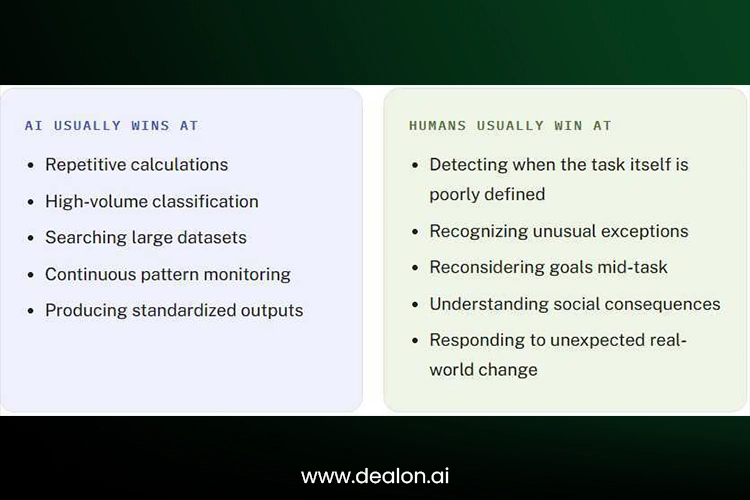
The honest answer avoids both extremes. AI can replace or automate specific tasks — particularly those that are repetitive, data-heavy, predictable, digitally measurable, and rule-constrained. But replacing a task is not the same as replacing an entire occupation, a whole person, or a form of intelligence altogether.
The routine, repetitive components embedded within many jobs — data entry, first-draft generation, basic classification, scheduling — are the most plausible candidates for automation. Predicting the complete disappearance of entire professions is a much shakier claim, and one this guide deliberately avoids making.
Professions that depend on judgment, trust, physical presence, leadership, accountability, emotional understanding, and reasoning across multiple domains at once are far more likely to be augmented by AI than replaced by it.
”Will AI replace humans?” is, in many ways, the wrong question. A more useful one is: which parts of human work should be automated, which should remain human, and how should responsibility be divided between them? That framing produces better decisions than a binary yes-or-no ever could.
The Hybrid Intelligence Model — Why the Best System May Be Both
Hybrid intelligence describes a system in which human and artificial capabilities are deliberately combined, rather than one simply standing in for the other. AI contributes scale, speed, search, pattern recognition, simulation, and consistency. Humans contribute goals, values, context, judgment, accountability, creativity, and relationship management. Neither list is optional — a system missing either half is a weaker system.
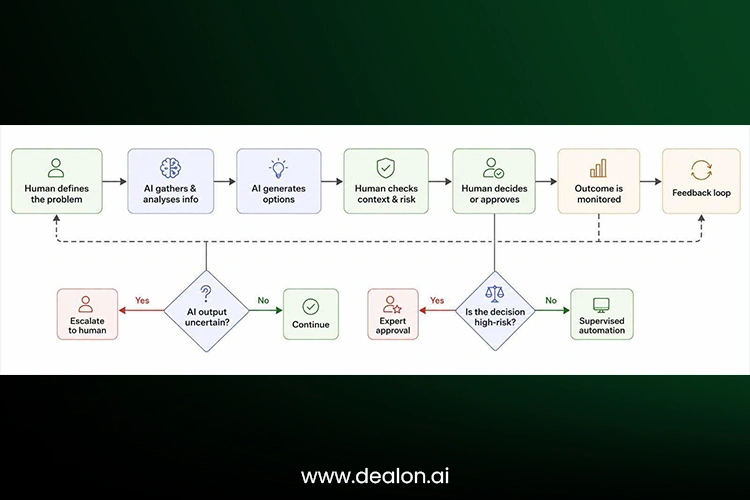
Flowchart — 2 Human-AI Collaborative Decision Process
How to Decide Whether a Task Should Be Done by AI, a Human, or Both
A practical framework starts by evaluating a task along several dimensions: risk level, the need for empathy, data availability, explainability requirements, how repetitive the task is, time pressure, legal responsibility, the complexity of the physical world it touches, the consequences of error, and the need for originality.
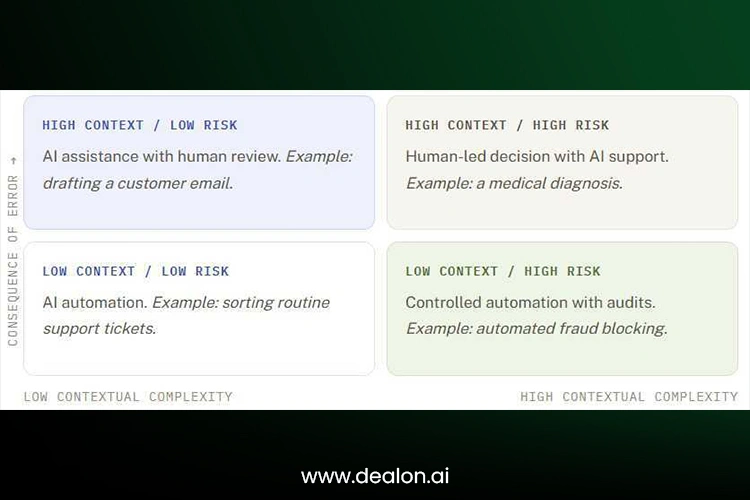
Diagram 3 — AI, Human, or Hybrid Decision Matrix
Major Misconceptions About Artificial and Natural Intelligence
Myth — AI thinks exactly like a human
Reality: Similar outputs do not demonstrate identical internal processes. Two very different mechanisms can arrive at the same answer.
Myth — Humans are always more creative
Reality: AI may outperform individuals in sheer idea volume, but human creativity includes intention, judgment, and meaning that AI cannot originate on its own.
Myth — AI is completely objective
Reality: AI systems reflect the data they were trained on, the design decisions their creators made, and the conditions of their deployment.
Myth — Human intelligence is always reliable
Reality: Humans are affected by bias, fatigue, emotion, and incomplete memory — reliability is a spectrum, not a guarantee, for either form of intelligence.
Myth — More data always produces more intelligence
Reality: Data quality, objectives, model design, and context all matter as much as raw volume.
Myth — AI will either replace everyone or replace no one
Reality: Most change is likely to happen at the level of individual tasks and workflows, not entire professions, overnight.
Myth — Emotional language proves that AI has emotions.
Reality: Generating emotionally appropriate language does not establish subjective experience behind it.
Myth — Natural intelligence cannot be improved
Reality: Education, practice, health, social support, and tools — including AI tools — can all strengthen human performance over time.
The Future of Artificial and Natural Intelligence
Several developments seem possible but not certain: the further development of more powerful AI agents that can take multiple steps to plan and act; deeper integration of AI into the routine of daily work; the establishment of AI proficiency as a fundamental skill, like proficiency with spreadsheets; advances in brain–computer interface technology; more personalised forms of education; acceleration of the pace of scientific discovery; improved regulation and governance of AI; new modes of digital labour; the greater significance of human judgment and verification as a counterbalance to automated output; and continued discussion of machine consciousness, with any related rights and protections.
Wearable technology, AI assistants, augmented reality, prosthetics, and brain–computer interfaces could gradually make intelligence feel more distributed between humans and machines than it does today — less a strict boundary, more a continuum of assistance. That shift, if it happens, will make the framework in this guide more relevant, not less: knowing which capabilities come from where will matter more, not less, as the two become more entangled.
As AI takes on more routine cognitive work, the human skills that grow in relative value include critical thinking, the ability to verify AI output rather than accept it uncritically, ethical reasoning, clear communication, creativity, systems thinking, emotional intelligence, deep domain expertise, and general adaptability.
Final Verdict — Which Form of Intelligence Is Better?
No form of intelligence is universally superior — the honest answer depends entirely on the task in front of you.
Frequently Asked Questions
What is the fundamental distinction between artificial intelligence and natural intelligence?
Artificial Intelligence is designed by humans with algorithms and data sets with a specific purpose. Natural intelligence is something that naturally grows in the brain and body, as a result of sensory experience, feeling, and social life. The two are not only different in raw processing speed, but also in learning approach and the type of judgment they can provide.
Can artificial intelligence think like humans?
Not in the way the question usually implies. AI systems can produce outputs that resemble human reasoning. Still, the underlying process — statistical pattern prediction rather than embodied, emotional, socially-grounded cognition — is fundamentally different, even when the results look similar on the surface.
Can AI have emotions?
Current AI systems can recognize emotional language and generate emotionally appropriate responses, but this does not demonstrate that the system subjectively experiences feelings. Simulating emotional expression and having an inner emotional life are two different claims, and only the first is well supported by current evidence.
Can artificial intelligence replace natural intelligence?
AI can replace specific repetitive, data-heavy, rule-based tasks. It is far less able to replace whole roles that depend on judgment, accountability, empathy, or physical presence. Most realistic change looks like task automation and augmentation, rather than wholesale replacement of people.
What are the advantages of natural intelligence over artificial intelligence?
Natural intelligence has contextual understanding, common sense based on experience, moral responsibility, flexible adaptation to new situations, true emotional experience, and incredible energy efficiency in comparison to a large computing infrastructure.
What are the advantages of artificial intelligence over human intelligence?
AI offers speed, scale, and consistency on well-defined tasks; the ability to process very large datasets; tireless availability without fatigue; and reproducible outputs under stable conditions — advantages that make it especially valuable for automation and large-scale analysis.
Is AI conscious or self-aware?
There is no scientific consensus that current AI systems are conscious or self-aware. Fluent, human-like language is not sufficient evidence of subjective experience, and researchers still lack a widely accepted test for machine consciousness — a genuinely open question rather than a settled one.
How can artificial and natural intelligence work together?
The hybrid intelligence combines the abilities of AI to process data, recognize patterns, and generate options efficiently with the human brain’s capacity for problem definition, adding context and values, assessing risk, and making or approving decisions. This form of division of labor performs better than working on one’s own.



