

Table of Contents
Which AI SEO tools should you use in 2026?
If you only read one section, read this one. Below is the fastest path to a decision, matched to who you are and what you’re trying to do.
| User type | Best tool category | Recommended tools |
| Solo blogger | AI writing + on-page SEO | SurferSEO, NeuronWriter |
| Agency | Full SEO suite + automation | Semrush AI, Ahrefs AI |
| E-commerce | Product SEO optimization | Jasper + SEO.ai |
| Enterprise | Data-driven SEO intelligence | BrightEdge, MarketMuse |
| Beginner | All-in-one AI assistant | Writesonic, RankIQ |
Table 1 — Decision matrix by user type
What are AI SEO tools in 2026?
AI SEO tools have moved well past the keyword-density checkers and backlink counters of the last decade. The category today is built around predictive systems: software that doesn’t just report what happened on a search results page, but models what’s likely to happen next, and recommends — or automatically executes — the content and technical changes to get there.
Three shifts define the current generation of tools. First, SERP analysis using AI to study top-ranking pages, where a tool ingests the top-ranking pages for a query and builds a synthetic profile of what a competitive page needs to contain, structurally and semantically, rather than just matching keyword frequency.
Second, search intent prediction and clustering, which groups thousands of keyword variants into intent-based topics automatically, replacing the manual spreadsheet work that used to take a strategist days. Third, AI-assisted topical authority building, where tools map an entire content library against a topic graph and flag the gaps that are quietly capping a site’s ranking ceiling.
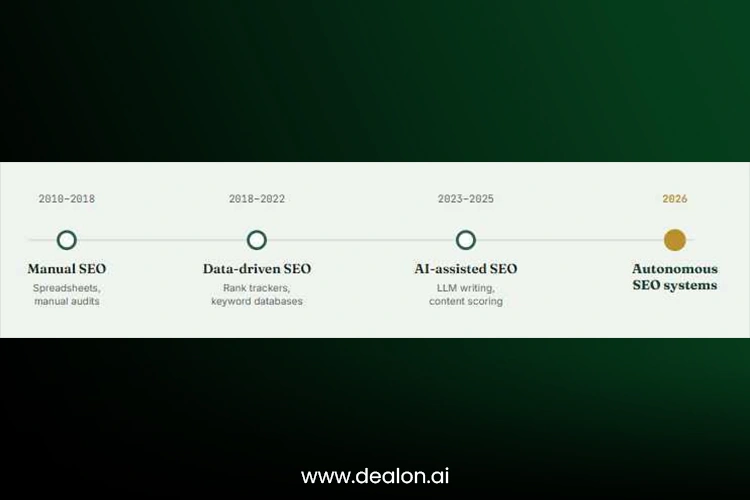
Diagram 1 — Evolution of SEO tools
Also Read: What Is Predictive Analytics in Digital Marketing? A Complete Guide for 2026
How AI SEO tools actually work behind the scenes
Underneath the dashboard, most modern AI SEO platforms share a similar pipeline. An NLP and LLM layer handles language understanding — parsing queries, generating draft content, and summarizing intent. A SERP scraping and clustering layer continuously pulls ranking data and groups similar queries and pages together.
A predictive ranking layer uses historical ranking movement to estimate how a page is likely to perform before it’s even published. And a content scoring layer compares a draft against the clustered competitive set and returns a numeric or letter-grade recommendation.
What’s changed in 2026 isn’t any single layer — it’s that these layers now talk to each other in a closed loop, so a ranking drop can trigger an automatic re-scoring of the page, which can trigger a content revision suggestion, without a human opening a dashboard at all.
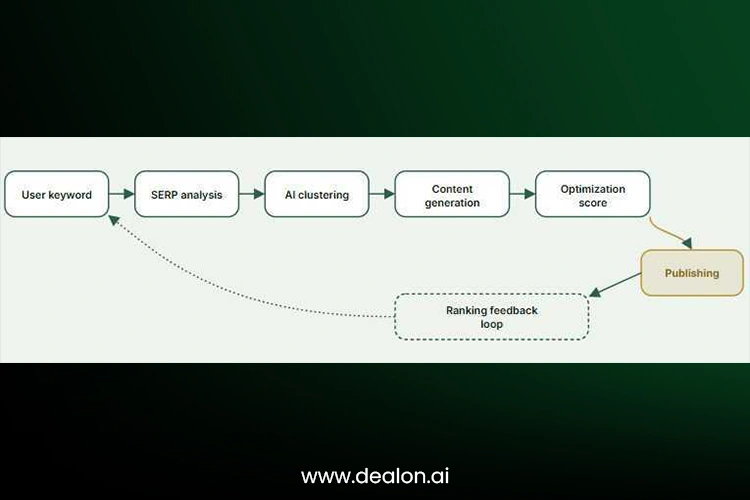
Diagram 2 — AI SEO workflow engine
Core categories of AI SEO tools in 2026
No single tool covers the whole workflow well, which is why most practitioners run a small stack rather than one platform. It helps to think of the market in five functional lanes.
| Category | Function | Example tools |
| AI writing | Blog and content generation | Jasper, Writesonic |
| Technical SEO AI | Site audits and fixes | Screaming Frog AI, Sitebulb AI |
| Keyword intelligence | Intent and clustering | Semrush AI, Ahrefs AI |
| Content optimization | On-page scoring | SurferSEO, NeuronWriter |
| Link intelligence | Backlink prediction | Pitchbox AI, BuzzStream AI |
Table 2 — Five functional categories of AI SEO software
Top 10 AI SEO tools — 2026 breakdown
A short profile of each tool: what it’s genuinely best at, and where it falls short.
- Semrush AI
Semrush AI is best suited for all-in-one SEO management, making it a strong choice for businesses, agencies, and marketing teams that want keyword research, site audits, competitor analysis, rank tracking, and content optimization in a single platform. Its biggest AI advantage lies in predictive analytics, helping users identify ranking opportunities and prioritize actions across an entire domain. The biggest drawback is its pricing, which can increase significantly as agencies add more projects, users, and client websites.
- Ahrefs AI
Backlink analysis and keyword research are among the strengths of Ahrefs AI, which has one of the largest live web indexes on the market. It’s AI-powered, which lets it discover keyword opportunities, estimate ranking difficulty, and find valuable link-building opportunities with great precision. It has also spread to AI-powered features for content, but writing and content generation are not its strong suit, and therefore, it is less ideal as an AI writing platform.
- SurferSEO
SurferSEO is mainly a content optimizer tool, allowing content writers to optimize content based on real-time SERP analysis. It features an AI-powered content score, keyword suggestions, and suggestions for improving keyword relevance and topic coverage, making it easy to optimize on-page SEO by writing. It’s not a full SEO suite; however, it specializes in content optimization, which means it is frequently used in conjunction with another SEO platform.
- Jasper (SEO Mode)
When businesses must create a lot of marketing and SEO content while maintaining a consistent brand image, Jasper, with its SEO mode, comes into play. It also has AI capabilities to create well-written, readable marketing content quickly that easily fits with optimization platforms, making content production more efficient. Its native analytics, keyword intelligence, and ranking insights, however, are quite basic and less extensive than what you can find in specialized SEO tools.
- MarketMuse
MarketMuse is designed for teams that want to build deep coverage of a topic over time, not publishing one-off articles. It uses AI to scan entire websites, pinpoint content gaps, and suggest full-range topic clusters that build up an author’s expertise in a topic over time. The downside is that it has a more complex learning curve, which may mean new users will need to get up to speed on its more advanced suggestions and processes.
- Writesonic
One of Writesonic’s most popular features is its ability to quickly create blog posts, landing pages, product descriptions, and other marketing content, which is perfect for teams focused on speed and productivity. Its AI generates first drafts that are of high quality in mere minutes, saving a lot of time in content creation. However, its output could be in need of further fact-checking and editing, as it may not be as accurate or in-depth as more specialized SEO and research tools.
- NeuronWriter
NeuronWriter is focused on on-page optimization using semantic analysis to assist writers in refining content around user intent and topical relevance. It gives AI-powered suggestions for keyword optimization, entity optimization, and content structure, making it especially valuable for enhancing current articles. While it has some advantages, its interface may be complex for users seeking simple content optimization options.
- Frase
Frase is especially good for generating detailed content briefs and automating competitive research before you start writing. It can scan the highest-ranking pages, identify common themes, and create outlines for writers to help them write about a subject in a comprehensive manner. It is a great solution for research and planning. Still, it isn’t as effective for organizations that require advanced workflow automation and enterprise-scale capabilities with their very large content operations.
- RankIQ
RankIQ is designed specifically for independent bloggers and niche content creators who want to find keywords that will bring a ton of traffic and have lower competition. Its artificial intelligence suggests handpicked keyword possibilities and gives optimization guidance to assist small publishers in rankings. The downside is that it has a fairly narrow scope and isn’t ideal for agencies, enterprise websites, or businesses doing work across various industries.
- BrightEdge
BrightEdge is optimized for enterprise SEO initiatives that need to analyze, predict, and measure hundreds of thousands of pages. Its predictive AI capabilities provide competitive intelligence, insights, and strategic recommendations, making it a valuable tool for large businesses dealing in complex SEO. But it is enterprise pricing that makes it far too expensive for most freelancers, startups, and small marketing teams.
Side-by-side comparison
| Tool | Best for | AI strength | Weakness |
| Semrush AI | All-in-one SEO | Predictive analytics | Expensive |
| Ahrefs AI | Backlinks + keywords | Strong data index | Limited writing tools |
| SurferSEO | Content optimization | SERP-based scoring | Not a full SEO suite |
| Jasper SEO mode | Content creation | High-quality writing | Weak analytics |
| MarketMuse | Topic authority | Deep clustering | Learning curve |
| Writesonic | Fast content | Speed | Less accuracy |
| NeuronWriter | On-page SEO | Semantic SEO | UI complexity |
| Frase | Content briefs | Research automation | Limited scaling |
| RankIQ | Bloggers | Keyword targeting | Narrow niche |
| BrightEdge | Enterprise SEO | Predictive insights | Very expensive |
Table 3 — Full ten-tool comparison
Pricing, ROI, and the hidden costs of AI SEO tools
The sticker price on any single AI SEO tool rarely tells the full story. Three cost patterns catch teams off guard most often.
- Subscription stacking. A realistic stack may involve various types of keyword research, content optimization, and writing tools used in isolation, and these subscriptions add up fast.
- Agency scaling costs. Per-seat and per-client versions of pricing can make something that costs one thing for one site cost a lot of money once it’s applied to the client base.
- Credit-based writing costs. Volume-based costing might make a tool appear inexpensive in the short term, but it becomes costly once it is time to produce content on a larger scale.
| Tool | Pricing model | Hidden cost risk | ROI level |
| Semrush | Subscription | High | Very high |
| Ahrefs | Subscription | Medium | High |
| SurferSEO | Usage-based | Medium | High |
| Jasper | Credit-based | High | Medium |
| Writesonic | Tiered | Low | Medium |
Table 4 — Pricing model and hidden cost exposure
Benchmark comparison: accuracy, speed, and SERP impact
These comparative ratings are on the basis of product capabilities, reviews, publicly available testing, and editorial evaluation.
Semrush AI
Semrush AI delivers an excellent balance of content quality, SEO accuracy, and overall performance. It scores 9/10 for content quality, 10/10 for SEO accuracy, and 7/10 for speed, making it one of the most reliable platforms for creating and optimizing content that has a strong potential to perform well in search results. Its overall SERP impact is high, particularly for users managing comprehensive SEO campaigns.
SurferSEO
SurferSEO is a strong performer for on-page optimization, earning 8/10 for content quality, 9/10 for SEO accuracy, and 8/10 for speed. Its AI-driven recommendations are closely aligned with real-time SERP analysis, helping users optimize content efficiently. With a high SERP impact, it is particularly effective for improving the ranking potential of individual pages.
Jasper
Jasper performs strongly when it comes to speed and content quality, earning a 10/10 for speed and a 9/10 for content quality, making it great for creating a lot of content in a short amount of time. Its SEO accuracy is slightly less at 6/10, due to the fact that it uses integrations or other tools to optimize it further. Therefore, it has a medium overall SERP impact.
MarketMuse
MarketMuse is particularly strong in terms of strategic content planning and topical authority, scoring a 10 on those two areas and a 10 for content quality and accuracy of SEO. It may only score 6/10 on speed, as it’s quite in-depth, but it offers very in-depth recommendations that can help with long-term growth in organic traffic. It has a high SERP impact, particularly for sites that are trying to develop in-depth topical authority.
Generally, compromising between speed and accuracy is a necessity. Some tools produce content faster, but they’re not the most precise tools for optimizing your website for SEO, and some of the most precise tools will require more processing time and user input. The answer is whether you need a speedy content creation process or a process that will offer you maximum long-term search results.
AI SEO automation in 2026: no-code workflows
The biggest practical shift this year is how much of the SEO workflow now runs without a person clicking “generate” at each stage. Auto keyword clustering groups new queries as they appear in Search Console data. Auto internal linking scans a site’s content graph and inserts contextually relevant links as new pages are published. AI-generated content briefs assemble themselves from live SERP data rather than a strategist’s notes. And programmatic SEO systems can spin up hundreds of templated, data-driven pages from a single structured feed.
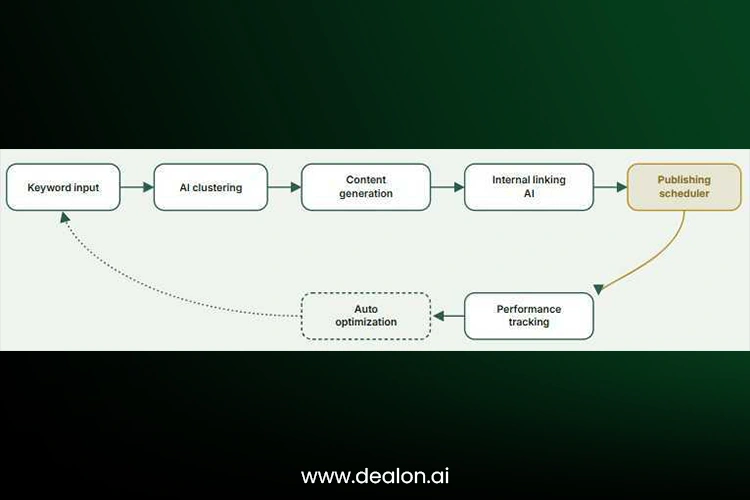
Diagram 5 — AI SEO automation system
AI SEO vs traditional SEO tools
It’s worth being precise about what’s actually different, because “AI SEO” is sometimes just traditional SEO software with a chat interface bolted on. The real differences show up in how work gets done, not just how it’s described.
| Feature | Traditional SEO | AI SEO tools |
| Keyword research | Manual | Automated clustering |
| Content writing | Human-only | AI-assisted |
| Optimization | Static rules | Dynamic scoring |
| Scaling | Slow | Fast |
| Cost efficiency | Medium | High, long-term |
Table 5 — Traditional vs AI-driven SEO, feature by feature
How a modern AI SEO stack is layered
Underneath any individual tool, the stack tends to organize into four layers, each handing data to the one above it.
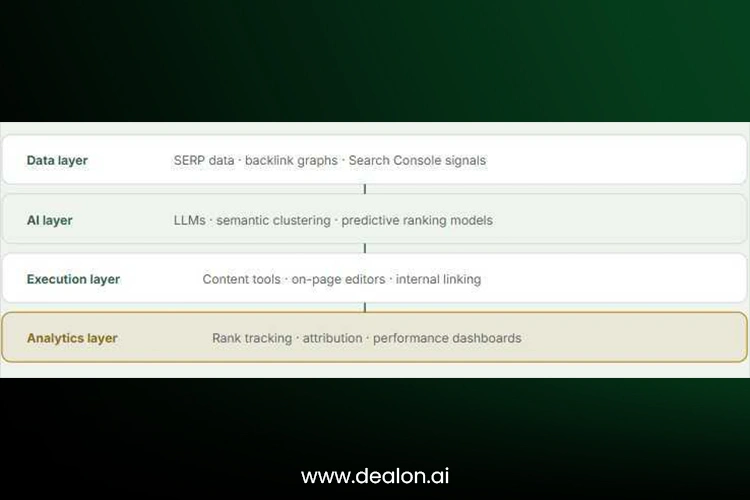
Diagram 3 — AI SEO stack architecture
The best AI SEO stack for 2026
Rather than one universal answer, here’s how the winning combinations tend to look by context.
- Blogger stack: a keyword-intent tool paired with a content-optimization tool, kept lean and cheap.
- Agency stack: complete reporting across clients and a dedicated reporting tool that ensures a predictable production cost.
- Enterprise stack: a predictive intelligence platform that has been stacked on top of a topical-authority tool and provides a large writing team, whether internal or contracted, with predictive intelligence.
- E-commerce stack: a product-focused optimization tool combined with a general writing assistant for category and buying-guide content.
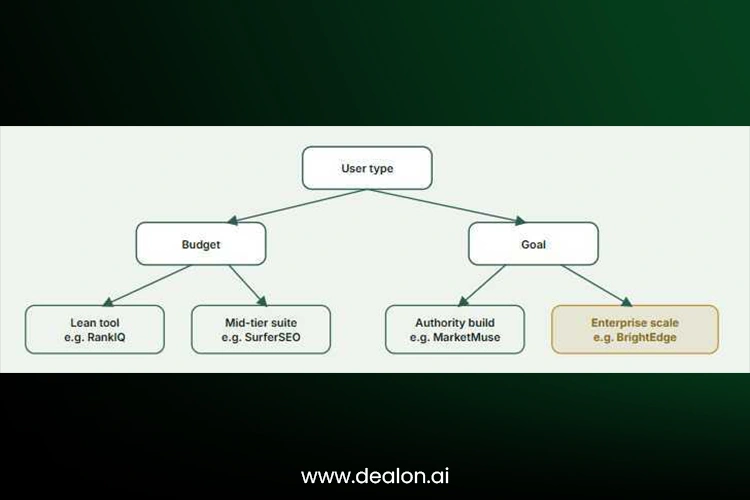
Diagram 4 — Tool selection decision tree
Limitations of AI SEO tools
None of this replaces judgment, and treating any tool as infallible is where teams get into trouble.
- Over-optimization risk. Chasing a content score too aggressively can produce pages that read as mechanical rather than useful, which search engines are increasingly good at detecting.
- SERP volatility. Predictive models are trained on historical patterns, and a sudden algorithm update can make yesterday’s predictions unreliable overnight.
- AI-hallucinated SEO advice. Generated recommendations can sound authoritative while being wrong, especially around fast-moving technical guidance.
- Dependency risk. Teams that outsource all judgment to a platform lose the underlying expertise needed to catch the platform’s own mistakes.
Practical takeaway: Use AI SEO tools to remove repetitive analysis work, not to remove the person who understands why a recommendation does or doesn’t make sense for a specific site.
The future of AI SEO tools, 2026–2028
AI SEO tools are no longer just assistants; they are becoming self-learning systems capable of strategizing, executing, and optimizing SEO campaigns without needing much human intervention. Future platforms will go further than suggesting keywords and optimizing content, and automate topics and content clusters, internal links, technical audit, and performance monitoring.
At the same time, the rise of AI-generated search results and zero-click experiences will shift the focus beyond traditional rankings. SEO tools will need to optimize content for visibility in AI-generated answers as well as on conventional search engine results pages. Predictive SEO is also expected to become more accurate, helping marketers estimate the impact of content and technical changes before they are implemented.
The teams that gain the greatest advantage won’t necessarily use the most AI tools—they’ll build focused AI workflows that automate repetitive tasks while leaving strategy, creativity, and editorial judgment to humans.
Conclusion
In 2026, it will not have all the AI SEO tools that will make you the best competitor. It will come from creating a targeted stack that can handle repetitive tasks while allowing seasoned marketing pros to make strategic choices.
The tools described here are quite different in scope from what is used in writing to clustering to enterprise-scale prediction, and the “right” stack is the smallest of the tools that actually fills your specific gaps. Read the decision table at the top of this guide and choose one or two tools that will suit you and your budget; don’t subscribe to many at once.
The teams getting the most out of AI SEO in 2026 aren’t the ones with the biggest stack — they’re the ones who know exactly what each tool in their stack is for.
Frequently asked questions
What are the best AI SEO tools in 2026?
This is based on your function. Semrush AI and Ahrefs AI are both the best for full-suite agency work. At the same time, SurferSEO and NeuronWriter both excel at optimizing content, and MarketMuse and BrightEdge are both best for enterprise topical authority work.
Is it possible to boost Google rankings with AI tools?
They can help to accelerate research and optimization activities that lead to better rankings. However, there is no tool that can ensure ranking because there are lots of signals that search engines employ that are not visible in any tool.
Is SurferSEO better than Semrush AI?
They solve different problems. SurferSEO is stronger for optimizing a specific piece of content against a SERP; Semrush AI is stronger for managing SEO strategy across an entire site or client portfolio.
Do AI SEO tools replace SEO experts?
No. They replace repetitive analysis work, not the judgment needed to interpret results, prioritize efforts, and catch a tool’s own mistakes.
Which AI tool is best for beginners?
Writesonic and RankIQ are generally the easiest entry points, since both are designed as all-in-one assistants rather than requiring a stack of separate tools.
Are AI SEO tools worth it?
For most teams, yes, particularly when subscription costs are weighed against the hours saved on keyword clustering, content briefs, and technical audits. The exception is teams that stack too many overlapping subscriptions without a clear workflow.
Is it possible to make AI-generated SEO blogs rank?
With the right editing and valuable content, AI-generated material can be a good ranking factor, but not a first draft. Depth and original thinking are more valued by search engines today than shallow optimization.
What will the future of AI SEO look like?
The path is clear to more autonomous SEO agents that plan and perform SEO end-to-end. More attention is being drawn to visibility in AI-generated responses, not just in blue link rankings.



